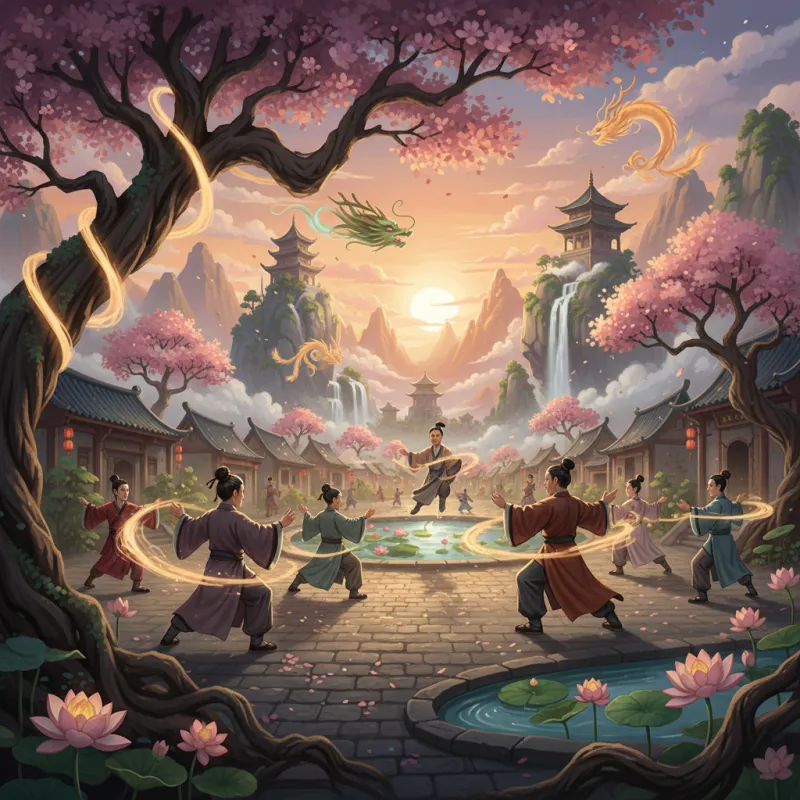
Every morning in Beijing's Temple of Heaven Park, a 78-year-old woman named Mrs. Wang moves through a sequence that could disarm an attacker twice her size. Her hands trace circles in the air with the precision of a calligrapher's brush. A younger man watches, trying to mirror her movements, but his shoulders are tense, his breathing shallow. "You're trying to use muscle," she tells him in Mandarin. "In Tai Chi, we use jin (劲) — a different kind of power entirely."
This is the paradox at the heart of Tai Chi (太极拳, tàijíquán): the world's most popular martial art doesn't look like fighting at all. Over 300 million people practice it globally, according to Chinese government estimates. UNESCO recognized it as Intangible Cultural Heritage in 2020. You'll find it in Florida retirement communities, London corporate wellness programs, and Sydney hospital rehabilitation wards. But somewhere between the parks and the physiotherapy clinics, we've forgotten what Tai Chi actually is — a sophisticated combat system that happens to make you healthier while learning to break someone's arm.
The Chen Village Secret
The origin story matters because it explains why Tai Chi looks the way it does. Most martial arts historians trace it to Chenjiagou (陈家沟), Chen Family Village, in Henan Province during the late Ming or early Qing Dynasty. The Chen family had been practicing their martial art for generations, but they kept it secret, teaching only family members and a handful of trusted students.
The breakthrough came with Chen Changxing (陈长兴, 1771-1853), who broke tradition by teaching an outsider named Yang Luchan (杨露禅, 1799-1872). Yang was a servant in the Chen household who supposedly learned by watching through windows and practicing in secret until Chen discovered him and, impressed by his dedication, took him as a formal student.
Yang Luchan took the Chen family art to Beijing, where he modified it, softening some movements and emphasizing the health aspects to make it more palatable to wealthy clients who wanted self-defense skills without the brutal conditioning of traditional martial arts. He became known as "Yang the Invincible" after reportedly never losing a challenge match. His grandson Yang Chengfu (杨澄甫, 1883-1936) further refined the style into what most people now recognize as Tai Chi — those slow, flowing movements that look more like meditation than combat.
But here's what gets lost: the slow movements aren't the fighting. They're the training method. It's like watching someone practice scales on a piano and concluding that music is very slow and repetitive. The slow practice develops ting jin (听劲) — "listening energy" — the ability to sense an opponent's intention through physical contact and respond before they complete their technique.
Five Families, One Principle
Today, five major styles dominate Tai Chi practice, each descended from a different family lineage. Chen style (陈式, chénshì) remains the oldest, characterized by its mix of slow movements and sudden explosive power called fajin (发劲). Watch a Chen stylist and you'll see the martial application clearly — those sudden stamps and strikes aren't subtle.
Yang style (杨式, yángshì) is the most popular worldwide, the one you see in parks. It's large, open, and flowing, with movements that rise and fall like ocean swells. Wu/Hao style (武式, wǔshì) is more compact, emphasizing precise internal mechanics over external appearance. Wu style (吴式, wúshì) — yes, a different Wu, different Chinese character — features even smaller movements and a distinctive forward lean. Sun style (孙式, sūnshì) is the youngest, created in the early 20th century by Sun Lutang, who combined Tai Chi with Xingyi Quan and Bagua Zhang to create something uniquely agile.
Despite their differences, all five styles share the same foundational principle: taiji (太极), the Supreme Ultimate, that yin-yang symbol everyone recognizes. In practice, this means using softness to overcome hardness, yielding to incoming force rather than meeting it head-on, and turning an opponent's strength against them. It's the martial application of Daoist philosophy — the water that wears away stone, the willow that bends in the storm while the rigid oak breaks.
The Movements Have Names for a Reason
The poetic names of Tai Chi movements — "White Crane Spreads Its Wings," "Grasp the Sparrow's Tail," "Snake Creeps Down" — aren't just pretty metaphors. Each name describes a specific martial application, often multiple applications depending on how you interpret the movement.
Take "Ward Off" (peng, 掤), one of the eight fundamental energies. In the slow form, it looks like you're gently pushing a beach ball. In application, it's a devastating technique that uses whole-body power to uproot an opponent. Your arm isn't pushing — it's connected to your legs through your core, and when you shift your weight, the opponent goes flying. I've seen a 60-year-old Tai Chi master send a 200-pound martial artist stumbling backward with what looked like a gentle touch.
"Rollback" (lu, 捋) appears to be a simple turning motion, but it's actually a sophisticated way to redirect an incoming punch, stick to the opponent's arm, and pull them off balance while simultaneously setting up a strike. "Press" (ji, 挤) looks like you're closing a door, but it's a two-handed strike that can break ribs. "Push" (an, 按) seems self-explanatory until you realize it's not about arm strength — it's about dropping your weight through your opponent's center of gravity.
The problem is that most people never learn these applications. They practice the form for years without understanding that "Single Whip" is a strike to the throat while controlling the opponent's arm, or that "Brush Knee and Twist Step" is a takedown that sweeps the leg while striking the head.
The Health Benefits Aren't Accidental
Here's where Tai Chi gets interesting from a modern perspective: the health benefits that made it popular worldwide aren't a happy accident. They're built into the martial training method.
The slow, controlled movements develop proprioception — your body's awareness of its position in space. The constant weight shifting strengthens legs and improves balance, which is why hospitals use Tai Chi for fall prevention in elderly patients. The emphasis on relaxation and proper body alignment reduces chronic tension and improves posture. The deep, coordinated breathing enhances cardiovascular function without the joint stress of running or high-impact exercise.
Studies have shown Tai Chi helps with arthritis, fibromyalgia, Parkinson's disease, and chronic pain. It reduces blood pressure, improves sleep quality, and enhances immune function. A 2018 study in the Journal of the American Geriatrics Society found that Tai Chi was more effective than conventional exercise for preventing falls in older adults.
But here's the thing: these benefits emerge from training methods designed to create better fighters. The rooting exercises that improve balance were originally for staying stable while throwing or being thrown. The relaxation that reduces stress was for staying calm in combat. The body awareness that helps with chronic pain was for sensing an opponent's intention through touch.
Traditional martial artists understood something modern sports science is only now confirming: the best training for longevity and health looks a lot like training for combat, just slowed down and practiced with attention to detail rather than speed and power.
Push Hands: Where Theory Meets Reality
If the solo form is Tai Chi's vocabulary, push hands (tuishou, 推手) is where you learn to speak the language. Two practitioners stand facing each other, arms in contact, and try to uproot each other using Tai Chi principles — no grabbing, no striking, just continuous circular movements that probe for weakness and exploit imbalance.
Good push hands looks like a dance. Great push hands looks like nothing is happening until suddenly one person is stumbling backward or sitting on the ground, wondering what just occurred. The goal isn't to use muscular force but to develop sensitivity — that ting jin I mentioned earlier — so you can feel what your opponent is about to do and neutralize it before it develops.
I once watched a push hands demonstration where a Tai Chi master invited people to try to push him over. A young weightlifter stepped up, muscles bulging, and shoved with everything he had. The master didn't resist or push back. He simply turned slightly, and the weightlifter went flying past him, propelled by his own force. "You pushed yourself," the master explained. "I just got out of the way and helped you continue."
This is the core of Tai Chi combat theory: si liang bo qian jin (四两拨千斤) — "four ounces deflects a thousand pounds." You don't meet force with force. You redirect it, add a little energy at the right moment, and let physics do the work.
Push hands competitions have become popular in recent years, though purists argue they've become too aggressive, with competitors using techniques that violate Tai Chi principles. The debate reveals a tension in modern Tai Chi: is it a martial art that happens to be healthy, or a health practice with martial roots?
The Modernization Dilemma
In 1956, the Chinese government created a simplified 24-movement Yang style form to promote Tai Chi as a health exercise for the masses. This was brilliant public health policy — it made Tai Chi accessible to millions who might never have learned the traditional 108-movement form. But it also accelerated a trend that was already underway: the separation of Tai Chi from its martial roots.
Today, most Tai Chi practitioners worldwide learn simplified forms designed for health and wellness. They never learn push hands, never practice applications, never develop the martial skills that the movements represent. This isn't necessarily bad — the health benefits are real and valuable. But it does mean that "Tai Chi" now describes two quite different practices: a martial art and a moving meditation that happens to use the same movements.
The martial Tai Chi community has responded by emphasizing competition. The International Wushu Federation holds Tai Chi push hands tournaments. Some schools have reintroduced sparring and full-contact applications. But this creates its own problems — when you add competition and ego, you often lose the relaxation and sensitivity that make Tai Chi unique.
There's also the question of effectiveness. In an era of mixed martial arts, where techniques are tested against resisting opponents, can Tai Chi actually work for fighting? The honest answer is: it depends. A Tai Chi practitioner who only does the slow form will lose to anyone with basic boxing skills. But someone who has trained push hands seriously for years, who understands the applications and has tested them against resistance, can absolutely use Tai Chi principles effectively.
The catch is that this kind of training is rare. Most Tai Chi schools focus on health, and most students aren't interested in martial applications. The few schools that teach combat-oriented Tai Chi often supplement it with techniques from other martial arts, which raises the question: at what point does it stop being Tai Chi?
What Mrs. Wang Knows
Back in Temple of Heaven Park, Mrs. Wang has finished her form. The young man asks her if Tai Chi really works for self-defense. She smiles and invites him to push her shoulder. He does, gently at first, then harder when she insists. Each time, she turns slightly, and his force goes past her into empty space. He's pushing as hard as he can, and she's barely moving, just making small adjustments that leave him off-balance and frustrated.
"Tai Chi works," she tells him, "but not the way you think. You're not going to learn it in a few months, and you're not going to use it to win street fights. But if you practice correctly, in twenty years you'll be healthier and stronger than people half your age. And if someone does attack you, you'll know how to protect yourself without hurting them more than necessary."
This might be the most honest assessment of Tai Chi's value in the modern world. It's not the ultimate martial art — no such thing exists. It's not a quick path to fighting skill — that requires different training. But it is a sophisticated system that develops body awareness, health, and martial skill simultaneously, if you're patient enough to learn it properly.
The slow movements in the park aren't the whole story. They're the visible part of something deeper — a training method that has survived for centuries because it works, both for fighting and for living. Mrs. Wang will probably never need to use Tai Chi in combat. But the same principles that would let her defend herself also keep her mobile, balanced, and healthy at 78.
That's the real conquest Tai Chi has achieved: not dominating the martial arts world, but finding a way to remain relevant by being useful in multiple ways. It's a martial art you can practice your entire life, that makes you healthier while teaching you to fight, that looks gentle but contains hidden power. In a world obsessed with quick results and obvious strength, Tai Chi offers something different — the long game, the subtle approach, the water that wears away stone.
Related Reading
- Real Chinese Martial Arts: Beyond the Movie Myths
- Tai Chi for Beginners: Your First Steps into Moving Meditation
- Chinese Martial Arts in the Real World: What Actually Works
- Bruce Lee's Legacy: How One Man Changed Global Culture
- Discovering the Rich Tapestry of Chinese Folklore: Myths, Legends, and Traditions
- Chinese Dynasties: A Quick Guide to 5,000 Years
- Unveiling the Rich Tapestry of Chinese Folklore and Legends
Explore Chinese Culture
- Explore feng shui in daily life
- Explore supernatural folklore
- Explore classical Chinese literature