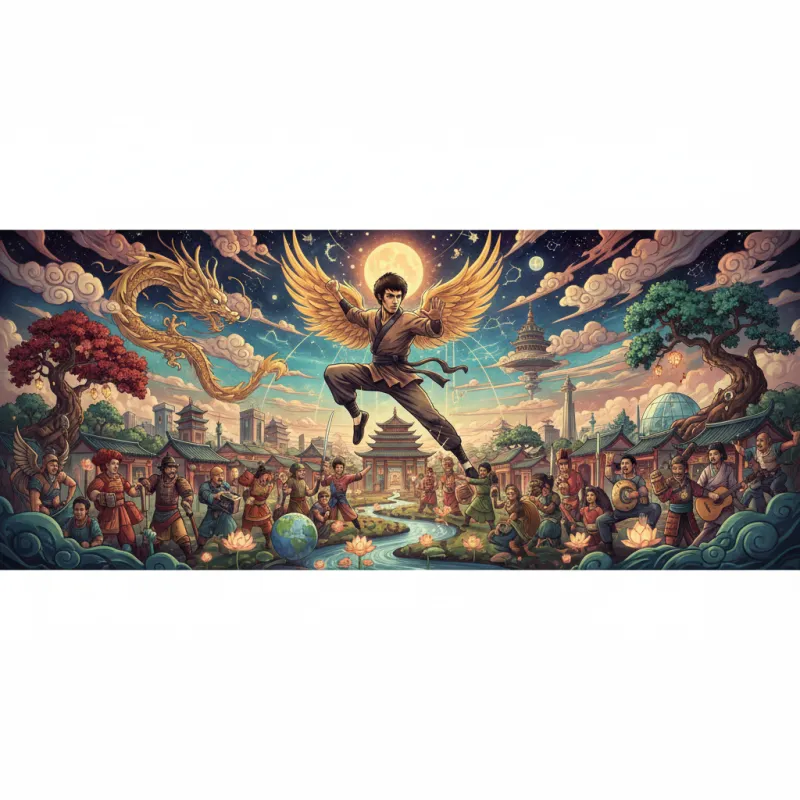
A skinny Chinese kid walks onto a Hollywood set in 1966 and tells the producers he can teach their star how to move. They laugh. Five years later, that same kid—now a global phenomenon—kicks down the door of Western cinema so hard it never closes again. 李小龙 (Lǐ Xiǎolóng, Bruce Lee) didn't just become famous. He rewired the cultural operating system of the entire planet, and we're still running on his code.
The Philosopher Who Happened to Fight
Most people remember the kicks, the nunchucks, the yellow tracksuit. What they forget—or never knew—is that Bruce Lee was a philosophy major at the University of Washington who read Krishnamurti before breakfast and annotated the 道德经 (Dàodéjīng, Tao Te Ching) in the margins. His personal library contained over 2,500 books on subjects ranging from quantum physics to classical Chinese poetry. He didn't stumble into martial arts philosophy by accident; he deliberately constructed a worldview that treated the body as a laboratory for testing metaphysical ideas.
His concept of 截拳道 (Jié Quán Dào, Jeet Kune Do)—"the way of the intercepting fist"—wasn't just a fighting system. It was applied Daoism, a physical manifestation of 无为 (wúwéi, effortless action) and 水 (shuǐ, water's adaptability). When Lee said "be like water," he wasn't offering a motivational platitude. He was teaching a sophisticated philosophical principle that had been circulating in Chinese thought since Laozi wrote it down 2,500 years ago. Lee's genius was making ancient wisdom visceral, immediate, and cinematically explosive.
This fusion of Eastern philosophy and Western pragmatism created something unprecedented. Unlike the rigid, style-bound martial arts of traditional Chinese cinema, Lee's approach was iconoclastic, almost heretical. He rejected the 师父 (shīfu, master) worship that dominated kung fu culture, famously declaring that "styles separate man." In a culture where lineage and tradition were sacred, this was revolutionary—and it made him enemies among traditional martial artists who saw him as a traitor to Chinese heritage.
Breaking the Yellow Peril Stereotype with a Flying Kick
Before Bruce Lee, Asian men in Western media were either sinister villains (Fu Manchu), emasculated servants (countless nameless houseboys), or comic relief. Hollywood's racism wasn't subtle—it was structural, written into every casting call and script. Asian actors were systematically denied leading roles, romantic storylines, and basic dignity. Even martial arts films featured white actors in yellowface playing Asian characters.
Lee smashed through this with pure charisma and undeniable physical prowess. When he stripped to the waist in The Big Boss (1971) and revealed a physique that looked like it had been carved from teak wood, when he moved with a speed that made cameras struggle to capture him, when he stared down opponents with absolute confidence—he created an image of Asian masculinity that simply didn't exist in global popular culture. He was sexual, dangerous, intelligent, and utterly in control.
The numbers tell the story. The Big Boss broke box office records throughout Asia. Fist of Fury (1972) made even more. By the time Way of the Dragon (1972) premiered—a film Lee wrote, directed, and starred in—he was the biggest box office draw in Asia and increasingly recognized in the West. When Enter the Dragon (1973) was released shortly after his death, it became the highest-grossing martial arts film of all time and turned Lee into a global icon.
But the impact went beyond box office receipts. Lee's success forced Hollywood to reconsider its assumptions about who could be a leading man, who could be a sex symbol, who could be a hero. He didn't just open doors for Asian actors—he kicked them off their hinges. Every Asian actor who has played a leading role since, from Jackie Chan to Donnie Yen's contributions to modern martial arts cinema, walks through the space Lee created.
The Revolution in How We Film Violence
Watch a fight scene from a Hollywood film made before 1970. Now watch a Bruce Lee fight. The difference is staggering. Pre-Lee fight choreography was theatrical, staged, obviously fake—punches that clearly missed, reactions that came too early, movements that defied physics in all the wrong ways. Lee brought a documentary realism to screen combat that changed cinema forever.
He insisted on filming at full speed, no slow motion tricks to hide sloppy technique. He demanded that cameras capture the actual impact of strikes, the genuine physics of bodies in motion. He choreographed fights that told stories, where every exchange revealed character and advanced the plot. The famous nunchaku scene in Fist of Fury isn't just impressive—it's a statement about Chinese resistance to Japanese occupation, performed through weapon work that flows like calligraphy.
Lee's influence on fight choreography extends far beyond martial arts films. The Wachowskis hired 袁和平 (Yuán Hépíng, Yuen Woo-ping)—a choreographer trained in the Hong Kong tradition Lee helped establish—to design the fights in The Matrix. The kinetic, bone-crunching combat of the John Wick series traces its lineage directly to Lee's insistence on realistic, consequential violence. Even the Marvel Cinematic Universe's fight scenes, particularly in films like Shang-Chi, are built on foundations Lee laid down fifty years ago.
Jeet Kune Do: The Anti-Style Style
Traditional Chinese martial arts were—and often still are—deeply conservative. You learned a style: 咏春拳 (Yǒngchūn Quán, Wing Chun), 太极拳 (Tàijí Quán, Tai Chi), 少林拳 (Shàolín Quán, Shaolin Kung Fu). You learned it from a master who learned it from his master, preserving techniques passed down through generations. You didn't question, you didn't innovate, you didn't mix styles. This was the way.
Lee looked at this system and said: this is nonsense. Why would you limit yourself to techniques developed centuries ago for different bodies, different contexts, different threats? Why would you refuse to learn from boxing, fencing, wrestling, just because they weren't Chinese? His answer was Jeet Kune Do, which he described not as a style but as "the style of no style."
This was radical pragmatism applied to combat. Lee studied everything—Western boxing's footwork, fencing's distance management, wrestling's grappling, even the biomechanics of how different body types generate power. He kept what worked, discarded what didn't, and synthesized it into something personal and adaptive. "Absorb what is useful, discard what is useless, add what is specifically your own," he wrote. This wasn't just martial arts philosophy—it was a template for how to live in a rapidly changing world.
The impact on modern martial arts is incalculable. Mixed Martial Arts (MMA) as we know it today is essentially Jeet Kune Do's logical conclusion—fighters who train in multiple disciplines, who adapt their approach to each opponent, who value effectiveness over tradition. UFC champions cite Lee as an influence. The entire concept of "cross-training" in martial arts stems from Lee's iconoclastic approach. He didn't just create a fighting system; he created a methodology for continuous improvement that has applications far beyond combat.
The Body as Art and Argument
Lee's physique was as revolutionary as his philosophy. In an era when bodybuilders pursued massive, bulky frames and martial artists were often slight and wiry, Lee built a body that was pure functional sculpture—8% body fat, muscles that looked like steel cables under skin, a frame that combined explosive power with liquid grace. He trained with an intensity that bordered on obsession: weight training, cardiovascular conditioning, flexibility work, technique drilling, all calibrated to create maximum efficiency.
His training notebooks—preserved and published after his death—reveal a mind as disciplined as his body. He tracked every workout, analyzed every movement, constantly experimented with new methods. He was doing what we now call "evidence-based training" decades before the term existed. He corresponded with bodybuilders, studied kinesiology, read scientific papers on muscle physiology. His approach to physical culture was scholarly, systematic, and utterly modern.
This matters because Lee's body became an argument. It proved that Asian men could be physically powerful, that martial arts training could produce aesthetic results that rivaled bodybuilding, that speed and power weren't mutually exclusive. Every shirtless scene in his films was a political statement, a refutation of stereotypes, a claim to space in the global imagination. The rippling back muscles in the opening of Enter the Dragon, the casual way he performs one-finger pushups—these weren't just showing off. They were rewriting the visual language of masculinity.
The Tragedy That Amplified the Legend
Bruce Lee died on July 20, 1973, at age 32, from cerebral edema likely triggered by a reaction to pain medication. The suddenness was shocking—he was at the peak of his powers, about to break through to mainstream Hollywood success with Enter the Dragon. His death turned him from a star into a myth, from a person into a symbol.
The conspiracy theories started immediately and have never stopped. Was he killed by Triads? By jealous martial artists? By a dim mak (death touch) strike that took weeks to manifest? The theories are nonsense, but they reveal something true: people couldn't accept that someone so vital, so powerful, could simply die from a medical accident. The mundane reality felt wrong, inadequate to the scale of the loss.
His early death also froze him in time. We never saw Bruce Lee age, never saw him make a bad film, never saw him compromise or fade. He remains eternally 32, eternally at peak physical condition, eternally kicking through doors. This has its costs—we lost decades of potential work, potential evolution, potential wisdom. But it also preserved his image with unusual purity. Unlike many action stars who decline into self-parody, Lee's legacy remains sharp, focused, undiluted.
The Inheritance: What Lee Left Behind
Walk into any martial arts school in the world today and you'll see Lee's influence. The emphasis on practical application over traditional forms. The willingness to cross-train in multiple styles. The focus on physical conditioning alongside technique. The philosophical dimension, the idea that martial arts training is also mental and spiritual training. These are all now standard, but they weren't before Lee.
His cultural impact is even broader. The global popularity of martial arts films, the acceptance of Asian actors in leading roles, the integration of Eastern philosophy into Western popular culture, the fitness industry's emphasis on functional training—all of these trace back to Lee's brief but explosive career. He created a template that others have followed, modified, and built upon, from Jackie Chan's acrobatic comedy to Jet Li's wushu-influenced style to the parkour-influenced action of contemporary cinema.
Perhaps most importantly, Lee demonstrated that you could be proudly Chinese and globally influential, that you could honor tradition while innovating fearlessly, that you could be a bridge between cultures without diluting either side. In an era of increasing cultural exchange and tension, this model feels more relevant than ever.
The kid who walked onto that Hollywood set in 1966 didn't just change movies. He changed what was possible, what was imaginable, what was permissible. He kicked open a door that had been locked for generations, and the world that rushed through has never been the same. That's not just legacy—that's revolution.
Related Reading
- Chinese Martial Arts in the Real World: What Actually Works
- Tai Chi for Beginners: Your First Steps into Moving Meditation
- Tai Chi: The Martial Art That Conquered the World's Parks
- Real Chinese Martial Arts: Beyond the Movie Myths
- The Chinese Zodiac: All 12 Animals Explained
- Legendary Flavors: Exploring Chinese Food Folklore and Timeless Culinary Traditions
- Wuxia in the Modern World: How Martial Arts Culture Went Global
Explore Chinese Culture
- Explore feng shui in daily life
- Explore supernatural folklore
- Explore classical Chinese literature