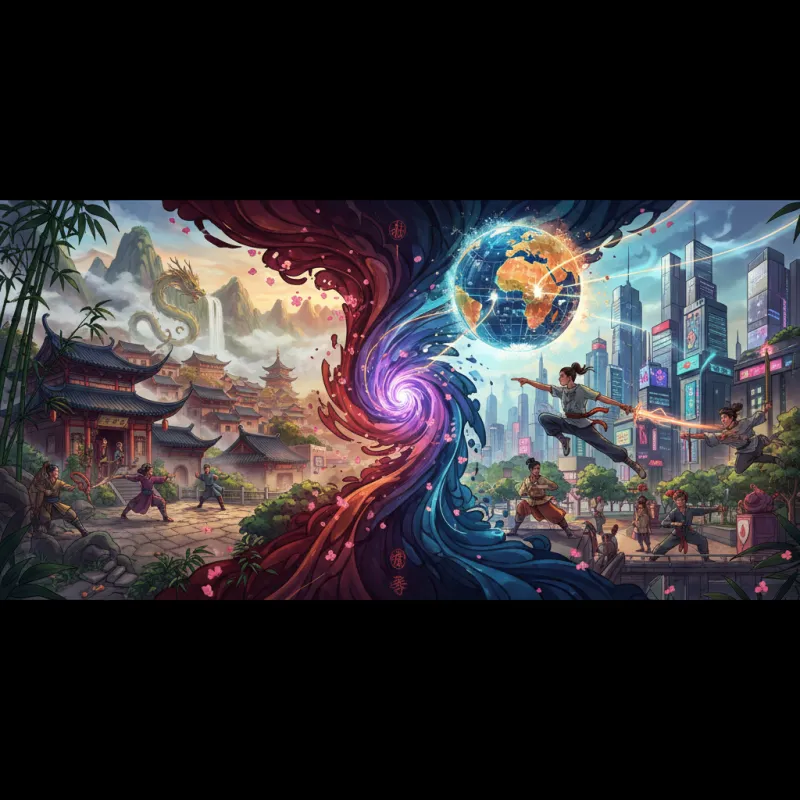
A teenager in São Paulo practices tai chi in a park at dawn. A film student in Paris writes a thesis on Crouching Tiger, Hidden Dragon. A game developer in Los Angeles designs a wuxia-inspired RPG. None of them speak Mandarin. Most have never been to China. Yet they're all participating in one of the most successful cultural exports in human history: the world of wuxia (武侠, wǔxiá) — Chinese martial arts culture.
But here's the uncomfortable truth: what the world received isn't quite what China sent. The global version of Chinese martial arts culture has been filtered, remixed, and sometimes fundamentally transformed. The question isn't whether this transformation happened — it's whether it matters.
The Translation Problem Nobody Talks About
When Jin Yong's (金庸, Jīn Yōng) The Legend of the Condor Heroes was first translated into English in the 2010s, translators faced an impossible task. How do you explain jianghu (江湖, jiānghú) — the martial arts underworld that's part criminal network, part honor society, part parallel universe — to readers who think "martial arts" means karate classes at the strip mall?
You can't. Not really. So translators made choices. Jianghu became "the martial world" or "the rivers and lakes" (a literal translation that captures the poetry but loses the cultural weight). Qinggong (轻功, qīnggōng) — the ability to move with supernatural lightness — became "lightness kung fu," which sounds like a diet program.
These aren't bad translations. They're the best possible compromises. But every compromise is a small betrayal. The global audience gets the plot, the action, the romance. What they miss is the Confucian ethics embedded in every master-student relationship, the Daoist philosophy underlying internal martial arts, the Buddhist concepts of karma and reincarnation that drive revenge narratives across multiple lifetimes.
What Survived the Journey
Some elements of wuxia culture proved remarkably portable. The visual language of martial arts cinema — wire work, slow-motion combat, the physics-defying choreography pioneered by directors like King Hu (胡金铨, Hú Jīnquán) and choreographers like Yuen Woo-ping (袁和平, Yuán Hépíng) — needs no translation. A flying kick is a flying kick in any language. When The Matrix borrowed heavily from Hong Kong action cinema in 1999, American audiences didn't need footnotes to understand what they were seeing.
The training montage, that beloved narrative device where a student transforms through discipline and suffering, translates perfectly. Rocky running up the Philadelphia Museum of Art steps is a direct descendant of Shaw Brothers training sequences. The structure is universal: struggle, failure, breakthrough, mastery. It works in Chinese, English, or silent film.
Even some philosophical concepts made the crossing intact. The idea of qi (气, qì) — life energy, breath, vital force — has entered global consciousness, even if most people couldn't define it precisely. Yoga studios and martial arts schools worldwide teach concepts that would be recognizable to a Ming Dynasty Daoist, even if the terminology has shifted.
The Hollywood Remix
Then came the adaptations, and things got interesting. Hollywood's relationship with wuxia has always been complicated — part homage, part appropriation, part creative misunderstanding. Kung Fu, the 1970s TV series, cast David Carradine as a Shaolin monk wandering the American West. It introduced millions to martial arts philosophy while simultaneously erasing Asian actors from Asian stories.
Crouching Tiger, Hidden Dragon (2000) represented a different kind of translation. Ang Lee (李安, Lǐ Ān) made a wuxia film for global audiences that was somehow both authentic and accessible. It kept the wire work, the honor codes, the tragic romance. It also added subtitles, slower pacing, and emotional beats calibrated for Western viewers. Chinese audiences found it too slow, too sentimental. Western audiences found it revelatory. Both were right.
The Marvel Cinematic Universe's Shang-Chi and the Legend of the Ten Rings (2021) took another approach: use wuxia aesthetics and fight choreography, but wrap them in a superhero narrative structure that American audiences understand instinctively. The result feels like wuxia to viewers who've never read Jin Yong, and feels like a superhero movie to viewers who grew up on Shaw Brothers films. It's a hybrid, and hybrids are always controversial.
The Video Game Revolution
If you want to see where wuxia culture is truly thriving globally, look at gaming. Video games solved the translation problem by making it interactive. You don't need to understand the historical context of jianghu when you're creating your own character, choosing your martial arts school, and fighting your way through a digital version of it.
Games like Jade Empire (2005), developed by Canadian studio BioWare, introduced Western gamers to wuxia concepts through gameplay mechanics. Sleeping Dogs (2012) let players experience Hong Kong action cinema from the inside. Chinese developers like miHoYo (Genshin Impact) and Game Science (Black Myth: Wukong) are now exporting their own interpretations of Chinese martial arts culture, creating a feedback loop where Chinese developers make games influenced by Western games that were influenced by Chinese cinema.
The result is a global wuxia culture that exists primarily in digital spaces, where a player in Stockholm can team up with players in Shanghai and Seoul to raid a virtual Shaolin Temple. The cultural context may be simplified, but the engagement is real.
What Got Lost in Translation
Not everything survived the journey. The deep connection between martial arts and Chinese medicine — the idea that a true master understands both how to harm and how to heal — rarely makes it into global adaptations. The complex web of sect politics, where martial arts schools function like feudal states with their own territories and alliances, gets simplified into "good guys vs. bad guys."
The literary sophistication of the best wuxia novels — Jin Yong's intricate plotting, Gu Long's (古龙, Gǔ Lóng) noir-influenced style, Liang Yusheng's (梁羽生, Liáng Yǔshēng) historical detail — often gets reduced to action sequences and romance. It's like knowing Shakespeare only through 10 Things I Hate About You. The adaptation might be good, but you're missing layers.
Most significantly, the ethical framework that underlies traditional wuxia — the concept of xia (侠, xiá) itself, meaning righteousness, chivalry, and the obligation to help the weak — often gets lost. Western audiences understand the lone warrior, the revenge quest, the chosen one narrative. They're less familiar with the Confucian ideal of the scholar-warrior who serves society, or the Buddhist concept of the martial artist who fights to end fighting.
The Reverse Flow
Here's where it gets really interesting: Chinese popular culture is now being influenced by its own global adaptations. Young Chinese creators grew up watching Hollywood martial arts films, playing Japanese and Western video games inspired by wuxia, reading manga that borrowed from Jin Yong. They're creating works that reflect this hybrid heritage.
The Untamed (2019), a Chinese web series based on a danmei (耽美, dānměi) novel, became a global phenomenon by blending traditional wuxia elements with modern sensibilities about friendship, loyalty, and ambiguous relationships. It's wuxia, but not as Jin Yong wrote it. It's something new, shaped by global fan culture and social media.
Chinese game developers are making wuxia games that incorporate Western RPG mechanics. Chinese filmmakers are using Hollywood-style CGI to create effects that would have been impossible in the wire-work era. The culture is evolving, and the global feedback loop is accelerating that evolution.
Does Authenticity Even Matter?
This brings us to the central question: is global wuxia culture a success story or a cautionary tale about cultural dilution? The answer is probably both, and that's okay.
Culture has never been static. The wuxia novels that Chinese readers consider classics were themselves innovations, blending historical fiction, romance, and martial arts in ways that earlier generations would have found strange. Jin Yong was influenced by Western literature — he loved Dumas and Tolstoy. The "authentic" wuxia tradition was always a hybrid.
What matters is that martial arts culture — in some form — has become genuinely global. A Brazilian capoeira practitioner and a Chinese tai chi master might not share a language, but they share an understanding that the body can be a vehicle for philosophy, that movement can be meditation, that fighting can be art.
The teenager in São Paulo doing tai chi at dawn isn't practicing exactly what a Ming Dynasty Daoist would recognize. But she's part of a living tradition that stretches back centuries and now spans continents. The tradition has changed in the crossing. That's not corruption — that's survival.
The global version of wuxia culture may be simplified, commercialized, and sometimes misunderstood. But it's also vibrant, evolving, and reaching audiences that the original creators never imagined. Jin Yong's novels have sold over 300 million copies, but his influence extends far beyond readers who can parse classical Chinese. It extends to everyone who's ever watched a martial arts film, played a wuxia-inspired game, or believed that discipline and training can transform a person.
That's not a perfect transmission of culture. But it might be the best we can hope for in a globalized world — and honestly, it's pretty remarkable.
Related Reading
- Wuxia vs. Xianxia vs. Xuanhuan: Chinese Fantasy Genres Explained
- The Ultimate Guide to Chinese Martial Arts Fiction (Wuxia)
- Best Wuxia Novels Available in English: A Reader's Guide
- Cultivation Web Novels: The Genre Taking Over the Internet
- Modern Retellings of Chinese Folklore: Bridging Ancient Legends and Contemporary Culture
- Chinese Philosophy for Beginners: Confucius, Laozi, and Zhuangzi Walk Into a Bar
- Unveiling the Celestial Tales of Chinese Folklore and Legends
Explore Chinese Culture
- Explore feng shui in daily life
- Explore supernatural folklore
- Explore classical Chinese literature