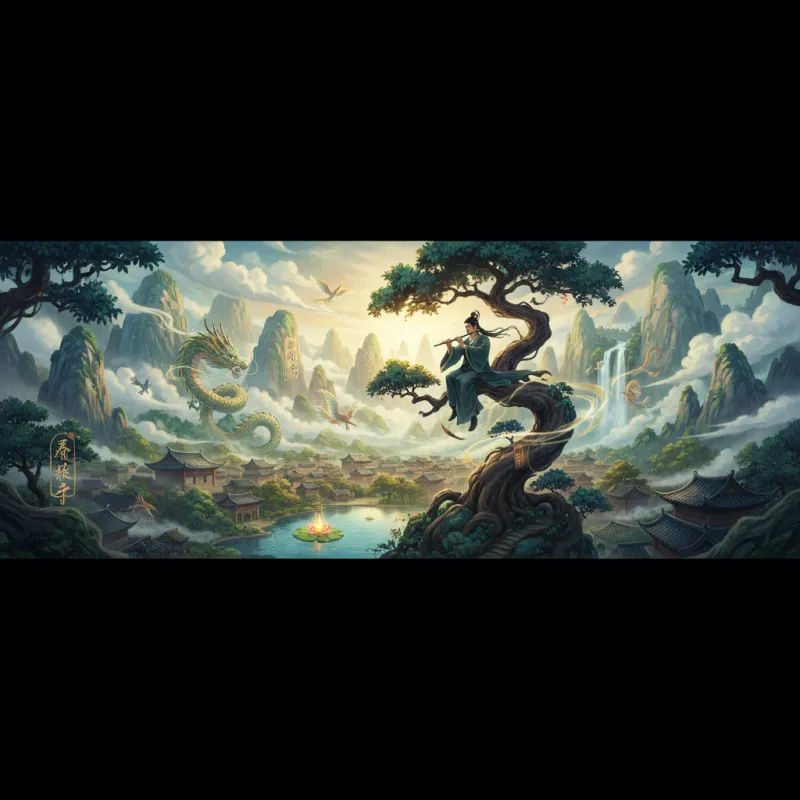
The first time you watch a martial artist leap across rooftops in a film, you're witnessing the tip of an iceberg. Beneath that single gravity-defying moment lies an entire literary tradition — 武侠小说 (wǔxiá xiǎoshuō, martial arts fiction) — that has captivated Chinese readers for generations with stories of honor, revenge, forbidden love, and warriors who can shatter stone with their palms. For decades, this world remained locked behind a language barrier. But translation efforts over the past ten years have finally cracked open the vault, and what's emerged is nothing short of revelatory: sprawling epics that make Game of Thrones look like a novella, philosophical depth that rivals Tolstoy, and fight choreography so intricate it reads like poetry.
Why Wuxia Novels Hit Different
Wuxia isn't just "kung fu books." The genre operates on its own internal logic — one where mastering martial arts means cultivating your inner energy (内功, nèigōng), where a single technique might take decades to perfect, and where the 江湖 (jiānghú, literally "rivers and lakes") represents a parallel society of martial artists operating outside conventional law. Think of it as a shadow world with its own codes, hierarchies, and blood feuds that span generations.
The novels blend action with genuine literary ambition. Jin Yong's The Legend of the Condor Heroes doesn't just describe fights — it explores what loyalty means when your teacher's enemy saved your life, or how nationalism shapes identity during the Mongol invasion of Song Dynasty China. These aren't simple adventure stories. They're meditations on ethics, power, and what it means to be righteous in a morally complex world, all wrapped in plots involving poison masters, beggar kings, and techniques that can kill with a touch.
Start Here: The Condor Trilogy
If you're going to read one wuxia series in English, make it Jin Yong's Condor Trilogy. The first volume, Legends of the Condor Heroes (射雕英雄传, Shèdiāo Yīngxióng Zhuàn), introduces Guo Jing — a simple, honest boy who becomes one of the greatest heroes in the jianghu through sheer determination and moral clarity. The translation by Anna Holmwood and Gigi Chang captures Jin Yong's voice beautifully, preserving both the action and the subtle humor.
What makes this trilogy essential is how it evolves. The second book, The Return of the Condor Heroes, flips the script with Yang Guo, a morally ambiguous protagonist whose forbidden romance with his teacher violates every social norm. By the third volume, The Heaven Sword and Dragon Saber, Jin Yong is deconstructing the very concept of heroism he built in the first book. It's a masterclass in long-form storytelling, and now all three are available in English from multiple publishers.
The Condor books also serve as your crash course in wuxia conventions. You'll learn about the 降龙十八掌 (Jiàng Lóng Shíbā Zhǎng, Eighteen Dragon-Subduing Palms), understand why everyone wants the 九阴真经 (Jiǔ Yīn Zhēnjīng, Nine Yin Manual), and grasp the political dynamics between martial sects. Once you've absorbed this foundation, every other wuxia novel becomes more accessible.
Beyond Jin Yong: Gu Long's Noir Sensibility
While Jin Yong built sprawling historical epics, Gu Long wrote wuxia as hardboiled detective fiction. His prose is terse, almost minimalist — the complete opposite of Jin Yong's elaborate descriptions. The Legend of Lu Xiaofeng series, partially translated, reads like Raymond Chandler set in ancient China, with a protagonist who's equal parts Sherlock Holmes and James Bond.
Lu Xiaofeng solves mysteries in the jianghu using wit rather than overwhelming martial prowess. The plots twist like corkscrews, the dialogue crackles, and Gu Long's fight scenes are impressionistic rather than choreographed — you get the emotional impact without the blow-by-blow breakdown. It's a completely different flavor of wuxia, proving the genre's range.
For readers who find Jin Yong's thousand-page novels daunting, Gu Long offers a more accessible entry point. His books are shorter, faster-paced, and the cultural references are less dense. The trade-off is less historical depth, but what you gain is pure narrative momentum and some of the most quotable lines in Chinese literature.
The Web Novel Revolution: Wuxiaworld and Beyond
Here's where things get interesting. While traditional publishers slowly translated classic wuxia, a parallel movement emerged online. Websites like Wuxiaworld began fan-translating Chinese web novels — many of which blend wuxia with fantasy elements in ways the old masters never imagined. These aren't your grandfather's martial arts novels.
Coiling Dragon, I Shall Seal the Heavens, and Martial World represent 修真 (xiūzhēn, cultivation) fiction, a subgenre where martial artists literally cultivate immortality through increasingly absurd power levels. The protagonists don't just master kung fu — they ascend to godhood, shatter dimensions, and reforge the cosmos. It's wuxia meets shonen anime meets Western fantasy, and it's wildly popular.
The quality varies dramatically. Some web novels are brilliantly inventive; others read like they were written by an algorithm trained on RPG mechanics. But the best ones — like Er Gen's A Will Eternal — balance genuine character development with the addictive progression systems that make you read "just one more chapter" at 3 AM. They're also completely free to read online, making them the most accessible wuxia content available.
What Gets Lost (and Found) in Translation
Let's be honest: translating wuxia is brutally difficult. The genre is packed with classical Chinese poetry, historical allusions, and martial arts terminology that has no English equivalent. How do you translate 轻功 (qīnggōng, lightness skill) without making it sound ridiculous? What's the English equivalent of 点穴 (diǎnxué, striking pressure points to paralyze opponents)?
The best translators don't just convert words — they recreate the reading experience. Anna Holmwood's decision to translate technique names literally ("Eighteen Dragon-Subduing Palms" instead of leaving it as "Jiàng Lóng Shíbā Zhǎng") makes the text accessible while preserving its flavor. Other translators include footnotes explaining cultural context, which helps but can interrupt the flow.
You'll inevitably miss nuances that Chinese readers catch instantly. When a character quotes a Tang Dynasty poem, you might not recognize it as a literary reference. When someone's name contains a pun or historical allusion, it might sail past you. But here's the thing: even with these losses, the core of what makes wuxia compelling — the intricate plots, the moral dilemmas, the spectacular action — survives translation intact.
Building Your Reading List
Start with Jin Yong's Legends of the Condor Heroes. If you love it, continue through the trilogy and then explore his other works — Demi-Gods and Semi-Devils and The Smiling, Proud Wanderer are both excellent and fully translated. If Jin Yong feels too dense, try Gu Long's The Legend of Lu Xiaofeng for something leaner and meaner.
For readers who want something more contemporary, dive into the web novel world. Grandmaster of Demonic Cultivation (also known as Mo Dao Zu Shi) by Mo Xiang Tong Xiu has become a cultural phenomenon, blending wuxia with mystery and a central romance that's genuinely moving. It's also been adapted into an animated series, audio drama, and live-action show, so you can experience the story across multiple media.
Don't sleep on the newer translations either. The Deer and the Cauldron, Jin Yong's comedic masterpiece about a con artist who stumbles into historical events, is finally getting an English release. Strange Tales of the Jianghu anthologies collect shorter wuxia stories, perfect for sampling different authors without committing to a thousand-page epic.
Why Now Is the Golden Age
We're living through the best time ever to be an English-speaking wuxia fan. Major publishers like St. Martin's Press and Penguin are investing in translations. Fan translation communities have professionalized, with some translators now working officially with Chinese publishers. Streaming services are adapting wuxia novels into high-budget series, creating new entry points for curious viewers.
The genre is also evolving in real-time. Chinese authors are experimenting with wuxia conventions, blending them with science fiction, horror, and romance in ways that would have been unthinkable thirty years ago. Some of these experiments are already available in English, meaning Western readers aren't just catching up — we're experiencing the genre's evolution alongside Chinese audiences.
This is your invitation to a literary tradition that's been hiding in plain sight. The novels are long, yes, and sometimes bewildering in their complexity. But they're also thrilling, profound, and unlike anything else in world literature. Start with one book. Let yourself get lost in the jianghu. I promise you'll emerge changed, probably with a list of twenty more novels you desperately need to read. Welcome to wuxia. Your journey through the martial arts world begins now, and like any good cultivation novel, there's always another level to reach.
Related Reading
- Wuxia vs. Xianxia vs. Xuanhuan: Chinese Fantasy Genres Explained
- Cultivation Web Novels: The Genre Taking Over the Internet
- Wuxia in the Modern World: How Martial Arts Culture Went Global
- The Ultimate Guide to Chinese Martial Arts Fiction (Wuxia)
- Exploring Transformation in Chinese Folklore: Legends, Fairy Tales, and Cultural Traditions
- Unraveling the Rich Tapestry of Chinese Animal Tales in Folklore
- Modern Retellings of Chinese Folklore: Bridging Ancient Legends and Contemporary Culture
Explore Chinese Culture
- Explore feng shui in daily life
- Explore supernatural folklore
- Explore classical Chinese literature