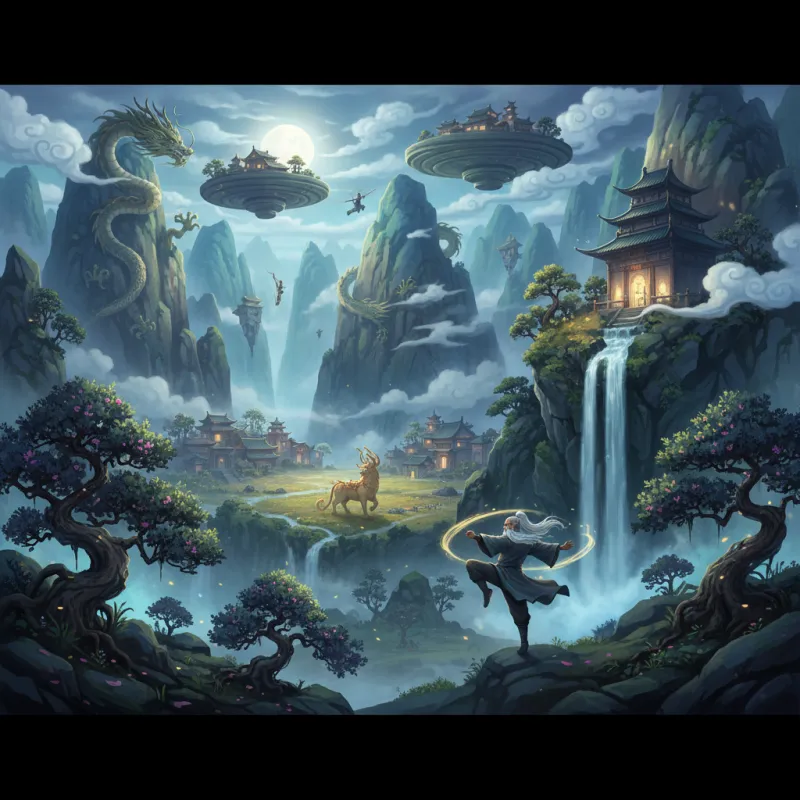
A swordsman leaps from a bamboo grove, his blade singing through mist as he deflects twenty arrows mid-flight before landing silently on a single leaf. If this sounds impossible, you've never read wuxia — and you're missing out on one of the world's most imaginative literary traditions. Chinese martial arts fiction has been captivating readers for over two millennia, creating a parallel universe where honor matters more than law, and a single fighter can reshape kingdoms.
The DNA of Wuxia: More Than Flying Swordsmen
Wuxia (武侠, wǔxiá) breaks down to "martial" (武, wǔ) and "chivalry" (侠, xiá), but that translation barely scratches the surface. This isn't just kung fu with a plot — it's a complete moral universe built on Confucian loyalty, Daoist mysticism, and Buddhist compassion, all wrapped in spectacular combat choreography that defies physics.
The genre lives in the jianghu (江湖, jiānghú), literally "rivers and lakes," a shadow society of martial artists, bandits, monks, and wandering heroes who operate outside imperial authority. Think of it as China's Wild West meets Arthurian legend, except it's been evolving since the Han Dynasty (206 BCE–220 CE). The jianghu has its own rules, hierarchies, and moral codes that often conflict with official law — which is precisely the point.
What makes wuxia distinct from other martial arts fiction is its emphasis on yi (义, yì) — righteousness or moral duty. A true wuxia hero doesn't just fight well; they fight for something. They protect the weak, avenge injustice, and uphold their word even when it costs them everything. Jin Yong's Guo Jing from The Legend of the Condor Heroes embodies this perfectly: he's not the smartest or most talented fighter, but his unwavering integrity makes him legendary.
The Martial Arts: Where Philosophy Meets Combat
Combat in wuxia operates on principles that would make a physicist weep. Fighters cultivate qi (气, qì) — vital energy — through neigong (内功, nèigōng), internal cultivation techniques that grant abilities like walking on water, shattering stone with a palm strike, or healing mortal wounds through meditation. This isn't magic in the Western fantasy sense; it's presented as the ultimate expression of martial discipline.
The qinggong (轻功, qīnggōng) or "lightness skill" lets masters leap onto rooftops, run across water, or balance on bamboo tips. Gu Long's Chu Liuxiang can steal into any fortress and vanish like smoke. Jin Yong's Linghu Chong masters the Dugu Nine Swords (独孤九剑, Dúgū Jiǔ Jiàn), a technique with no fixed forms that counters any weapon style through pure adaptability.
Each martial arts school has its signature techniques, often tied to philosophy. The Shaolin Temple emphasizes Buddhist compassion and external strength. The Wudang Sect follows Daoist principles of yielding and internal power. The Beggars' Sect uses deceptively simple moves that hide devastating force. These aren't just fighting styles — they're worldviews expressed through combat.
The Golden Age: Jin Yong and His Rivals
Modern wuxia reached its peak in 20th-century Hong Kong, where three masters dominated: Jin Yong (金庸, Jīn Yōng, 1924–2018), Gu Long (古龙, Gǔ Lóng, 1938–1985), and Liang Yusheng (梁羽生, Liáng Yǔshēng, 1924–2009). Their serialized novels in newspapers created a cultural phenomenon that still shapes Chinese pop culture today.
Jin Yong (pen name of Louis Cha) is the undisputed king. His fifteen novels have sold over 300 million copies and been adapted countless times. The Condor Trilogy spans three generations and multiple dynasties, while Demi-Gods and Semi-Devils weaves together three protagonists whose fates intersect in tragic, brilliant ways. Jin Yong's genius lies in grounding fantastical martial arts in meticulously researched historical settings — his Song Dynasty feels lived-in, his Mongol invasions carry real weight.
Gu Long took a different path, stripping away historical detail for noir-influenced tales of lonely heroes and moral ambiguity. His Chu Liuxiang series reads like James Bond meets Chinese opera, while The Legendary Siblings explores identity and brotherhood with psychological depth rare in the genre. Gu Long's prose is sparse, poetic, almost modernist — a sharp contrast to Jin Yong's epic scope.
Liang Yusheng pioneered the modern wuxia novel in 1954 with The Legend of the Jade Bow, but his more conservative style was eventually overshadowed by his bolder contemporaries. Still, his influence on establishing genre conventions cannot be overstated.
Essential Tropes: The Building Blocks of Jianghu
Certain patterns recur across wuxia with the reliability of myth. The orphaned protagonist discovers they're heir to a legendary martial arts manual or bloodline. The secret manual itself — like the Nine Yang Manual or Sunflower Manual — promises ultimate power but demands terrible sacrifice. The tournament arc gathers the jianghu's greatest fighters to determine supremacy or settle old grudges.
Then there's the shifu-disciple relationship (师父, shīfu), which carries the weight of parent-child bonds. A master doesn't just teach techniques; they shape character. Betraying your shifu is among the worst sins in the jianghu. Similarly, sworn brotherhood creates bonds stronger than blood — think Liu Bei, Guan Yu, and Zhang Fei from Romance of the Three Kingdoms, a template wuxia has used for centuries.
The femme fatale appears frequently, though modern wuxia has evolved beyond simple seductress roles. Jin Yong's Huang Rong is brilliant and playful, while his Zhao Min is a Mongol princess who chooses love over empire. Gu Long's female characters often match or exceed male heroes in skill and complexity.
Revenge plots drive countless narratives, but the best wuxia complicates simple vengeance. In Demi-Gods and Semi-Devils, Xiao Feng discovers his parents' killers only to learn the truth is far more painful than he imagined. The genre asks: when does justice become mere violence? When does honor demand you spare your enemy?
From Page to Screen: Wuxia's Visual Evolution
Wuxia's influence extends far beyond novels. Hong Kong cinema transformed the genre through directors like King Hu (A Touch of Zen, 1971) and Tsui Hark (Zu Warriors from the Magic Mountain, 1983). The wire-work and choreography pioneered in these films influenced everything from The Matrix to Crouching Tiger, Hidden Dragon.
Ang Lee's Crouching Tiger, Hidden Dragon (2000) introduced Western audiences to wuxia aesthetics, though purists debate whether its art-house sensibility captures the genre's spirit. Zhang Yimou's Hero (2002) and House of Flying Daggers (2004) emphasized visual poetry over narrative complexity, creating something beautiful but arguably removed from wuxia's roots.
Television adaptations of Jin Yong's novels appear every few years, each generation reinterpreting the classics. The 2003 version of Demi-Gods and Semi-Devils remains definitive for many fans, while newer adaptations experiment with tone and pacing for modern audiences. Video games like Sword and Fairy and Gujian translate wuxia into interactive experiences, letting players cultivate their own martial arts journey.
Beyond Wuxia: The Genre's Descendants
Wuxia spawned xianxia (仙侠, xiānxiá), which adds explicit Daoist immortal cultivation and fantasy elements. Where wuxia heroes might live 100 years through martial arts, xianxia protagonists pursue literal immortality through spiritual refinement. Web novels like Coiling Dragon and I Shall Seal the Heavens have built massive international followings, though they often sacrifice wuxia's moral complexity for power-fantasy progression.
Xuanhuan (玄幻, xuánhuàn) goes even further, incorporating Western fantasy elements like magic systems and alternate worlds. These genres share wuxia's DNA but serve different appetites — they're more concerned with spectacular power scaling than the ethical dilemmas that define classic wuxia.
For those interested in how these genres intersect with broader Chinese storytelling traditions, exploring Chinese mythology and legendary heroes provides essential context for understanding wuxia's deep cultural roots.
Why Wuxia Still Matters
In an age of superhero franchises and grimdark fantasy, wuxia offers something increasingly rare: heroes who struggle with honor, not just survival. The genre asks what it means to be righteous in an unjust world, whether loyalty can coexist with truth, and how much sacrifice duty demands.
The jianghu remains relevant because it represents freedom from oppressive systems — a space where personal virtue matters more than official rank. In societies where conformity is enforced and dissent is dangerous, wuxia's wandering heroes who answer to no master carry subversive power.
Start with Jin Yong's The Legend of the Condor Heroes for classic wuxia, or Gu Long's The Legendary Siblings for something darker and more psychological. Read them not as escapism but as moral philosophy disguised as adventure. The swordplay is spectacular, yes, but the real battles happen in the heart — and that's what makes wuxia timeless.
Related Reading
- Wuxia in the Modern World: How Martial Arts Culture Went Global
- Wuxia vs. Xianxia vs. Xuanhuan: Chinese Fantasy Genres Explained
- Cultivation Web Novels: The Genre Taking Over the Internet
- Best Wuxia Novels Available in English: A Reader's Guide
- Modern Retellings of Chinese Folklore: Bridging Ancient Legends and Contemporary Culture
- Martial Arts Films: A History of Flying Fists and Hidden Meaning
- The Chinese Tea Ceremony: Finding the Dao in Every Cup
Explore Chinese Culture
- Explore feng shui in daily life
- Explore supernatural folklore
- Explore classical Chinese literature