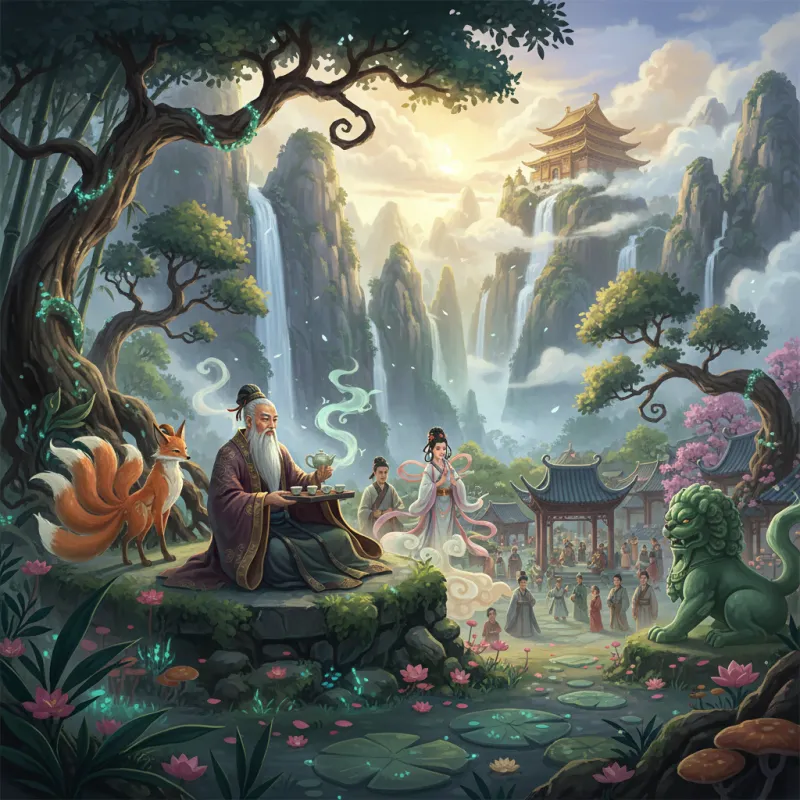
The water hits the leaves at exactly 85°C. Or maybe 90°C. You weren't checking — you were watching the steam rise from the kettle, listening for that particular sound between a whisper and a rumble that tells you it's ready. This is 功夫茶 (Gōngfu Chá, "tea with skill"), and the first thing you need to know is that there's no exam at the end.
Why "Tea Ceremony" Misses the Point
Call it a ceremony and you've already lost the thread. The Japanese have 茶道 (Chadō, "the way of tea"), with its prescribed movements, specific utensils, and aesthetic principles refined over centuries. It's beautiful, meditative, and deliberately formal. Chinese tea practice shares the meditative quality but throws out the rulebook. There's no single correct way to brew gongfu tea — there are hundreds of correct ways, and they all depend on the leaves in front of you, the water you're using, the weather, your mood, and whether you're paying attention.
The Chinese term 功夫 (gōngfu) literally means "skill acquired through practice and time." It's the same word used in martial arts, and the connection isn't metaphorical. Both practices require you to show up repeatedly, make small adjustments, and develop sensitivity to subtle changes. You can read every book about tea and still brew terrible tea if you're not present for the process. Conversely, someone who's never read a word about tea theory but has brewed the same oolong every morning for five years will likely make an excellent cup.
The Daoist Laboratory
Tea drinking in China evolved alongside 道教 (Dàojiào, Daoism) and 禅宗 (Chán Zōng, Chan Buddhism), and the tea table became a practical space for exploring their core concepts. Take 无为 (Wú Wéi, "effortless action" or "non-forcing"). It sounds paradoxical — how do you act without acting? — until you're sitting with a gaiwan full of overbrewed tea because you were trying too hard to get it perfect.
The Daoist philosopher 庄子 (Zhuāngzǐ) wrote about the butcher whose knife never dulled because he cut along the natural grain of the meat, never forcing the blade. Brewing tea offers the same lesson in miniature. You can't force leaves to release their flavor on your schedule. You can only create conditions and respond to what happens. Water too hot? The tea turns bitter. Too cold? The leaves won't open. The right temperature isn't a number you memorize — it's something you learn to feel.
This connects directly to Chinese philosophy and daily practice, where abstract concepts become tangible through repetition. The tea table is where 道 (Dào, "the way") stops being a philosophical abstraction and becomes the specific weight of a clay teapot in your hand, the particular green of fresh leaves unfurling in hot water.
The Setup: Simple Tools, Complex Attention
A basic gongfu tea setup requires surprisingly little: a small teapot or 盖碗 (gàiwǎn, a lidded bowl), small cups, a tea tray to catch overflow, and leaves. That's it. You can spend thousands on antique Yixing teapots or use a simple porcelain gaiwan that costs less than lunch. The tools matter less than what you do with them.
The gaiwan deserves special mention because it's both the simplest and most versatile brewing vessel. It's essentially a bowl with a lid and saucer — no handle, no spout, nothing between you and the tea. Learning to pour from a gaiwan without burning your fingers or spilling everywhere takes practice. Your thumb and middle finger hold the rim, your index finger steadies the lid, and you tilt the whole assembly to pour. Do it wrong and you'll scald yourself. Do it right and the motion becomes automatic, freeing your attention for the tea itself.
The small cups — often no bigger than a shot glass — aren't about being precious or pretentious. They're practical. Gongfu tea uses a high ratio of leaves to water and short steeping times, sometimes just seconds. You're not making one big pot to last an hour; you're making many small infusions, each one slightly different from the last. The first steep might be bright and sharp, the third deeper and sweeter, the seventh subtle and lingering. Small cups let you taste these changes without getting overwhelmed or caffeinated into oblivion.
The Practice: Repetition Without Routine
Here's what actually happens when you brew gongfu tea: You heat water. You warm the pot and cups with hot water, then discard it. You add leaves — usually filling a third to half the pot, far more than Western-style brewing. You pour hot water over the leaves, wait a brief moment, and pour out the tea. Then you do it again. And again. A good tea might give you ten infusions, each one revealing something different.
The repetition is the point. Not because repetition itself is virtuous, but because it creates space for noticing. The first infusion, you're still settling in, adjusting the temperature, getting a sense of the tea. By the third or fourth, you're not thinking about technique anymore — you're just responding. The leaves need five more seconds. The water should be slightly cooler. You can't explain how you know; you just know.
This is 正念 (zhèngniàn, "right mindfulness" or "present awareness"), though that term comes with baggage from its Buddhist origins and modern mindfulness culture. In the context of tea, it's simpler: you're here, with these leaves, this water, this moment. Not thinking about the email you need to send or the conversation you had yesterday. Just pouring water and noticing what happens.
Tea and Social Space
Gongfu tea is often a solitary practice, but it's also deeply social. The person brewing tea — the 茶主 (cházhǔ, "tea master" or simply "host") — serves others, creating a shared experience that's simultaneously intimate and impersonal. You're not making small talk; you're drinking tea together. The silence isn't awkward; it's companionable.
This relates to the Chinese concept of 茶缘 (cháyuán, "tea affinity" or "tea fate") — the idea that sharing tea creates a particular kind of connection between people. It's not friendship exactly, though it can lead there. It's more like a temporary alignment, a shared attention to the same thing. You might share tea with a stranger in a tea shop and never see them again, but for those twenty minutes, you were both present in the same way.
The social dimension also appears in traditional Chinese hospitality customs, where offering tea is both greeting and gesture of respect. But gongfu tea takes this further — it's not just offering a beverage, it's offering time and attention. The host is saying, "Sit. Be here. Let's pay attention together."
What the Tea Teaches
After brewing the same tea dozens of times, you start noticing patterns. This oolong opens up better with slightly cooler water. That pu-erh needs a longer first rinse. Green tea is unforgiving — too hot and it's ruined, but get it right and it's transcendent. These aren't rules you can write down and follow mechanically. They're responses you develop through practice.
The tea also teaches you about impermanence in a very direct way. That perfect fourth infusion? It's gone. You can't recreate it exactly, even with the same leaves and water. The fifth infusion will be different. This isn't a problem to solve; it's just how it is. The Daoist concept of 无常 (wúcháng, "impermanence") stops being abstract philosophy and becomes the concrete reality of tea that changes with each steep.
There's also the lesson of 适度 (shìdù, "appropriate measure" or "moderation"). Too many leaves and the tea is overwhelming. Too few and it's weak. Too hot and it's bitter. Too cool and it's flat. The right amount isn't a fixed quantity — it depends on the specific tea, your equipment, and what you're trying to achieve. You learn to calibrate, to adjust, to find the appropriate response to the specific situation. This is 中庸 (zhōngyōng, "the doctrine of the mean"), not as boring compromise but as dynamic balance.
The Dao You Can't Name
The 道德经 (Dàodéjīng, the foundational Daoist text) opens with a warning: "The Dao that can be spoken is not the eternal Dao." Try to pin it down with words and you've already missed it. This is frustrating if you want clear instructions, but it's honest. The practice of brewing tea can't be fully captured in a guide or tutorial. You have to do it, repeatedly, with attention.
That said, there are practical starting points. Get decent leaves — not necessarily expensive, but fresh and whole-leaf. Get a gaiwan or small teapot. Heat water. Start with more leaves than seems reasonable and shorter steeping times than you're used to. Pour, taste, adjust. Do it again tomorrow. And the day after. The skill develops slowly, through repetition and attention, not through following rules.
The goal isn't to achieve some perfect, ceremonial tea experience. The goal is to show up, pay attention, and respond to what's actually happening rather than what you think should happen. The tea is just tea — leaves and water and heat. But the practice of brewing it, of paying attention to the small details and adjustments, becomes a way of practicing presence itself. Not as a spiritual achievement, but as a simple, repeatable action: pouring water over leaves and noticing what happens.
That's the Dao in every cup — not a mystical revelation, but the ongoing practice of showing up and paying attention. The water cools. The leaves unfurl. You pour. You taste. You adjust. You do it again. There's no ceremony to complete, no final mastery to achieve. Just the next cup, and the one after that.
Related Reading
- Chinese Landscape Painting: Mountains and Water
- Chinese Calligraphy for Beginners: The Art of the Brush
- Chinese Calligraphy: Why Writing Is Considered the Highest Art Form
- Chinese Calligraphy: The Five Major Styles
- Traditional Chinese Music: Instruments, Scales and Soul
- Exploring the Enigmatic World of Chinese Animal Tales and Their Cultural Significance
- Unraveling China's Trickster Tales: Lore, Legends, and Cultural Impact
- Chinese Supernatural Fiction: From Liaozhai to Modern Web Novels
Explore Chinese Culture
- Explore feng shui in daily life
- Explore supernatural folklore
- Explore classical Chinese literature