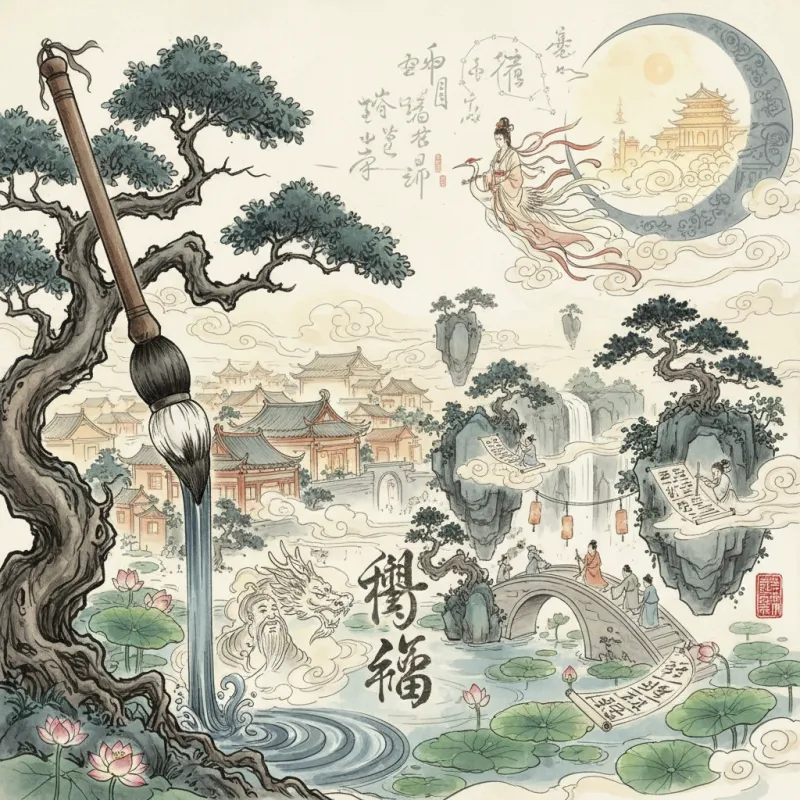
The brush hovers above white paper, loaded with ink. Your hand trembles slightly — not from nervousness, but from the tension of holding potential energy. In the next moment, you'll drag horsehair across rice paper and create something irreversible. No erasing. No ctrl-z. This is 书法 (shūfǎ, "the method of writing"), and it's about to teach you more about control, release, and the space between them than any meditation app ever could.
Why Calligraphy Isn't Just Pretty Handwriting
Chinese calligraphy occupies a position in Chinese culture that no Western art form precisely parallels. It's simultaneously visual art, physical practice, philosophical expression, and social performance. When Tang Dynasty officials evaluated candidates for government positions, they assessed 身言书判 (shēn yán shū pàn) — body, speech, writing, and judgment. Notice that calligraphy ranked equally with a person's physical presence and speaking ability. Your handwriting could literally determine your career trajectory.
The phrase 字如其人 (zì rú qí rén, "the character reveals the person") wasn't metaphorical. Calligraphy masters could supposedly read personality, education, and moral character from how someone wielded a brush. Aggressive strokes suggested an impulsive nature. Timid, thin lines indicated weakness. Balanced, confident characters reflected a cultivated mind. Whether this was accurate or just elaborate gatekeeping is debatable, but the belief shaped Chinese society for millennia.
Unlike Western calligraphy, which decorates letters, Chinese 书法 is considered the highest of the visual arts — traditionally ranked above painting and sculpture. This seems bizarre until you understand what calligraphy demands: the synthesis of physical discipline, aesthetic judgment, historical knowledge, and spontaneous expression. A painter can revise. A calligrapher gets one shot. The brush touches paper, and whatever happens in the next few seconds is permanent.
The Four Treasures You Actually Need
Every calligraphy guide mentions the 文房四宝 (wénfáng sìbǎo, "four treasures of the study"): brush, ink, paper, and inkstone. What they don't mention is that you can start with cheap versions of all four and still learn effectively. The fetishization of expensive materials is real, but beginners benefit more from quantity of practice than quality of tools.
Your first brush should be a medium-sized 兼毫 (jiānháo) — a mixed-hair brush combining stiff and soft bristles. Pure wolf hair brushes (狼毫, lángháo) are too stiff for beginners. Pure goat hair (羊毫, yángháo) is too soft. The mixed brush forgives mistakes while teaching proper technique. Expect to pay $8-15 for a decent beginner brush, not $80.
For ink, buy a bottle of prepared liquid ink (墨汁, mòzhī) rather than an ink stick. Yes, grinding your own ink from a 墨 (mò) stick on an inkstone (砚, yàn) is meditative and traditional. It's also time-consuming and irrelevant to learning stroke technique. Save the ritual for when you can actually write characters that don't look like drunk spiders.
Paper matters more than you'd think. Start with 毛边纸 (máobiānzhǐ), an inexpensive practice paper with a slight texture. The fancy stuff — 宣纸 (xuānzhǐ, Xuan paper) from Anhui Province — is too absorbent for beginners. Your strokes will bleed and blur before you understand why. Cheap paper gives you honest feedback about your technique without the heartbreak of ruining expensive materials.
The Eight Principles That Contain Everything
The character 永 (yǒng, "eternal") contains eight basic strokes that form the foundation of all Chinese calligraphy. This isn't coincidence — calligraphers specifically chose this character as a teaching tool. Master these eight strokes, called 永字八法 (yǒngzì bāfǎ, "the eight principles of yǒng"), and you've got the vocabulary to write thousands of characters.
The dot (点, diǎn) seems simple until you try it. It's not a blob. It's a complete gesture with a beginning, middle, and end — like a miniature brushstroke that contains all the energy of larger movements. Press, twist slightly, lift. The dot should look alive, not dead.
The horizontal stroke (横, héng) moves left to right, but not in a straight line. It rises slightly as it travels, like a boat riding a gentle wave. Begin with a slight downward press, travel right while gradually lifting, then press down again at the end. This creates the characteristic "head and tail" that distinguishes calligraphy from mere writing.
The vertical stroke (竖, shù) drops straight down with authority. But "straight" is relative — there's a subtle curve, a sense of tension, like a bamboo stalk bending slightly under its own weight. Too rigid looks mechanical. Too curved looks weak. Finding the balance takes hundreds of repetitions.
The remaining five strokes — hook (钩, gōu), rising stroke (提, tí), left-falling stroke (撇, piě), right-falling stroke (捺, nà), and turning stroke (折, zhé) — build on these principles. Each has its own personality, its own way of moving through space. You'll spend months just learning how these eight strokes feel in your hand, your arm, your whole body.
Why Your First Hundred Characters Will Look Terrible
They will. Accept this now. Chinese calligraphy has a learning curve like a cliff face. You'll practice the same stroke fifty times and see no improvement. Then suddenly, on attempt fifty-one, something clicks. Your hand remembers what your brain couldn't explain. This is 功夫 (gōngfu) — skill acquired through time and effort, the same word used for martial arts.
The problem is that calligraphy requires unlearning everything your hand knows about writing. You've spent years developing efficient, minimal movements to get words on paper quickly. Calligraphy demands the opposite: deliberate, exaggerated movements that prioritize aesthetic quality over speed. Your hand will rebel. It will try to revert to normal writing. You'll need to consciously override decades of muscle memory.
Start with 楷书 (kǎishū, "regular script"), the standard printed style. It's the most structured and rule-bound of the major scripts, which makes it the best foundation. Later you can explore 行书 (xíngshū, "running script") and 草书 (cǎoshū, "cursive script"), but those require understanding the rules before you can break them artfully. Learning Chinese painting techniques follows a similar progression from structured to spontaneous.
Practice the same character repeatedly — twenty, thirty, fifty times in a session. This seems monotonous until you realize that each repetition reveals something new. The fifteenth time you write 人 (rén, "person"), you notice how the two strokes balance each other. The thirtieth time, you feel how the left stroke sets up the right stroke. The fiftieth time, you stop thinking entirely and just write.
The Posture Nobody Tells You About
Sit up straight. No, straighter than that. Your spine should be vertical, your feet flat on the floor, your non-writing hand resting on the table to stabilize your body. This isn't arbitrary formality — it's biomechanics. Calligraphy uses your entire arm, from shoulder to fingertips. Slouching restricts movement and creates tension in the wrong places.
Hold the brush vertically, perpendicular to the paper. Western writing uses an angled pen, but Chinese brushes work best when held upright. Grip it about one-third of the way up the handle — higher for larger characters, lower for smaller ones. Your thumb and first two fingers control the brush, while your ring finger and pinky provide support. The grip should be firm but not tense. Imagine holding a small bird: secure enough that it can't escape, gentle enough that you don't crush it.
Your wrist should float above the table, not rest on it. This is called 悬腕 (xuánwàn, "suspended wrist"), and it's exhausting at first. Your arm will ache after ten minutes. But resting your wrist on the table limits your range of motion and creates stiff, lifeless strokes. The discomfort is temporary. The bad habits from improper posture are permanent.
Breathe. Seriously. Beginners hold their breath while writing, creating tension throughout their body. Each stroke should coordinate with your breathing — inhale while preparing, exhale while executing. This isn't mystical nonsense; it's practical technique. Controlled breathing regulates your nervous system and steadies your hand.
Copying the Masters (And Why It's Not Cheating)
Chinese calligraphy education is built on 临摹 (línmó, "copying models"). You don't develop your own style first and then study the masters. You copy the masters obsessively until their techniques become part of your muscle memory. Only then do you have the vocabulary to develop personal expression.
Start with 欧阳询 (Ōuyáng Xún, 557-641), a Tang Dynasty master whose 楷书 is considered the gold standard for beginners. His characters are structured, balanced, and clear — perfect for learning proper proportions. Buy a copybook (字帖, zìtiè) of his work and trace it. Yes, trace it. Put thin paper over the original and follow the strokes exactly. This teaches your hand the correct movements before you try to reproduce them from memory.
After tracing, practice 对临 (duìlín, "copying while looking") — place the model beside your paper and recreate it. This is harder than it looks. Your brain sees the character as a whole, but your hand must break it down into sequential strokes. You'll discover that characters you've read thousands of times have structural details you never noticed.
Eventually progress to 背临 (bèilín, "copying from memory") — write the character without looking at the model. This reveals what you've actually learned versus what you only thought you learned. Most beginners discover they've memorized the general shape but missed crucial details about stroke order, proportion, and spacing.
The relationship between copying and creativity in Chinese arts differs fundamentally from Western concepts of originality. As with traditional Chinese opera, mastery comes through deep engagement with established forms, not rejection of them.
What Calligraphy Actually Teaches You
After six months of practice, you'll notice changes that have nothing to do with writing. Your hand is steadier. Your patience has increased. You can focus on a single task for longer periods without mental drift. These aren't side effects — they're the point.
Calligraphy is a practice of presence. Each stroke demands complete attention. Let your mind wander and the brush betrays you immediately. The ink bleeds, the line wavers, the character collapses. You can't fake presence in calligraphy. The paper records every moment of distraction, every flicker of doubt.
It's also a practice of acceptance. That stroke you just made? It's permanent. You can't fix it. You can only learn from it and do better on the next character. This sounds simple but contradicts everything modern life teaches us about revision, editing, and endless optimization. Calligraphy says: make your mark, accept the result, move forward.
The physical practice builds something that translates beyond the page. The same focused calm you develop while writing carries into other activities. The same acceptance of imperfection applies to other creative work. The same patience with slow progress helps in any skill acquisition. This is why calligraphy was considered essential education for scholars — not because they needed beautiful handwriting, but because the practice cultivated qualities necessary for a cultivated life.
Starting Today, Not Someday
You don't need to wait for the perfect moment, the perfect materials, or the perfect teacher. Buy a basic set online for $30. Find a copybook of 欧阳询's work. Set aside twenty minutes. Write the character 一 (yī, "one") — a single horizontal stroke — fifty times. That's it. That's how you start.
The barrier to entry is low, but the ceiling is infinite. Calligraphers spend lifetimes refining their technique, and the greatest masters claim they're still learning. This isn't discouraging — it's liberating. You're not trying to achieve perfection. You're engaging with a practice that has no endpoint, only deepening.
Chinese calligraphy won't make you a better person automatically. It won't solve your problems or answer your questions. But it will give you a space where the only thing that matters is the next stroke, the next character, the next moment of focused attention. In a world of infinite distraction, that space is increasingly rare and increasingly valuable.
Pick up the brush. Load it with ink. Let it hover above the paper for a moment. Then make your mark.
Related Reading
- Chinese Opera for Beginners: A Visual and Musical Feast
- Chinese Opera: A Living Art Form
- Chinese Arts: The Four Treasures of the Study and Beyond
- The Chinese Tea Ceremony: Finding the Dao in Every Cup
- Chinese Calligraphy: Why Writing Is Considered the Highest Art Form
- The Art of War: Sun Tzu's Lessons Beyond the Battlefield
- Chinese Cinema: An Essential Guide for Film Lovers
- Chinese Philosophy for Beginners: Confucius, Laozi, and Zhuangzi Walk Into a Bar
Explore Chinese Culture
- Explore feng shui in daily life
- Explore supernatural folklore
- Explore classical Chinese literature