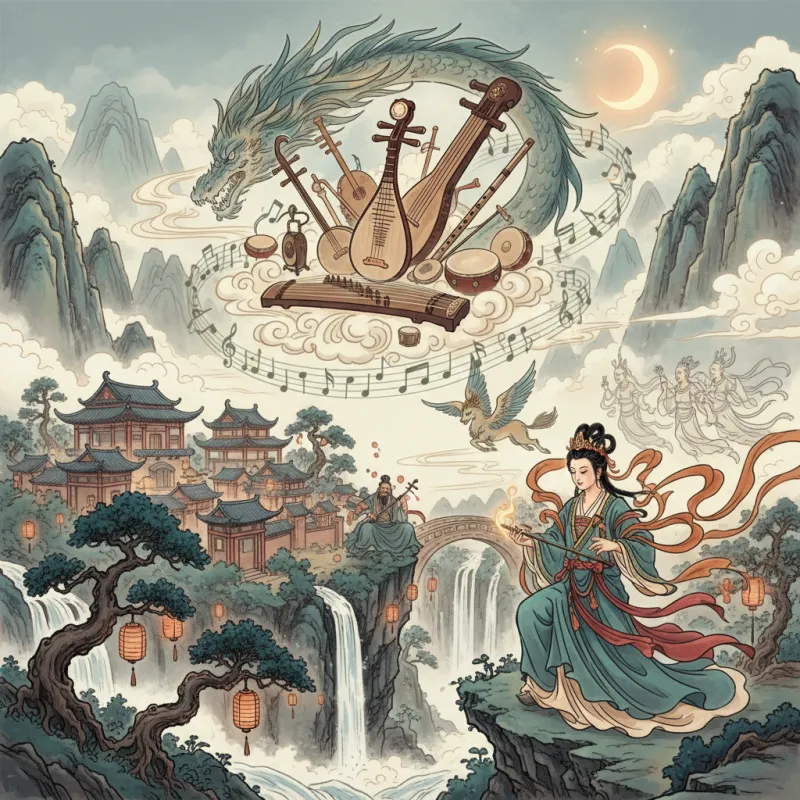
The seven-stringed guqin sits silent on the table, its lacquered surface reflecting centuries of philosophical debate about whether a note exists in the moment it's played or in the resonant silence that follows. This isn't abstract theorizing — it's the foundational question of Chinese musical aesthetics, and the answer shapes everything from how instruments are constructed to why a single plucked string can carry more emotional weight than an entire Western orchestra.
The Pentatonic Foundation
Traditional Chinese music — 中国传统音乐 (Zhōngguó Chuántǒng Yīnyuè) — builds on the five-tone pentatonic scale rather than the Western seven-tone system. These five notes — 宫 (gōng), 商 (shāng), 角 (jué), 徵 (zhǐ), and 羽 (yǔ) — correspond not just to pitches but to the five elements, five directions, five seasons, and five internal organs in traditional Chinese medicine. This isn't coincidental decoration. The ancient Chinese conceived of music as part of a cosmic order where sound, body, nature, and society formed an integrated whole.
The pentatonic scale produces what Western ears might initially perceive as "gaps" — no semitones, no leading tones pulling toward resolution. But these gaps are intentional spaces for ornamentation, for the subtle bends and slides that give Chinese melody its distinctive character. A skilled performer doesn't just play the five notes; they explore the infinite gradations between them, the way a calligrapher's brush doesn't just make strokes but modulates pressure, speed, and moisture to create living lines.
During the Zhou Dynasty (1046-256 BCE), music theory became codified in texts like the Yueji (Record of Music), which argued that proper music could maintain social harmony and even prevent political collapse. The twelve lü (律) — a system of pitch standards — were calculated using bamboo pipes and mathematical ratios, creating a tuning system that differs subtly but significantly from Western equal temperament. This mathematical precision coexisted with the belief that music should sound natural, unforced, like wind through pine trees.
Instruments of Silk and Bamboo
Chinese instruments divide into eight categories based on their construction material — the 八音 (bā yīn) system: metal, stone, silk, bamboo, gourd, clay, leather, and wood. This classification reveals a culture that heard timbre as primary, pitch as secondary. The guqin (古琴), a seven-stringed zither with a history spanning three thousand years, exemplifies the silk category and remains the most philosophically loaded instrument in Chinese culture.
Playing the guqin was never about entertainment. It was a form of self-cultivation, a meditation practice, a way to align oneself with the Dao. The instrument has no frets, requiring the player to find pitches by feel and memory. Its range of techniques includes over thirty different ways to pluck, slide, and harmonize strings, many with poetic names like "wild geese descending on a sandy beach" or "crane's cry in the nine heavens." The guqin repertoire includes pieces like Flowing Water (流水, Liú Shuǐ), which supposedly caused the legendary musician Bo Ya's only true listener to die of grief when he heard it, understanding its depths so completely that he couldn't bear the beauty.
The pipa (琵琶), a four-stringed lute with a pear-shaped body, represents a different aesthetic entirely. Introduced from Central Asia during the Han Dynasty, it became thoroughly sinicized by the Tang period, when poets like Bai Juyi wrote about its ability to evoke everything from cavalry charges to intimate sorrow. The pipa is percussive, dramatic, capable of rapid-fire tremolo that mimics rainfall or battle. Its most famous piece, Ambush from Ten Sides (十面埋伏, Shí Miàn Mái Fú), depicts the final battle between Chu and Han forces in 202 BCE with such visceral intensity that listeners can hear swords clashing and horses screaming.
Bamboo instruments — the dizi (笛子) transverse flute and xiao (箫) vertical flute — carry different connotations. The dizi, bright and penetrating, appears in folk music, opera, and ensemble pieces. The xiao, breathy and melancholic, is the instrument of hermits and scholars, its sound evoking mist-shrouded mountains and the loneliness of the cultivated mind. Both require circular breathing techniques and subtle finger vibrato that Western flute pedagogy barely acknowledges.
The Aesthetics of Emptiness
Here's where Chinese music diverges most radically from Western practice: the concept of 虚 (xū, emptiness) as equal to 实 (shí, substance). In Western music, silence is the absence of music, the space between meaningful events. In Chinese aesthetics — derived from Daoist philosophy and visible in painting, poetry, and garden design — emptiness is active, generative, essential. The pause between notes isn't dead space; it's where the note continues to resonate in the listener's mind, where meaning accumulates.
This shows up in performance practice as a resistance to continuous sound. A guqin player will let notes decay completely before playing the next one, allowing the instrument's long sustain to create a sense of spaciousness. The ornamentation — slides, vibrato, harmonics — happens in these spaces, decorating the silence rather than filling it. Western listeners trained on Bach and Beethoven often find this unsettling at first, this refusal to provide constant sonic information.
The concept extends to ensemble playing. Traditional Chinese ensembles practice 支声 (zhīshēng, heterophony), where multiple instruments play the same melody but with individual variations in ornamentation and timing. There's no conductor enforcing unity, no score dictating exact synchronization. Instead, musicians listen to each other and respond, creating a texture that's unified but not uniform, like multiple streams flowing in the same direction but at their own pace. This requires a different kind of musical intelligence than Western ensemble playing — less about precision, more about sensitivity.
Regional Styles and Opera Traditions
Chinese music isn't monolithic. The jiangnan sizhu (江南丝竹, silk and bamboo music of the Jiangnan region) sounds nothing like the xian gu (弦鼓, string and drum music) of Chaozhou or the shifan luogu (十番锣鼓, percussion ensemble music) of Jiangsu. Regional styles developed in isolation for centuries, shaped by local dialects, climate, and social structures.
Opera traditions — and China has over three hundred regional opera forms — each developed distinctive musical characteristics. Beijing opera (京剧, jīngjù) uses the jinghu, a high-pitched two-stringed fiddle that cuts through percussion and can follow the tonal contours of Mandarin speech. Cantonese opera employs different instruments and scales to match Cantonese's nine tones. The connection between linguistic tone and musical melody is so tight that changing the melody can literally change the meaning of the words being sung.
The erhu (二胡), a two-stringed fiddle that's become emblematic of Chinese music globally, actually has relatively recent prominence. It gained popularity in the early twentieth century through the work of composer and performer Liu Tianhua, who created a concert repertoire for the instrument and established it as a solo voice rather than just an accompaniment to opera. His piece Beautiful Night (良宵, Liáng Xiāo) demonstrated that the erhu could express the same depth as the guqin while remaining accessible to modern audiences.
Music and Cosmology
The ancient Chinese didn't separate music from cosmology, medicine, or statecraft. The Yueji states explicitly that music reflects the state of government — harmonious music indicates good governance, chaotic music predicts political disorder. This wasn't metaphor. Court musicians during the Han Dynasty were responsible for maintaining the pitch standards that supposedly kept the empire in alignment with cosmic forces. When the pitch pipes went out of tune, it was considered an omen of dynastic decline.
This cosmological thinking shaped instrument construction. The guqin's dimensions encode numerological significance: seven strings for the seven stars of the Big Dipper, thirteen studs marking harmonic nodes for the thirteen months of the lunar calendar. The instrument's three parts — heaven (the curved top), earth (the flat bottom), and humanity (the player) — form a microcosm of the universe. Playing it correctly meant participating in cosmic order, not just making pleasant sounds.
Even the materials mattered spiritually. The best guqin were made from wood that had been submerged in water for decades or salvaged from ancient temples, the theory being that age and exposure to the elements gave the wood spiritual resonance. The silk strings — before the modern switch to metal-wound nylon — required constant adjustment for humidity and temperature, making the instrument a living thing that responded to environmental conditions.
Modern Transformations
The twentieth century hit Chinese music like a cultural earthquake. The May Fourth Movement of 1919 rejected traditional culture as feudal and backward. Western-style conservatories opened, teaching Western notation, harmony, and orchestration. Composers like Huang Zi and Xian Xinghai tried to create a new Chinese music that combined Western techniques with Chinese materials — essentially treating Chinese melodies as raw material for Western compositional methods.
The Cultural Revolution (1966-1976) nearly destroyed traditional music entirely. Instruments were burned, musicians persecuted, and only eight "model operas" approved for performance. The guqin tradition survived primarily through elderly masters who continued practicing in secret, passing knowledge to a handful of students. When restrictions lifted in the 1980s, there were fewer than a hundred active guqin players in all of China.
The revival since then has been remarkable but complicated. The guqin was inscribed on UNESCO's Intangible Cultural Heritage list in 2003, sparking renewed interest. Conservatories now teach traditional instruments alongside Western ones. But there's ongoing tension between preservation and innovation, between treating traditional music as a museum piece and allowing it to evolve. Some contemporary composers like Tan Dun have achieved international success by blending Chinese instruments with Western orchestras, though purists argue this dilutes the essential character of Chinese musical thinking.
Listening as Cultivation
The traditional Chinese approach to music wasn't about passive entertainment. Listening to guqin music required the same cultivation as playing it — the ability to hear not just notes but the spaces between them, to appreciate subtle variations in timbre and attack, to understand the literary and philosophical allusions embedded in piece titles and performance techniques. This is why guqin music was traditionally performed in intimate settings for small audiences of educated listeners, not in concert halls for hundreds.
This aesthetic persists in how traditional music is taught and transmitted. There's no standardized curriculum, no method books with progressive exercises. Instead, students learn through imitation and oral transmission, absorbing not just techniques but the philosophical framework that makes those techniques meaningful. A teacher might spend months on a single piece, exploring its historical context, its connection to poetry and painting, the emotional states it's meant to evoke. The goal isn't technical mastery — it's understanding music as a path to self-cultivation and cosmic harmony.
For modern listeners, especially those raised on Western music, this requires a fundamental shift in listening habits. Stop waiting for harmonic progression, for development and recapitulation, for the tension and release of Western tonality. Instead, attend to the quality of each individual note, the way it emerges from silence and returns to it, the micro-variations in vibrato and dynamics that give it character. Listen to the spaces. Let the music unfold at its own pace without imposing expectations of where it should go.
Traditional Chinese music offers something increasingly rare in our overstimulated age: the aesthetic of restraint, the power of suggestion over statement, the recognition that emptiness and fullness are equally necessary. It's music that doesn't demand attention so much as invite contemplation, that treats silence not as absence but as presence. In a world of constant noise, that might be its most radical offering.
Related Reading
- Chinese Opera for Beginners: A Visual and Musical Feast
- Chinese Landscape Painting: Mountains and Water
- Chinese Opera: A Living Art Form
- Chinese Calligraphy: Why Writing Is Considered the Highest Art Form
- Chinese Calligraphy for Beginners: The Art of the Brush
- Enchanting Chinese Mountain Legends: Myths, Mysteries, and Cultural Heritage
- Chinese Martial Arts in the Real World: What Actually Works
- Unraveling the Rich Tapestry of Chinese Animal Tales in Folklore
Explore Chinese Culture
- Explore feng shui in daily life
- Explore supernatural folklore
- Explore classical Chinese literature