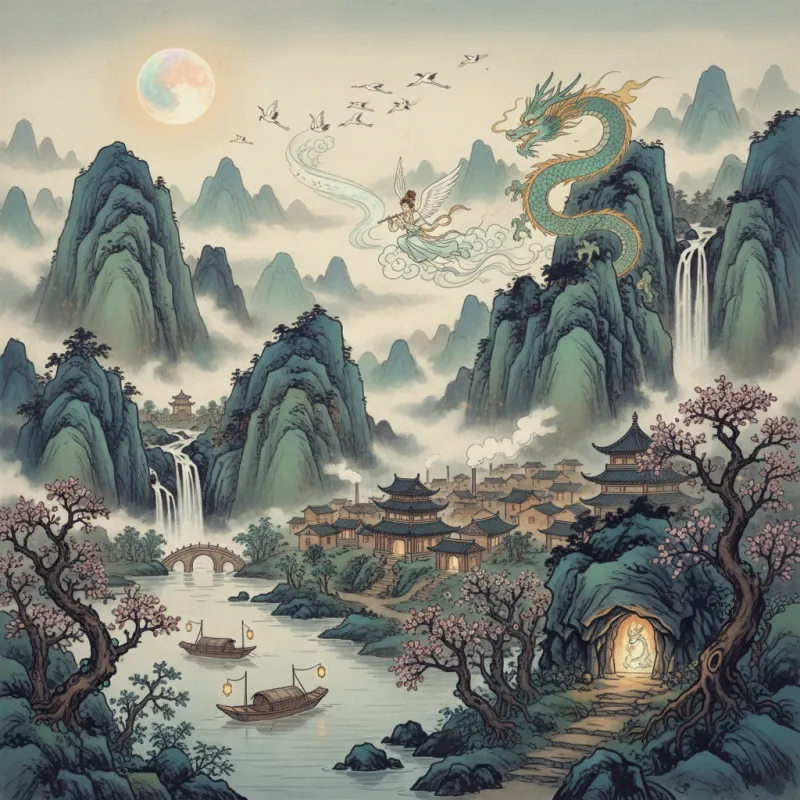
A single brushstroke can contain an entire mountain range. In Chinese landscape painting, this isn't poetic exaggeration—it's technical precision honed over seventeen centuries. When the 10th-century master Jing Hao climbed into the Taihang Mountains with nothing but ink, paper, and an obsessive need to understand pine trees, he wasn't just painting scenery. He was mapping the philosophical architecture of the universe itself.
The Philosophy Behind Mountains and Water
Shanshui (山水, shānshuǐ)—literally "mountain-water"—isn't landscape painting in the Western sense. European landscapes frame nature as something observed from the outside, a view through a window. Chinese shanshui invites you to walk inside the scroll itself. The mountains aren't backdrop; they're the dwelling place of immortals. The water isn't decoration; it's the Dao flowing through all things.
This distinction matters because it reveals the entire cosmological framework. Mountains represent yang energy—solid, enduring, masculine, reaching toward heaven. Water embodies yin—fluid, adaptive, feminine, seeking the lowest places. A shanshui painting isn't depicting a specific location you could visit with a map. It's showing you how cosmic forces achieve balance, how emptiness and form create each other, how the ten thousand things emerge from and return to the void.
The Song Dynasty critic Guo Xi wrote in his 1070s treatise that mountains have four seasons, four times of day, and four weather conditions—and a true painter must know them all. But more than that, he insisted mountains have emotional states. Spring mountains are "alluring and smile," summer mountains are "verdant and drip," autumn mountains are "clear and serene," winter mountains are "withdrawn and sleep." This isn't anthropomorphism. It's recognizing that consciousness pervades everything, that the boundary between observer and observed dissolves when you truly see.
The Technical Revolution of the Tang and Song
When Wang Wei (699-759 CE) invented the "broken ink" technique during the Tang Dynasty, he fundamentally altered what painting could express. By layering diluted ink washes before they fully dried, he created atmospheric depth that earlier painters achieved only through color. Suddenly, mist wasn't white paint—it was unpainted silk, the void itself becoming visible between mountain peaks.
But the real explosion came during the Northern Song Dynasty (960-1127 CE). This is when Chinese landscape painting reached heights that, frankly, wouldn't be matched until the Yuan Dynasty three centuries later. Fan Kuan's "Travelers Among Mountains and Streams" (circa 1000 CE) towers over viewers at nearly seven feet tall. The central mountain doesn't just dominate the composition—it crushes you with its monumentality. Human figures appear as tiny dots on a path, barely visible. The message is clear: nature is vast, humans are small, and this proper understanding of scale is the beginning of wisdom.
Li Cheng and Guo Xi developed what became known as the "tall distance" perspective, where viewers look up at towering peaks that seem to pierce the clouds. This wasn't about showing off technical skill. It was about inducing a specific psychological state—the feeling of standing at the base of something incomprehensibly ancient and powerful, something that was here long before you and will remain long after.
The Three Distances and Spatial Philosophy
Guo Xi's son, Guo Si, compiled his father's teachings into "The Lofty Message of Forests and Streams," which codified the three distances (三远, sānyuǎn) that govern spatial composition. "High distance" (高远, gāoyuǎn) looks up from the mountain base to the peak. "Deep distance" (深远, shēnyuǎn) peers from the front mountain through layers of receding ranges. "Level distance" (平远, píngyuǎn) gazes across from one mountain to another.
These aren't just compositional tricks. They're philosophical positions about how consciousness relates to space. Western perspective, invented during the Renaissance, assumes a single fixed viewpoint—one eye, one moment, one position in space. Chinese painting assumes you're moving through the landscape, that your consciousness is fluid, that you can be simultaneously at the mountain base, halfway up the slope, and viewing from a distant peak. Time and space interpenetrate.
This is why Chinese landscape scrolls are meant to be unrolled gradually, section by section, like walking through an actual mountain range. You don't hang them on walls to view all at once. That would be like trying to experience an entire symphony in a single chord. The scroll format embodies the Daoist principle that the journey matters more than the destination, that revelation unfolds gradually, that truth can't be grasped all at once.
Ink, Brush, and the Aesthetics of Restraint
Chinese landscape painters worked with what seems like impossible limitation: black ink on white silk or paper. No oil paints, no color palette, no ability to correct mistakes. One wrong brushstroke and you start over. This constraint became the art form's greatest strength.
The "Six Principles of Painting" established by Xie He in the 5th century placed "spirit resonance" (气韵, qìyùn) first—above technical skill, above accurate representation, above everything else. A painting must have qi, the vital energy that animates all living things. Without it, you have mere illustration. With it, even a few spare brushstrokes can contain more life than a photorealistic rendering.
This is why the literati painters of the Yuan Dynasty (1271-1368 CE) deliberately cultivated "awkwardness" and "blandness." Zhao Mengfu, Huang Gongwang, and the other masters of this period rejected the technical perfection of Song Dynasty court painting. They wanted their brushwork visible, their compositions unbalanced, their mountains "ugly" by conventional standards. This wasn't incompetence—it was the highest sophistication, the understanding that too much polish kills spontaneity, that perfection is lifeless.
The concept of liubai (留白, liúbái)—"leaving white"—elevated emptiness to equal importance with form. The unpainted areas aren't background. They're mist, they're sky, they're the Dao itself. Negative space breathes. It gives the painted elements room to resonate. A landscape that fills every inch of the surface feels claustrophobic, dead. One that balances form and emptiness feels alive, infinite.
Regional Schools and Stylistic Divergence
By the Ming Dynasty (1368-1644 CE), distinct regional schools had emerged with recognizable styles. The Zhe School, centered in Zhejiang province, favored bold, dramatic compositions with strong contrasts—the kind of paintings that grab you by the throat. Ma Yuan and Xia Gui, though technically Song Dynasty painters, became the spiritual ancestors of this approach with their "one-corner" compositions that left vast areas of the scroll empty.
The Wu School, based in Suzhou, took the opposite approach. Shen Zhou, Wen Zhengming, and their followers painted gentler, more scholarly landscapes. These were paintings for contemplation, not drama. They emphasized literary cultivation, often including poems inscribed directly on the painting surface. The brushwork was more restrained, the compositions more balanced. This was painting as meditation, as a form of calligraphy extended into pictorial space.
The tension between these schools wasn't just aesthetic—it was philosophical and political. The Zhe School painters often worked for the imperial court, creating paintings that impressed with their technical virtuosity. The Wu School literati were often retired officials or scholars who rejected court service, painting for themselves and their friends. Their "amateur" status was actually a mark of moral superiority—they painted from inner necessity, not for money or fame.
The Enduring Influence on East Asian Art
Chinese landscape painting didn't stay in China. It flowed into Korea and Japan, transforming their artistic traditions. Korean sansuhwa (산수화) adopted the philosophical framework while developing its own aesthetic—often softer, more lyrical, with a particular genius for depicting mist and rain. The Joseon Dynasty painter Jeong Seon created landscapes of actual Korean mountains, localizing a tradition that had been largely imaginary.
Japanese sansui-ga (山水画) took Chinese principles in yet another direction. The Zen monk-painters of the Muromachi period (1336-1573) pushed the aesthetics of restraint even further, creating landscapes with just a few brushstrokes—mountains suggested by a single curved line, mist by blank paper. Sesshū Tōyō studied in China and returned to Japan to create landscapes that were somehow both Chinese and distinctly Japanese, proving that artistic traditions can cross borders while maintaining their essential character.
Even contemporary Chinese artists continue wrestling with this seventeen-century-old tradition. Some, like Liu Dan, work entirely in traditional ink on paper, creating landscapes that could almost be mistaken for Song Dynasty works—except for their unsettling psychological intensity. Others, like Zeng Fanzhi, incorporate landscape elements into otherwise contemporary paintings, suggesting that mountains and water remain potent symbols even in our urbanized, digitized age.
Walking Inside the Scroll
The ultimate goal of shanshui painting was never representation. It was transformation. The painter transformed their understanding of nature into brushstrokes. The viewer transformed those brushstrokes back into an experience of nature—but a nature clarified, intensified, made more real than reality itself.
This is why the Chinese concept of "wandering" (游, yóu) is so central to understanding these paintings. You don't look at a landscape scroll—you wander through it. Your eye travels up the mountain path, crosses the bridge, follows the river into the mist, emerges at a distant pavilion. The painting becomes a space you inhabit, not an object you observe.
In our age of screens and simulations, when "nature" increasingly means a curated Instagram feed, Chinese landscape painting offers something radical: a way of seeing that doesn't consume or possess, that honors mystery and emptiness, that understands humans as small parts of vast systems rather than masters of creation. A single brushstroke containing an entire mountain range isn't magic. It's what happens when seventeen centuries of philosophical depth meets technical mastery meets genuine humility before the natural world.
The mountains are still there, waiting. The water still flows. The scrolls still unroll, section by section, inviting us to walk inside and discover what the old masters knew: that the landscape isn't out there—it's in here, in the space between brush and paper, between eye and mind, between the ten thousand things and the one thing that contains them all.
Related Reading
- Chinese Calligraphy: The Five Major Styles
- Chinese Arts: The Four Treasures of the Study and Beyond
- Chinese Opera: A Living Art Form
- The Chinese Tea Ceremony: Finding the Dao in Every Cup
- Traditional Chinese Music: Instruments, Scales and Soul
- Unraveling China's Trickster Tales: Lore, Legends, and Cultural Impact
- Exploring the Enigmatic World of Chinese Animal Tales and Their Cultural Significance
- Chinese Festivals the World Should Know About
Explore Chinese Culture
- Explore feng shui in daily life
- Explore supernatural folklore
- Explore classical Chinese literature