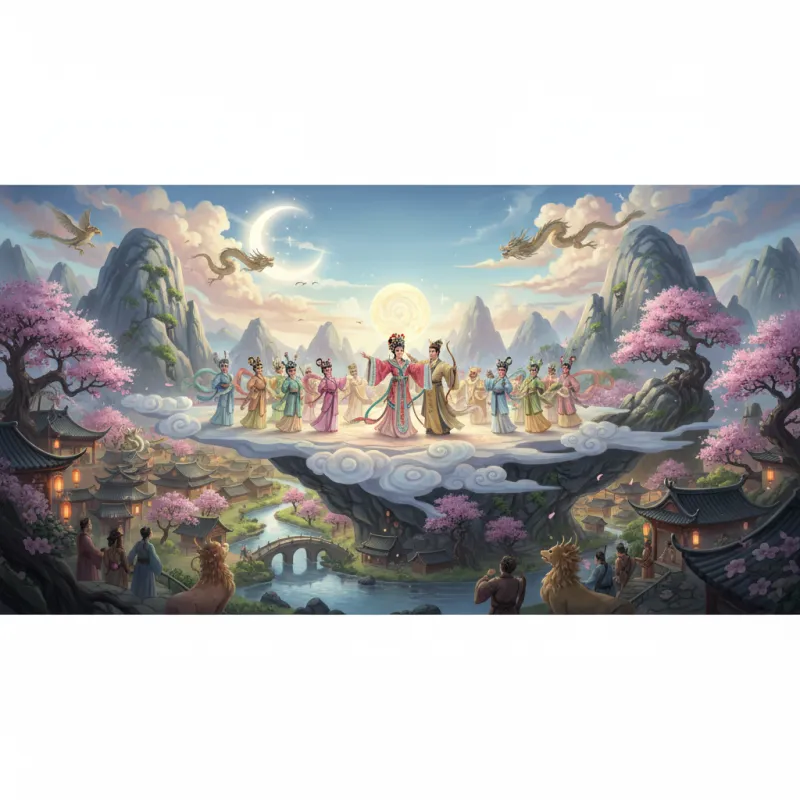
The painted face emerges from behind the silk curtain—half white, half red, with sweeping black eyebrows that curve like swallow's wings. Before a single note is sung, the audience already knows: this is Cao Cao, the cunning strategist of the Three Kingdoms, and tonight's performance will be a battle of wits as much as swords. This is the power of Chinese opera (戏曲, xìqǔ), where a flick of a sleeve can mean betrayal, where a warrior's acrobatic flip tells you he's just leaped over a city wall, and where centuries of storytelling tradition compress into two hours of stylized perfection.
The Four Great Anhui Troupes and the Birth of Peking Opera
Chinese opera didn't spring fully formed from the imperial court—it was born in the provinces and refined through competition. The watershed moment came in 1790, when Emperor Qianlong's 80th birthday celebration brought four theatrical troupes from Anhui Province to Beijing. These troupes—Sanqing, Sixi, Chuntai, and Hechun—performed in the Anhui style, characterized by its erhuang and xipi musical modes. What happened next was pure cultural alchemy: the Anhui performers absorbed elements from Hubei's Han opera, incorporated Kunqu opera's refined singing techniques, and borrowed acrobatic moves from regional folk traditions. Within fifty years, this hybrid had evolved into what we now call Peking opera (京剧, jīngjù), though calling it "Peking" opera is almost misleading—it's really a greatest-hits compilation of Chinese theatrical traditions.
The genius of Peking opera lies in its role system. Every character fits into one of four main categories: sheng (生, male roles), dan (旦, female roles), jing (净, painted-face roles), and chou (丑, clown roles). But these categories splinter into dozens of subcategories. A laosheng is a dignified older man; a xiaosheng is a young scholar or warrior; a wusheng is a martial hero who spends more time flipping through the air than singing. The dan roles are even more specific: qingyi are virtuous women who sing in high, restrained voices; huadan are vivacious young women; daomadan are female warriors who wield swords with the same skill as their male counterparts. This isn't just typecasting—it's a sophisticated symbolic language that audiences learn to read.
Regional Opera: Beyond the Capital's Shadow
While Peking opera dominates international recognition, China's regional opera traditions tell a more complex story. Cantonese opera (粤剧, yuèjù) in Guangdong Province features faster-paced music and incorporates Western instruments like the saxophone—yes, really—into its orchestras. Sichuan opera (川剧, chuānjù) is famous for its face-changing technique (变脸, biànliǎn), where performers swap masks in the blink of an eye, a trick so closely guarded that masters traditionally only taught it to family members. Kunqu opera (昆曲, kūnqǔ), the oldest surviving form, is the classical music of Chinese opera—refined, slow, and so demanding that singers train for decades to master its ornate vocal techniques.
Each regional style reflects its geography and dialect. Yue opera (越剧, yuèjù) from Zhejiang Province—not to be confused with Cantonese opera, which uses the same pinyin—is performed entirely by women and specializes in romantic stories that make audiences weep. Henan opera (豫剧, yùjù) has a earthy, folk quality that mirrors the agricultural heartland where it developed. These aren't museum pieces; they're living traditions that still pack theaters in their home regions, though they face the same challenges as traditional Chinese festivals in maintaining relevance for younger generations.
The Language of Gesture and Symbol
Chinese opera operates on a principle of maximum meaning with minimum props. A table isn't just a table—depending on how actors use it, it becomes a mountain, a bridge, a bed, or a throne. An actor holding a whip and miming a riding motion is obviously on horseback; the audience doesn't need to see an actual horse. Four soldiers carrying flags with wheels painted on them represent an entire army. This symbolic vocabulary developed partly from practical necessity—traveling troupes couldn't haul elaborate sets—but it evolved into an aesthetic philosophy. The emptiness of the stage isn't a limitation; it's a canvas for imagination.
The costumes, however, are anything but minimal. A single opera robe might weigh twenty pounds, embroidered with dragons, phoenixes, and clouds in silk thread that catches the stage lights. The colors follow strict conventions: yellow for emperors, red for loyalty and righteousness, black for integrity and fierceness, white for treachery or mourning. The water sleeves (水袖, shuǐxiù)—those impossibly long white silk extensions—are performance tools in themselves. A skilled actor can make them ripple like water, snap like whips, or float like clouds, expressing emotions that words cannot capture. Watch a heartbroken concubine flick her water sleeves in despair, and you'll understand why Chinese opera survived for centuries without needing subtitles.
The Painted Face: Reading Character in Color
The painted faces (脸谱, liǎnpǔ) of jing roles are Chinese opera's most iconic visual element, and they're essentially character résumés written in color and pattern. Red faces indicate loyalty and courage—Guan Yu, the deified general from the Three Kingdoms, always appears with a red face. Black suggests integrity and fierceness; Bao Zheng, the incorruptible Song Dynasty judge, wears a black face with a white crescent moon on his forehead. White faces are reserved for treacherous characters—Cao Cao's white face tells you he's cunning and untrustworthy before he speaks a word. Blue and green indicate wild, untamed characters, often demons or bandits.
But the patterns matter as much as the colors. A face divided vertically down the middle suggests a character with two natures—perhaps someone who appears righteous but harbors dark intentions. Elaborate patterns with swirls and flourishes indicate supernatural beings or characters of extreme complexity. The Monkey King from Journey to the West gets a face that's part monkey, part divine being, with patterns that suggest both his trickster nature and his eventual enlightenment. These designs weren't arbitrary inventions; they evolved over centuries as performers experimented with ways to make characters instantly recognizable from the back row of a crowded theater.
Music, Movement, and the Martial Arts Connection
The music of Chinese opera sounds alien to Western ears at first—the jinghu (京胡, a two-stringed fiddle) produces a high, piercing sound that cuts through the percussion, while the rhythmic patterns follow Chinese poetic meters rather than Western musical scales. But there's method in what seems like chaos. The music doesn't just accompany the action; it structures it. Specific percussion patterns signal entrances, exits, battles, and emotional states. The ban (板, wooden clappers) and gu (鼓, drum) create rhythmic frameworks that actors use to time their movements with split-second precision.
The acrobatic elements in Chinese opera share DNA with martial arts—not surprising, since many opera performers trained in kung fu, and many martial artists performed in opera troupes. The connection runs deeper than shared techniques; both traditions emphasize the same principles of qi (气, vital energy), balance, and the transformation of the body into an expressive instrument. A wusheng performing a fight scene isn't just showing off athletic prowess; he's demonstrating martial philosophy through stylized movement. The slow-motion combat sequences, where opponents circle each other with exaggerated poses, aren't realistic—they're balletic representations of strategy and counter-strategy, making visible the mental chess game that precedes physical conflict.
Modern Challenges and Adaptations
Chinese opera faces an existential crisis in the 21st century. Young audiences raised on cinema and K-pop find the stylized movements and lengthy performances tedious. Training new performers takes a decade or more—students often begin at age seven or eight, spending years mastering basic techniques before they're allowed on stage. The economic reality is harsh: regional opera troupes struggle to fill seats, and many survive only through government subsidies. Some traditions, like certain regional opera styles, teeter on the edge of extinction, kept alive by a handful of elderly masters.
Yet adaptation is nothing new for Chinese opera—it's been reinventing itself for centuries. Contemporary directors experiment with modern staging, lighting, and even projections while maintaining traditional performance techniques. Some productions tackle current social issues, proving that the form can address modern concerns. The 2008 production of "The Drunken Concubine" at the Beijing Olympics introduced millions of viewers worldwide to Peking opera, demonstrating its visual power even without cultural context. Young performers are finding audiences on social media, posting short videos that showcase the art form's most spectacular moments—face-changing, acrobatics, elaborate costumes—in digestible formats.
The Living Tradition
What makes Chinese opera a "living art form" isn't just that performances continue—it's that the tradition still evolves, still argues with itself about what's essential and what can change. Purists insist on preserving every gesture exactly as it was performed a century ago. Reformers push for shorter performances, modern stories, and accessibility for audiences unfamiliar with the conventions. Both sides have a point. The symbolic language of Chinese opera—the gestures, the face paint, the musical patterns—represents centuries of accumulated artistic wisdom. But art that doesn't speak to its contemporary audience becomes archaeology, not culture.
Perhaps the future of Chinese opera lies in recognizing that it's always been a hybrid, always absorbed new influences while maintaining its core identity. Just as the Four Anhui Troupes created Peking opera by mixing regional styles, today's practitioners might create something new by thoughtfully incorporating modern elements. The challenge is doing so without losing what makes Chinese opera distinctive: its symbolic richness, its demand for virtuosity, its ability to compress epic stories into stylized gestures that speak across centuries. Like traditional Chinese calligraphy, Chinese opera is both an art form and a cultural memory, a way of preserving not just stories but an entire way of seeing and representing the world.
The painted face still emerges from behind the curtain, and if we've learned to read its language, we see not just a character but a tradition that has survived dynasties, revolutions, and the relentless churn of modernity. That's the real performance—not just what happens on stage, but the ongoing negotiation between preservation and innovation, between honoring the past and speaking to the present.
Related Reading
- Chinese Calligraphy: The Five Major Styles
- Chinese Calligraphy: Why Writing Is Considered the Highest Art Form
- Chinese Calligraphy for Beginners: The Art of the Brush
- The Chinese Tea Ceremony: Finding the Dao in Every Cup
- Traditional Chinese Music: Instruments, Scales and Soul
- The Dragon in Chinese Culture: Power and Good Fortune
- Exploring the Rich Tapestry of Chinese Folklore, Legends, and Fairy Tales
Explore Chinese Culture
- Explore feng shui in daily life
- Explore supernatural folklore
- Explore classical Chinese literature