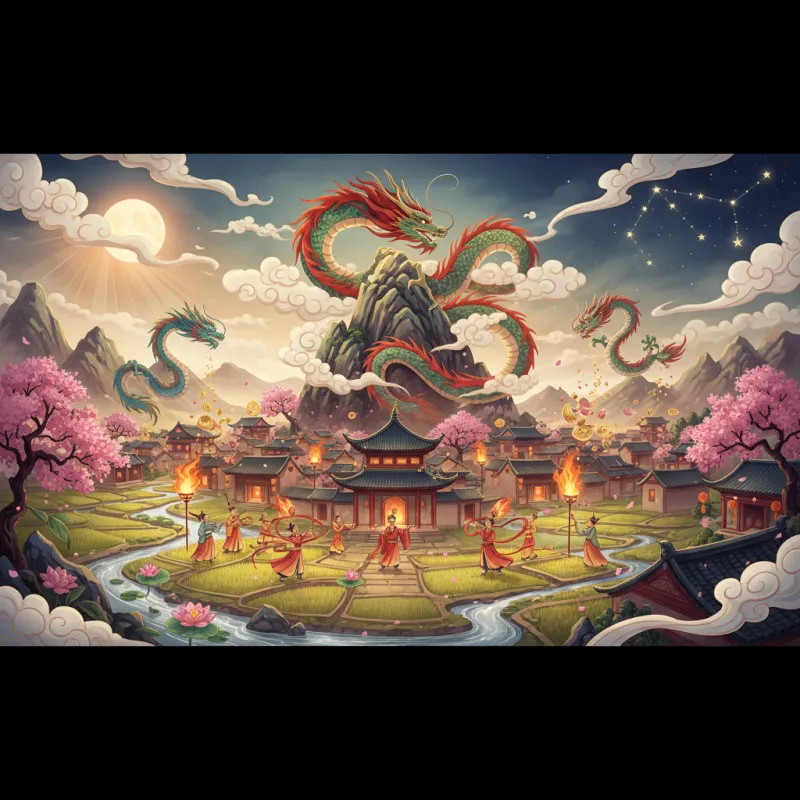
A peasant farmer kneeling in parched fields, eyes turned skyward, whispers a prayer not to any god but to a serpentine creature coiling through the clouds. When rain finally comes, he doesn't thank heaven—he thanks the dragon. This scene, repeated across millennia in countless Chinese villages, reveals something profound: the dragon isn't just a symbol in Chinese culture. It's a living presence that has shaped everything from imperial succession to the price of rice.
The Composite Beast: Assembling Divinity
The Chinese dragon—龙 (lóng)—didn't emerge fully formed from ancient imagination. Archaeological evidence from the Hongshan culture (4700-2900 BCE) shows jade dragons that predate written Chinese history, but the creature we recognize today was assembled piece by piece, like a divine puzzle. The Han dynasty scholar Wang Fu documented this in his Lunheng (论衡), describing the dragon as having "the horns of a deer, the head of a camel, the eyes of a demon, the neck of a snake, the belly of a clam, the scales of a carp, the claws of an eagle, the paws of a tiger, and the ears of an ox."
This wasn't random. Each feature carried meaning. The carp scales referenced the legend of fish leaping through the Dragon Gate at the Yellow River's rapids—a metaphor for scholars passing imperial examinations that still resonates today. The deer antlers suggested longevity and gentleness despite power. Ancient Chinese weren't creating a monster; they were building a philosophical statement about balanced authority.
The Yangshao culture (5000-3000 BCE) left us painted pottery with dragon-like creatures, but these early versions were simpler, more serpentine. By the Shang dynasty (1600-1046 BCE), oracle bone inscriptions show the character for dragon had stabilized, and bronze vessels featured elaborate dragon motifs that clearly served ritual purposes. The dragon was becoming institutionalized, moving from folk belief into state religion.
The Imperial Dragon: Five Claws and Absolute Power
Walk into Beijing's Forbidden City and count the dragon motifs. You'll give up around three thousand. The imperial dragon—specifically the five-clawed wulong (五爪龙)—became so intertwined with imperial authority that wearing dragon robes without permission meant execution. This wasn't metaphorical. During the Qing dynasty, a merchant named Wang Lun was beheaded in 1774 for embroidering five-clawed dragons on theatrical costumes.
The distinction mattered intensely. Five claws belonged exclusively to the emperor. Four-clawed dragons (mang, 蟒) could be worn by princes and high nobles. Three claws were for lower officials. This sartorial hierarchy reflected the cosmic order: the emperor was the "Son of Heaven" (天子, tiānzǐ), and the dragon was his zoological manifestation on earth. When Emperor Qin Shi Huang unified China in 221 BCE, he didn't just claim political authority—he claimed to be the dragon incarnate.
The Huangdi Neijing (黄帝内经), the foundational text of Chinese medicine attributed to the Yellow Emperor, describes how the legendary ruler transformed into a dragon and ascended to heaven. This wasn't considered mythology by ancient readers—it was history. The line between human emperor and divine dragon was deliberately blurred, creating a political theology that lasted two millennia.
Dragons as Weather Makers: The Hydraulic Empire
China's agricultural civilization depended on predictable rainfall and controlled flooding. The dragon became the explanation and the solution. The Dragon King (龙王, lóngwáng) wasn't one entity but four—one for each sea—plus countless river and lake dragons. These weren't abstract symbols; they had names, temples, and specific jurisdictions. The Dragon King of the Eastern Sea, Ao Guang, appears in Journey to the West as a bureaucrat managing underwater palaces and weather patterns.
This belief system had practical consequences. When drought struck, emperors performed elaborate rituals at dragon temples, sometimes personally. The Rites of Zhou (周礼) from the Western Zhou period (1046-771 BCE) codified these ceremonies. If rain didn't come, the emperor's legitimacy suffered—the dragon had withdrawn its mandate. This created a feedback loop where political stability and weather patterns became inseparable in the popular imagination.
Village rain-making rituals often involved dragon dances, a tradition that evolved into the lion and dragon dances performed during Chinese New Year. But originally, these weren't entertainment. Communities would craft dragon effigies, parade them to rivers or wells, and sometimes submerge them, believing this would summon the dragon's attention. In severe droughts, they'd expose the dragon statue to scorching sun—essentially threatening the dragon with discomfort until it produced rain.
The Dragon Boat: Racing Against Death
The Dragon Boat Festival (端午节, Duānwǔ Jié) commemorates the poet-official Qu Yuan, who drowned himself in 278 BCE after his state of Chu fell to Qin. Locals raced out in boats, beating drums to scare fish away from his body. But the dragon connection runs deeper. The boats themselves, with their carved dragon heads and tails, were believed to be dragons. Racing them wasn't just memorial—it was sympathetic magic to awaken dragons from their winter slumber and ensure summer rains.
The festival falls on the fifth day of the fifth lunar month, considered the peak of yang energy when dragons were most active. People hung mugwort and calamus—plants with sword-like leaves—to ward off evil spirits, but also to honor dragons. Children wore silk pouches filled with fragrant herbs shaped like small dragons. Every element reinforced the dragon's presence in daily life.
Dragons in Literature: From Deity to Character
The dragon's literary evolution reveals changing Chinese attitudes toward authority. In the Classic of Mountains and Seas (山海经, Shānhǎi Jīng), compiled around the 4th century BCE, dragons are geographical features—creatures that inhabit specific mountains and rivers, neither wholly good nor evil. They simply exist, powerful and strange.
By the Tang dynasty (618-907 CE), dragons had become more anthropomorphized. In The Tale of Liu Yi, a scholar encounters a dragon princess tending sheep in human form, mistreated by her husband. When her uncle, the Qiantang Dragon King, learns of this, he unleashes devastating floods in revenge. The story treats dragons as an aristocratic family with recognizable emotions—pride, anger, familial loyalty—making them more relatable yet still dangerous.
Journey to the West (西游记), written by Wu Cheng'en in the 16th century, features multiple dragons, but they're bureaucrats and servants more than gods. The dragon-horse that carries the monk Xuanzang was originally a dragon prince punished for arson. This demotion of dragons from cosmic forces to flawed individuals mirrors the Ming dynasty's increasingly complex view of authority itself.
The Dragon and the Phoenix: Gendered Power
The pairing of dragon (male) and phoenix (female) became the ultimate symbol of marital harmony and imperial partnership, but this wasn't always the case. Early representations show dragons as gender-neutral or even female. The shift toward masculine dragons coincided with increasingly patriarchal social structures during the Han dynasty.
The empress wore phoenix robes while the emperor wore dragons, creating a complementary duality. Wedding chambers were decorated with dragon-phoenix motifs, suggesting that ordinary couples could embody this cosmic balance. Yet the hierarchy was clear: the dragon represented yang (active, heavenly, masculine), while the phoenix represented yin (receptive, earthly, feminine). This gendered symbolism reinforced social structures while providing a romantic ideal.
Interestingly, in southern Chinese folk traditions, particularly among the Hakka people, female dragons appear more frequently, suggesting regional variations that resisted imperial standardization. The Dragon Mother (龙母, Lóngmǔ) temples in Guangdong province honor a woman who raised five dragon children, reversing the typical gender dynamics.
Modern Dragons: From Mao Suits to Mascots
When the People's Republic of China was established in 1949, the dragon faced an identity crisis. Communist ideology rejected feudal symbols, and some intellectuals argued the dragon represented backward superstition. For decades, dragon imagery was suppressed in official contexts, though it persisted in folk celebrations.
The rehabilitation began in the 1980s as China opened economically. The dragon was rebranded as a symbol of Chinese civilization itself, stripped of imperial associations. The 2008 Beijing Olympics featured dragon imagery extensively, presenting it to the world as cultural heritage rather than political symbol. Today, Chinese people call themselves "descendants of the dragon" (龙的传人, lóng de chuánrén), a phrase popularized by a 1978 song that became an unofficial anthem.
Yet tensions remain. In 2006, some Chinese scholars proposed replacing the dragon with the panda as China's national symbol, arguing that Western associations with dragons were too negative. The proposal was overwhelmingly rejected by the public, revealing how deeply the dragon remains embedded in Chinese identity despite—or perhaps because of—its complex history.
The Dragon's Breath: Living Symbolism
Stand in any Chinese community during New Year celebrations and you'll see the dragon isn't historical artifact—it's living culture. The dragon dance requires a team of performers manipulating a long, flexible dragon body on poles, creating the illusion of serpentine movement. The lead dancer, controlling the head, must be skilled and strong; the dragon's vitality depends on human coordination, a perfect metaphor for how Chinese culture views the relationship between symbol and society.
The dragon appears on everything from corporate logos to tattoos, from architecture to children's toys. It's been commercialized, certainly, but also democratized. What was once exclusive to emperors now belongs to everyone. A street vendor can sell dragon-shaped pastries without fear of execution. This transformation from imperial monopoly to public property represents a fundamental shift in Chinese society itself.
The dragon endures because it's adaptable. It survived the transition from shamanic cultures to Confucian bureaucracy, from imperial dynasties to communist revolution, from isolated civilization to global power. Each era reinterprets the dragon according to its needs, yet something essential remains: the dragon represents aspiration, the possibility of transformation, the hope that power can be benevolent. Whether that hope is justified is another question entirely, but the symbol persists, coiling through Chinese culture like water through ancient channels, shaping everything it touches.
Related Reading
- The Chinese Zodiac: All 12 Animals Explained
- Jade in Chinese Culture: The Stone of Heaven
- Legendary Heroes of Chinese Folklore: Tales That Shaped Culture and Identity
- Chinese Cinema: An Essential Guide for Film Lovers
- Tai Chi for Beginners: Your First Steps into Moving Meditation
Explore Chinese Culture
- Explore feng shui in daily life
- Explore supernatural folklore
- Explore classical Chinese literature