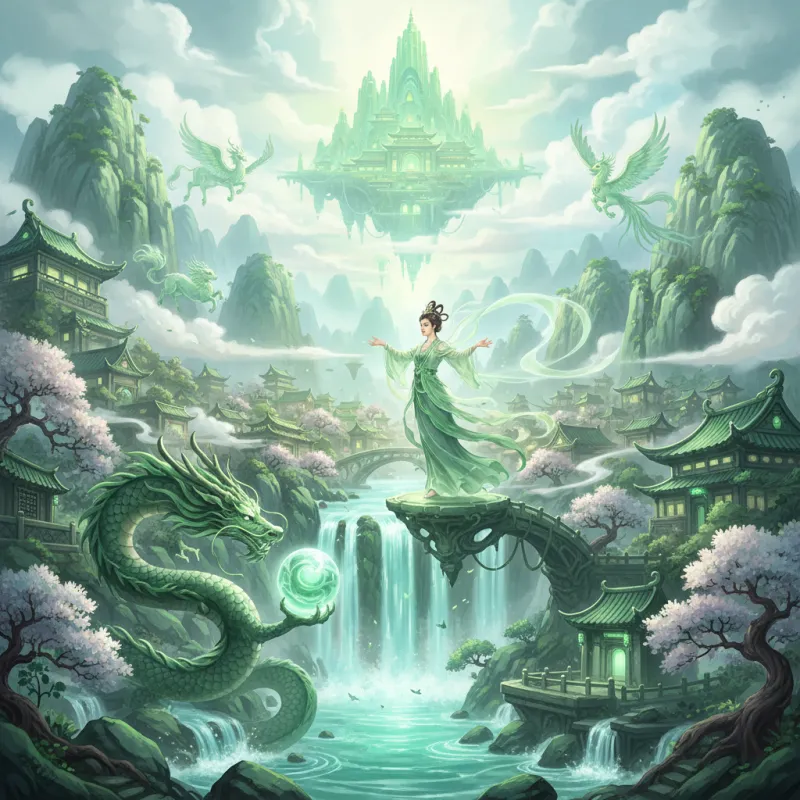
A Qing dynasty emperor once declared he would rather die without gold than live without jade. This wasn't mere poetic flourish—it was a statement about the soul of Chinese civilization itself. For over 8,000 years, jade (玉, yù) has occupied a position in Chinese culture that no Western gemstone can match. It's not just precious; it's sacred. It's not just beautiful; it's moral. And unlike diamonds or rubies, jade's value has never been about rarity or sparkle—it's about what the stone represents in the human heart.
The Neolithic Origins: When Jade Became Divine
The story begins in the mists of prehistory, around 6000 BCE, when Neolithic communities along the Yangtze River began shaping this tough stone into ritual objects. The Hongshan culture (4700-2900 BCE) in northeastern China created the first jade dragons—coiled, pig-faced creatures that would become China's most enduring symbol. But it was the Liangzhu culture (3300-2300 BCE) that elevated jade to its celestial status.
Liangzhu artisans crafted the bi (璧, bì)—flat discs with circular holes—and the cong (琮, cóng)—square tubes with circular inner channels. These weren't decorative trinkets. The bi represented heaven (round, infinite, encompassing), while the cong symbolized earth (square, stable, bounded). When Liangzhu elites were buried, they wore jade suits and were surrounded by hundreds of jade pieces. The message was clear: jade was the material that bridged the mortal and divine realms.
What's remarkable is that these cultures had no metal tools. Carving jade—one of the hardest stones known—required sand, water, bamboo, and extraordinary patience. A single cong might take years to complete. This labor wasn't just craft; it was devotion.
Confucius and the Eleven Virtues
By the time Confucius (551-479 BCE) walked the earth, jade had already been revered for millennia. But Confucius did something transformative: he made jade a moral teacher. In the Book of Rites (《礼记》, Lǐjì), he identified eleven virtues embodied in jade's physical properties.
Its luster represents benevolence (仁, rén). Its translucency shows sincerity (诚, chéng). Its hardness demonstrates wisdom (智, zhì). Its resistance to breaking symbolizes courage (勇, yǒng). The way it hangs straight reflects righteousness (义, yì). When struck, jade produces a clear, lingering tone—this is music, harmony, the proper ordering of society.
This wasn't metaphorical thinking; it was a complete philosophy. A gentleman (君子, jūnzǐ) should be like jade: beautiful but not flashy, strong but not brittle, valuable but not arrogant. The saying "宁为玉碎,不为瓦全" (nìng wéi yù suì, bù wéi wǎ quán)—"better to be shattered jade than intact pottery"—captures this perfectly. Integrity matters more than survival.
This moral dimension explains why jade, unlike gold, was never merely about wealth. Emperors wore jade seals not because jade was expensive, but because it represented the mandate of heaven. Scholars wore jade pendants not to show off, but to remind themselves of virtue. Even today, when Chinese parents give jade to their children, they're not just giving jewelry—they're passing down an ethical inheritance.
The Imperial Obsession: Jade as Political Power
The Han dynasty (206 BCE - 220 CE) took jade reverence to its logical extreme: the jade burial suit. When Prince Liu Sheng died in 113 BCE, his body was encased in 2,498 jade plates sewn together with gold thread. His wife received a similar suit with 2,160 plates. The belief was that jade's incorruptible nature would preserve the body for eternity, allowing the soul to achieve immortality.
This wasn't superstition—it was state ideology. The emperor's jade seal, carved from the legendary Heirloom Seal of the Realm (传国玉玺, chuánguó yùxǐ), legitimized dynastic rule. When the seal was lost during the chaos of the Five Dynasties period, subsequent emperors felt their authority was incomplete. The Qing dynasty's Qianlong Emperor (r. 1735-1796) was so obsessed with jade that he wrote over 800 poems about it and commissioned countless jade carvings, many depicting scenes from classical literature.
The imperial workshops in Beijing employed thousands of jade carvers. The most prized material was Hetian jade (和田玉, Hétián yù) from Xinjiang, transported along the Silk Road at enormous expense. White jade with a slight yellow tint—"mutton-fat jade" (羊脂玉, yángzhī yù)—was reserved exclusively for the emperor. To possess such jade without imperial permission was treason.
Jade in Daily Life: From Amulets to Aesthetics
But jade wasn't just for emperors and philosophers. Ordinary people wore jade amulets for protection, gave jade bracelets to daughters as dowries, and placed jade cicadas (玉蝉, yù chán) in the mouths of the deceased to ensure rebirth. The cicada, which emerges from underground after years of dormancy, symbolized resurrection—a hope carved in stone.
Chinese medicine incorporated jade into treatments, believing it could balance qi (气, qì) and promote longevity. Jade pillows, jade massage tools, and jade-infused water were all part of traditional wellness practices. Whether these had physical benefits is debatable, but the psychological comfort was real. Jade was believed to grow more lustrous when worn by a virtuous person and to crack or shatter when warning its owner of danger.
The aesthetic appreciation of jade developed its own vocabulary. Collectors speak of "water" (水头, shuǐtóu)—the stone's translucency—and "seed" (种, zhǒng)—its texture and crystalline structure. A piece with good water seems to glow from within, as if containing liquid light. This quality can't be manufactured or faked, which is why true jade connoisseurs spend decades training their eyes.
The Modern Paradox: Tradition Meets Market
Today's jade market is a fascinating collision of ancient values and modern commerce. In Hong Kong and Beijing auction houses, imperial jade pieces sell for millions of dollars. A single Qing dynasty jade seal recently fetched $21 million. Meanwhile, in Guangzhou's jade markets, vendors sell everything from genuine antiques to convincing fakes, and tourists struggle to tell the difference.
The Chinese government has tried to regulate the jade trade, but the cultural demand is too strong. When the Beijing Olympics needed a design for medals, they embedded jade discs in the center—the first time in Olympic history that medals incorporated a precious stone. The symbolism was deliberate: China was announcing its return to global prominence through its most ancient symbol.
Yet there's a darker side. The demand for Burmese jade (Myanmar supplies 90% of the world's high-quality jade) has fueled conflict and environmental destruction. Illegal mining operations scar mountainsides, and the profits fund armed groups. The jade trade, once a symbol of virtue, now involves some decidedly unvirtuous practices.
Why Jade Still Matters
In an age of lab-grown diamonds and synthetic gemstones, jade remains stubbornly authentic. You can't manufacture its history or replicate its cultural weight. When a Chinese grandmother gives her granddaughter a jade bangle, she's not just giving a pretty object—she's connecting that child to 8,000 years of civilization, to Confucian ethics, to the belief that beauty and goodness are inseparable.
This is why jade appears in Chinese idioms and proverbs more than any other material. "抛砖引玉" (pāo zhuān yǐn yù)—"throw a brick to attract jade"—means to offer something modest to elicit something valuable. "金玉良言" (jīn yù liáng yán)—"golden-jade good words"—describes precious advice. The language itself is saturated with jade.
Compare this to Western gemstone culture, where diamonds symbolize love (thanks to a 20th-century marketing campaign) and rubies represent passion. These are emotional associations, not philosophical ones. Jade asks deeper questions: What does it mean to be incorruptible? How should a person of integrity behave? Can an object teach virtue?
The Living Tradition
Walk through any Chinese jewelry store today, and you'll see jade in every form: pendants carved with dragons and phoenixes, bangles in every shade from white to deep green, Buddha figures, zodiac animals, and abstract designs. Young Chinese professionals wear jade alongside their Apple Watches. Elderly women never remove their jade bracelets, believing they've absorbed decades of their life force.
The tradition adapts but doesn't disappear. Contemporary jade artists create pieces that blend ancient symbolism with modern aesthetics. Some carve jade using traditional hand tools, maintaining techniques unchanged for millennia. Others use computer-aided design and precision cutting, creating works their ancestors couldn't have imagined—yet the cultural meaning remains.
This is jade's true power: it connects past and present, material and spiritual, individual and civilization. It's not the stone of heaven because it's rare or beautiful, though it's both. It's the stone of heaven because for 8,000 years, Chinese culture has looked at this tough, lustrous mineral and seen a reflection of its highest ideals. In a world of constant change, jade endures—not despite its ancient associations, but because of them.
For more on Chinese cultural symbols, explore The Dragon in Chinese Mythology and The Phoenix: Symbol of Renewal.
Related Reading
- The Dragon in Chinese Culture: Power and Good Fortune
- The Chinese Zodiac: All 12 Animals Explained
- Legendary Flavors: Exploring Chinese Food Folklore and Timeless Culinary Traditions
- Why Chinese Food Tastes Different in China: A Culinary Reality Check
- Exploring the Enigmatic World of Chinese Animal Tales and Their Cultural Significance
Explore Chinese Culture
- Explore feng shui in daily life
- Explore supernatural folklore
- Explore classical Chinese literature