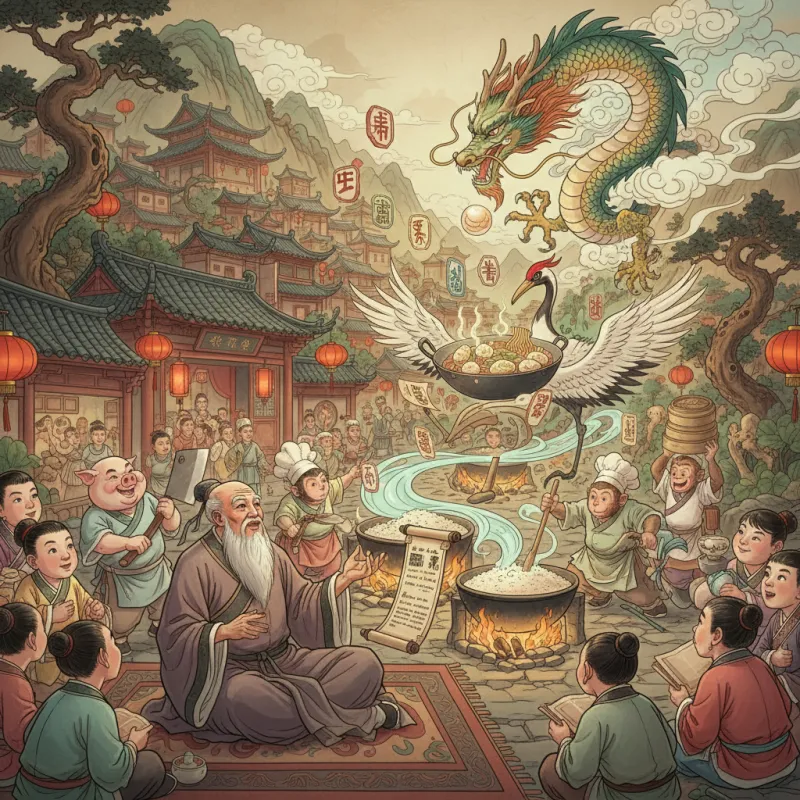
The emperor's chef trembled as he presented his creation—a simple bowl of tofu that would either save his life or end it. Legend says this moment, repeated in countless variations across Chinese history, gave birth to dishes that still grace tables today. In Chinese culinary tradition, nearly every beloved food carries a story, and these tales reveal far more than recipes: they expose the soul of a civilization that has always understood food as poetry, medicine, politics, and magic rolled into one.
When Food Becomes Legend
Chinese food folklore operates on a principle Western cuisine rarely embraces: the belief that a dish's story matters as much as its flavor. Take Dongpo Pork (东坡肉, dōngpō ròu), that melt-in-your-mouth braised pork belly. It's named after Su Dongpo, the Song Dynasty poet-official who supposedly invented it while exiled in Huangzhou around 1080 CE. The folklore claims Su, ever the optimist, turned his poverty into creativity by slow-cooking cheap pork cuts with wine and minimal seasoning. But here's what makes it legendary: the dish embodies Su's philosophy that life's constraints breed innovation. Every bite carries that narrative weight.
This pattern repeats endlessly. Mapo Tofu (麻婆豆腐, mápó dòufu) allegedly comes from a pockmarked (ma) old woman (po) in Qing Dynasty Chengdu who fed laborers with whatever she had—tofu, ground meat, and tongue-numbing Sichuan peppercorns. Buddha Jumps Over the Wall (佛跳墙, fó tiào qiáng), that extravagant Fujian soup, earned its name from a tale about a monk so seduced by the aroma that he leapt over the monastery wall, breaking his vows. These aren't just origin stories—they're moral lessons, social commentaries, and memory devices that ensure recipes survive generations.
The Dragon, the Phoenix, and Your Dinner Plate
Chinese food symbolism draws heavily from mythology, and nowhere is this clearer than in the dragon-phoenix dynamic that governs formal cuisine. Dragon (龙, lóng) represents yang energy, masculinity, and imperial power—typically symbolized by seafood, especially lobster or fish. Phoenix (凤, fèng) embodies yin energy, femininity, and grace—represented by chicken. At traditional weddings, you'll still find Dragon and Phoenix dishes served together, a culinary yin-yang that promises marital harmony.
But the symbolism goes deeper. The Eight Immortals Crossing the Sea (八仙过海, bāxiān guò hǎi) is both a famous legend and a banquet dish featuring eight premium ingredients—each representing one of the Daoist immortals. Eating it isn't just indulgence; it's invoking blessings from the celestial realm. Similarly, longevity noodles (长寿面, chángshòu miàn) must never be cut before eating because severing them symbolically cuts your lifespan short. My grandmother would literally scold anyone who broke their noodles, and she wasn't joking.
The folklore surrounding Chinese festival foods takes this further, linking specific dishes to cosmic events and seasonal transitions. Mooncakes during Mid-Autumn Festival carry hidden messages—literally, as the legend goes, since rebels used them to coordinate the overthrow of Mongol rule in the 14th century.
Imperial Kitchens and Mythical Recipes
The Forbidden City's imperial kitchens employed over 6,000 staff at their peak, and the folklore surrounding palace cuisine borders on the fantastical. The Manchu-Han Imperial Feast (满汉全席, mǎn hàn quán xí), that legendary 108-dish marathon banquet, supposedly took three days to consume and required ingredients from across the empire. While historians debate whether it ever existed in that exact form, the myth itself shaped Chinese haute cuisine for centuries.
One persistent legend claims that certain imperial dishes granted longevity or virility. The Qing Dynasty Qianlong Emperor allegedly lived to 89 (remarkable for the 18th century) partly due to his daily consumption of bird's nest soup (燕窝, yànwō). Whether true or not, this belief drove bird's nest prices to astronomical levels and created an entire industry that persists today. The folklore became self-fulfilling: if emperors ate it for health, it must work, so everyone who could afford it followed suit.
Then there's the tale of Beggar's Chicken (叫化鸡, jiàohuā jī), supposedly invented when a starving thief stole a chicken but had no cooking equipment. He wrapped it in lotus leaves and clay, then buried it in hot coals. When a passing emperor smelled the aroma and tasted it, he declared it a delicacy. The story's probably apocryphal—it has too many convenient coincidences—but it illustrates how Chinese food folklore often elevates peasant ingenuity to imperial status, suggesting that true culinary genius transcends class.
Regional Legends and Local Pride
Every Chinese province claims its cuisine is best, and each backs this claim with elaborate folklore. Sichuan insists its spicy food culture began when ancient settlers needed strong flavors to combat the region's dampness—a belief rooted in Traditional Chinese Medicine principles. Cantonese cuisine's reputation for eating "everything with four legs except tables" comes with stories of southern resourcefulness during famines and invasions.
Hangzhou's West Lake Vinegar Fish (西湖醋鱼, xīhú cù yú) carries a revenge tale: a woman whose husband was murdered by a local tyrant served the official this sweet-sour fish, reminding him through its contrasting flavors that justice would eventually balance the scales. Whether historically accurate or not, the story gives the dish emotional resonance that pure taste cannot achieve.
The folklore surrounding Chinese tea culture intersects with food legends constantly, since tea and food form an inseparable pair in Chinese dining philosophy. The legend of Tieguanyin tea's discovery involves a poor farmer, a dilapidated temple, and the goddess Guanyin appearing in a dream—a narrative structure that repeats across Chinese food folklore, suggesting divine intervention in culinary innovation.
Medicine, Magic, and the Kitchen
Chinese food folklore is inseparable from Traditional Chinese Medicine (TCM), which doesn't distinguish between food and medicine. The concept of "food therapy" (食疗, shíliáo) means every ingredient carries healing properties, and folklore reinforces this through countless tales of miraculous cures.
Goji berries (枸杞, gǒuqǐ) feature in legends about a village where everyone lived past 100, supposedly because they drank water from a well surrounded by goji plants. Ginseng (人参, rénshēn) folklore is even more elaborate, with stories of the root transforming into human form or glowing in the dark to reveal itself to worthy seekers. These aren't just quaint tales—they're marketing that has worked for millennia, making certain ingredients valuable beyond their nutritional content.
The folklore around "heating" and "cooling" foods shapes Chinese eating habits profoundly. Eating too much "hot" food (spicy, fried, or energetically yang) supposedly causes inflammation, acne, or irritability, while excessive "cold" food (raw vegetables, certain fruits) leads to digestive issues and lethargy. My mother still warns me about eating watermelon during menstruation because it's "too cold"—a belief passed down through generations of folklore, not medical textbooks.
Festivals, Feasts, and Folkloric Cycles
Chinese festival foods operate on a different level of folklore because they're tied to cosmic cycles and ancestral worship. Eating dumplings (饺子, jiǎozi) during Chinese New Year isn't just tradition—the folklore says their shape resembles ancient gold ingots, so consuming them attracts wealth. The more you eat, the richer you'll become. This belief is so ingrained that dumpling sales spike dramatically before the holiday, a testament to folklore's economic power.
Zongzi (粽子, zòngzi), those sticky rice parcels wrapped in bamboo leaves, commemorate the poet Qu Yuan's suicide in 278 BCE. Legend says villagers threw rice into the river to prevent fish from eating his body, and this evolved into the Dragon Boat Festival tradition. Every zongzi consumed carries that 2,300-year-old story, connecting modern eaters to ancient grief and loyalty.
The Lantern Festival's tangyuan (汤圆, tāngyuán)—sweet glutinous rice balls—symbolize family reunion because their round shape represents completeness and unity. Folklore warns that families who don't eat tangyuan together during the festival risk separation in the coming year. It's emotional blackmail through food, and it works brilliantly.
Living Legends in Modern Kitchens
What strikes me most about Chinese food folklore is its persistence. In an age of molecular gastronomy and fusion cuisine, Chinese grandmothers still refuse to cut longevity noodles, restaurants still serve whole fish (never flipped, because that symbolizes capsizing boats), and families still argue about the "correct" way to make dumplings based on regional folklore.
This isn't mere superstition—it's cultural continuity through cuisine. When a Shanghai family makes niangao (年糕, niángāo, New Year cake) because its name sounds like "higher year" (promising advancement), they're participating in wordplay-based folklore that's at least a thousand years old. When Cantonese restaurants serve lettuce (生菜, shēngcài) because it sounds like "growing wealth," they're keeping alive a tradition that treats language as magic and food as its medium.
The legends continue evolving too. Modern Chinese restaurants now create origin stories for fusion dishes, borrowing the folkloric template to give new creations instant tradition. It's folklore in real-time, proving that Chinese food culture hasn't stopped generating myths—it's just adding new chapters to an ancient book.
Chinese food folklore ultimately reveals a civilization that refuses to separate the practical from the poetic, the nutritional from the narrative. Every dish is a story, every meal a ritual, every flavor a connection to ancestors who believed that how you eat matters as much as what you eat. In a world increasingly dominated by fast food and convenience, these legends remind us that cuisine can be—should be—something more than fuel. It can be memory, meaning, and magic, all served on a single plate.
Related Reading
- Discovering the Rich Tapestry of Chinese Folklore: Myths, Legends, and Traditions
- The Art of War: Sun Tzu's Lessons Beyond the Battlefield
- The Chinese Zodiac: Complete Guide to the 12 Animals
Explore Chinese Culture
- Explore feng shui in daily life
- Explore supernatural folklore
- Explore classical Chinese literature