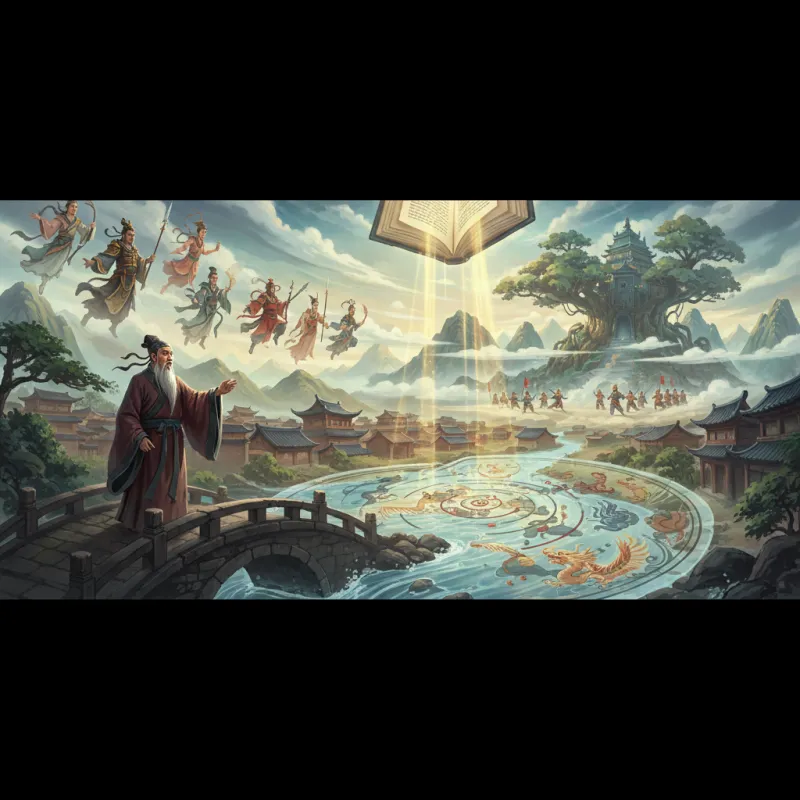
A general who has never lost a battle writes a book about war, and twenty-five centuries later, Silicon Valley founders are using it to plan product launches. Something got lost in translation — or maybe something profound got found. 孙子兵法 (Sūnzǐ Bīngfǎ, The Art of War) wasn't written for entrepreneurs or football coaches, but its principles have colonized every competitive domain imaginable. The question isn't whether Sun Tzu's wisdom applies beyond warfare. It's whether we're actually understanding what he meant in the first place.
The Man Who Wrote the Manual
孙武 (Sūn Wǔ, Sun Tzu) served as a general in the state of Wu during the Spring and Autumn period, around 512 BCE. The historical record is thin, but the legend is specific: King Helü of Wu tested Sun Tzu by asking him to train the royal concubines as soldiers. When the women laughed at his commands, Sun Tzu executed the king's two favorite concubines to demonstrate the principle of discipline. The remaining women performed flawlessly. The king, horrified but impressed, made him general.
Whether this story is true matters less than what it reveals about the text's philosophy. Sun Tzu wasn't interested in honor, glory, or martial virtue. He was interested in winning efficiently. His book is ruthlessly practical, almost cynical in its assessment of human nature and conflict. This is why it translates so well across contexts — and why it's so often misunderstood.
What the Text Actually Says
The Art of War is thirteen chapters of compressed strategic analysis. It's not inspirational. It's not particularly quotable out of context. The famous lines everyone knows — "All warfare is based on deception," "Appear weak when you are strong" — are tactical observations embedded in systematic thinking about resource management, terrain analysis, and organizational psychology.
Take the most quoted passage: 知己知彼,百战不殆 (Zhī Jǐ Zhī Bǐ, Bǎi Zhàn Bù Dài). The standard translation is "Know yourself and know your enemy, and you will not be imperiled in a hundred battles." But Sun Tzu immediately follows this with two more conditions: "If you know yourself but not the enemy, for every victory gained you will also suffer a defeat. If you know neither the enemy nor yourself, you will succumb in every battle." The structure is mathematical. It's a probability matrix, not a motivational slogan.
The text's genius lies in its systematic approach to uncertainty. Sun Tzu assumes you're operating with incomplete information, limited resources, and unpredictable opponents. His strategies are designed for real-world friction, not ideal conditions. This is why chapter eleven focuses entirely on terrain — not metaphorical terrain, but actual geographic features and how they constrain movement and supply lines. Modern readers skip this chapter because it seems too specific to ancient warfare. They're missing the point. Sun Tzu is teaching you to think about the physical constraints of your competitive environment, whatever that environment might be.
The Principle of 势 (Shì): Strategic Advantage
The concept that best captures Sun Tzu's thinking is 势 (shì), often translated as "strategic advantage" or "momentum." It refers to the configuration of forces that makes victory inevitable before the actual conflict begins. A boulder perched at the top of a hill has shì. It hasn't moved yet, but its potential energy is overwhelming.
Sun Tzu writes: "The quality of decision is like the well-timed swoop of a falcon which enables it to strike and destroy its victim." The falcon doesn't win through strength or courage. It wins through positioning, timing, and the physics of the dive. This is shì in action — creating conditions where success becomes natural rather than forced.
In business, shì might mean market positioning that makes competition irrelevant. In negotiations, it's structuring the conversation so your preferred outcome feels inevitable to all parties. In personal development, it's arranging your environment so good habits require less willpower than bad ones. The principle scales because it's about systems, not individual actions.
Why Corporate America Gets It Wrong
Walk into any business bookstore and you'll find a dozen books applying The Art of War to management, sales, and leadership. Most of them fundamentally misunderstand the text's core message: the best victory is the one you don't have to fight for.
Sun Tzu's ideal general wins without battle. He writes: "To subdue the enemy without fighting is the acme of skill." Corporate interpretations flip this into aggressive competition — outsmarting rivals, crushing competitors, dominating markets. They've turned a text about avoiding conflict into a manual for perpetual warfare.
The misreading stems from cultural context. Sun Tzu was writing during the Warring States period, when China was fragmented into competing kingdoms engaged in existential struggle. War was expensive, destructive, and often pointless. A general who could achieve political objectives without depleting the state's resources was invaluable. The text is fundamentally conservative — it's about preserving what you have while achieving what you need.
Modern business culture, especially in America, valorizes competition for its own sake. "Winning" becomes the goal rather than a means to an end. Sun Tzu would find this bizarre. He'd ask: What are you actually trying to accomplish? Is conflict necessary? What's the cost of victory versus the value of the objective?
The Chapters Nobody Reads
Chapter seven, "Maneuvering," contains some of the text's most sophisticated thinking, and it's almost never discussed in popular adaptations. Sun Tzu analyzes how armies communicate, maintain cohesion, and coordinate complex movements. He describes the use of gongs, drums, flags, and signals. He explains how to prevent soldiers from becoming separated or confused in the chaos of battle.
This seems archaic until you realize he's describing information systems and organizational communication. How does a large group of people act as a unified entity when individual members have limited visibility and understanding? How do you maintain strategic coherence when execution is distributed? These are the fundamental problems of any large organization, military or otherwise.
Similarly, chapter ten discusses terrain types and their strategic implications. Sun Tzu identifies six categories: accessible ground, entangling ground, temporizing ground, narrow passes, precipitous heights, and positions at a great distance from the enemy. Each type requires different tactics. The underlying lesson is about understanding the structure of your competitive environment and adapting your approach accordingly.
A tech startup operating in a mature market (narrow pass) needs different strategies than one creating a new category (accessible ground). A political campaign in a swing state (temporizing ground) faces different dynamics than one in a stronghold (precipitous heights). The specific terrain changes, but the analytical framework remains relevant.
Deception, Information, and the Fog of War
Sun Tzu's emphasis on deception troubles modern readers who want strategy to be about vision, leadership, and authentic communication. But his point isn't that you should lie constantly. It's that in competitive situations, information asymmetry is a decisive advantage.
"All warfare is based on deception" means that your opponent's decisions depend on their understanding of the situation, and their understanding is always incomplete. You can win by shaping what they know and what they think they know. This applies to poker, negotiations, product launches, and military campaigns.
The corollary is that you must resist being deceived. Sun Tzu emphasizes intelligence gathering, reconnaissance, and the use of spies. He devotes an entire chapter to the five types of spies and how to employ them. Modern readers find this distasteful, but the principle is sound: make decisions based on accurate information, not assumptions or wishful thinking.
In contemporary contexts, this might mean customer research, competitive analysis, or simply paying attention to what's actually happening rather than what you want to be happening. The number of businesses that fail because they didn't understand their market is a testament to how difficult this apparently simple principle is to execute.
The Paradox of Flexibility
One of Sun Tzu's most repeated ideas is that strategy must be flexible and adaptive. "Water shapes its course according to the nature of the ground over which it flows; the soldier works out his victory in relation to the foe whom he is facing." This sounds like obvious wisdom until you try to implement it in an organization that runs on processes, procedures, and predictable execution.
The paradox is that flexibility requires discipline. Water adapts to terrain because it follows physical laws consistently. An army can respond to changing circumstances because soldiers are trained to execute standard maneuvers reliably. The jazz musician can improvise because they've mastered scales and theory.
Sun Tzu isn't advocating chaos or making things up as you go. He's describing a system that's stable enough to function under pressure but not so rigid that it breaks when conditions change. This is extraordinarily difficult to achieve. Most organizations err toward either excessive rigidity (we've always done it this way) or excessive flexibility (every situation is unique, there are no rules).
The solution, implied throughout the text, is to distinguish between principles and tactics. Principles are stable: understand your environment, conserve resources, create advantageous positions, act decisively when the moment is right. Tactics are variable: the specific actions you take depend on circumstances. Confusing the two levels leads to either dogmatism or incoherence.
What Sun Tzu Didn't Write About
The Art of War is notably silent on certain topics that modern readers expect from strategy texts. There's almost nothing about motivation, morale, or inspiring troops beyond basic discipline and clear communication. There's no discussion of personal development, character building, or the warrior's inner journey. Sun Tzu treats soldiers as resources to be managed, not individuals to be transformed.
This absence is revealing. Sun Tzu assumes you're operating in a context where people will do what they're told if the system is designed correctly. He's not interested in leadership charisma or emotional connection. He's interested in structure, incentives, and information flow. This makes the text feel cold to modern readers raised on leadership literature that emphasizes vision, values, and authentic connection.
But perhaps this is precisely why the text has endured. By stripping away the cultural specifics of motivation and meaning, Sun Tzu created a framework that works across contexts. The principles apply whether you're commanding conscripts in ancient China, managing knowledge workers in Silicon Valley, or coordinating volunteers in a political campaign. The human elements — how you actually get people to care and commit — you have to figure out yourself.
Reading Sun Tzu in the 21st Century
The Art of War remains relevant not because ancient Chinese wisdom is timeless, but because competitive dynamics follow patterns that transcend specific contexts. Resources are always limited. Information is always incomplete. Opponents are always adapting. These constraints create strategic problems that recur across domains.
The text's value lies in its analytical framework, not its specific prescriptions. Sun Tzu teaches you to think systematically about competition, to see patterns in chaos, to distinguish between what you can control and what you can't. These are learnable skills, not mystical insights.
But reading Sun Tzu productively requires resisting the urge to extract quotable wisdom and actually engaging with the systematic thinking. The chapters on terrain and maneuvering aren't less important than the famous quotes about deception and knowing your enemy. They're the foundation that makes those quotes meaningful.
The best way to read The Art of War is slowly, with attention to structure and argument rather than memorable phrases. Ask what problem Sun Tzu is solving in each chapter. Notice how concepts build on each other. Consider how the principles might apply to your specific situation without forcing the analogy. The text rewards careful study in a way that skimming for inspiration never will.
Twenty-five centuries after Sun Tzu wrote his manual for generals, we're still trying to figure out how to compete effectively without destroying ourselves in the process. The book every CEO quotes and few actually understand might be worth understanding after all. Not because it contains secret wisdom, but because it offers a disciplined way of thinking about problems that haven't changed as much as we'd like to believe.
Related Reading
- The Dao De Jing: Key Concepts for Modern Life
- Confucianism, Daoism, Buddhism: The Three Pillars of Chinese Thought
- Chinese Proverbs and Their Stories: Wisdom in Four Characters
- Chinese Wisdom Literature: The Proverbs That Run a Civilization
- Martial Arts Films: A History of Flying Fists and Hidden Meaning
- The Sacred Mountains of China: Where Heaven Meets Earth
- Mencius on Human Nature: Are We Born Good?
Explore Chinese Culture
- Explore feng shui in daily life
- Explore supernatural folklore
- Explore classical Chinese literature