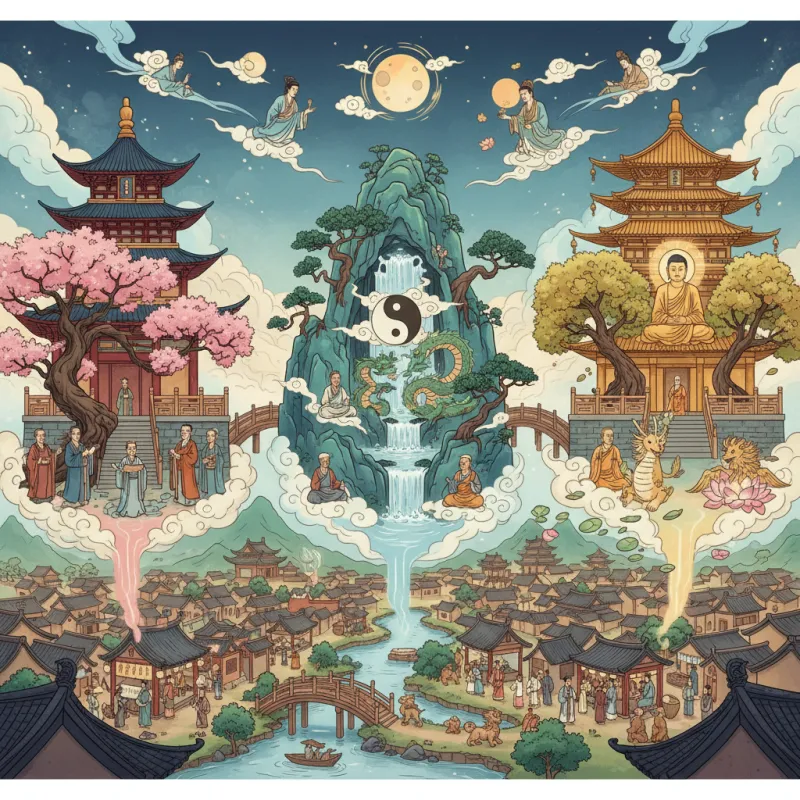
A scholar-official wakes before dawn in Tang Dynasty Chang'an. He performs Confucian rituals honoring his ancestors, practices Daoist breathing exercises in his garden, then meditates on Buddhist sutras before heading to the imperial court. His colleagues would find nothing contradictory in this routine. In fact, they'd probably do the same. This is the genius of Chinese philosophical synthesis—where the West saw competing religions demanding exclusive loyalty, China saw complementary systems addressing different aspects of being human.
The Three Pillars That Built a Civilization
The Chinese spiritual landscape rests on three foundations: 儒学 (Rúxué, Confucianism), 道教 (Dàojiào, Daoism), and 佛教 (Fójiào, Buddhism). Each emerged from different circumstances and offered distinct solutions to life's fundamental questions. Confucianism arose during the chaos of the Spring and Autumn period (770-476 BCE) as a blueprint for social harmony. Daoism developed as a counterweight to Confucian rigidity, celebrating spontaneity and natural rhythms. Buddhism arrived from India around the 1st century CE, bringing sophisticated metaphysics and the promise of liberation from suffering.
What makes the Chinese approach remarkable isn't the coexistence of these three traditions—plenty of cultures have religious pluralism. It's the deliberate integration captured in the concept of 三教合一 (Sān Jiào Hé Yī, "Three Teachings Unite as One"). This wasn't political compromise or philosophical laziness. It was the recognition that human life operates on multiple registers simultaneously, and no single system could address them all.
Confucianism: The Architecture of Social Life
Confucius (551-479 BCE) wasn't interested in gods, afterlives, or mystical experiences. When a disciple asked about serving spirits, he replied: "If you cannot serve people, how can you serve spirits?" His focus was ruthlessly practical: how do we create a society where people treat each other decently? His answer was 仁 (rén, humaneness) expressed through 礼 (lǐ, ritual propriety) within the framework of 五伦 (wǔlún, the Five Relationships): ruler-subject, father-son, husband-wife, elder-younger, friend-friend.
This sounds authoritarian to modern ears, but Confucius was actually quite radical. He insisted that rulers earned legitimacy through virtue, not birth. He opened education to anyone willing to learn, not just aristocrats. The Analects record him teaching everyone from peasants to princes, judging them by character rather than class. His vision was meritocratic—government positions should go to the most capable and ethical, determined through the imperial examination system that would eventually dominate Chinese bureaucracy for over a millennium.
Confucianism became the operating system of Chinese society. It structured family life, government administration, education, and social interaction. When you bowed to your elders, deferred to your teacher, or studied for the civil service exams, you were performing Confucianism. It was the public face you wore in the world, the ethical framework for navigating social obligations. As the saying goes: 修身齐家治国平天下 (xiū shēn qí jiā zhì guó píng tiānxià)—"Cultivate yourself, regulate your family, govern the state, bring peace to the world." Personal cultivation wasn't separate from political order; it was the foundation.
Daoism: The Art of Going With the Flow
If Confucianism built the structure of Chinese civilization, Daoism was the escape hatch. The Daodejing, attributed to the possibly-mythical Laozi, opens with a paradox: "The Dao that can be spoken is not the eternal Dao." Where Confucius offered detailed prescriptions for proper behavior, Daoism pointed toward something ineffable—the 道 (Dào), the underlying pattern or "way" of the universe that precedes and transcends human categories.
The Daoist ideal is 无为 (wúwéi), often translated as "non-action" but better understood as "effortless action" or "action in accordance with nature." Think of water flowing around obstacles rather than confronting them directly. The Daodejing says: "The softest things in the world overcome the hardest things in the world." This wasn't passivity—it was strategic yielding, knowing when to advance and when to retreat, when to speak and when to remain silent.
Daoism gave Chinese culture its appreciation for spontaneity, naturalness, and the limits of human control. It inspired landscape painting that depicted humans as tiny figures dwarfed by mountains and mist, reminding viewers of their place in the cosmic order. It developed 养生 (yǎngshēng, "nourishing life") practices—breathing exercises, dietary regimens, sexual techniques, and eventually internal alchemy aimed at cultivating 气 (qì, vital energy) and achieving longevity or even immortality. When Confucian officials retired from public life, they often "returned to the mountains" to pursue Daoist cultivation, shedding social masks to reconnect with their authentic nature.
The relationship between Confucianism and Daoism was complementary rather than contradictory. Confucianism governed your public persona; Daoism nurtured your private self. One was yang, the other yin. The scholar-official who spent his days enforcing ritual propriety might spend his evenings composing poetry about wine and moonlight, channeling the Daoist poet Li Bai rather than the Confucian bureaucrat he was by day.
Buddhism: The Technology of Mind
Buddhism arrived in China during the Han Dynasty, probably via the Silk Road, bringing something neither Confucianism nor Daoism offered: a systematic analysis of consciousness and a path to liberation from suffering. The Four Noble Truths diagnosed the human condition—life involves suffering (苦, kǔ), suffering arises from craving (爱, ài), suffering can cease, and there's a path to that cessation. The Eightfold Path provided the method: right view, right intention, right speech, right action, right livelihood, right effort, right mindfulness, right concentration.
Early Chinese intellectuals struggled with Buddhist concepts. Reincarnation seemed to contradict Confucian ancestor worship—if your parents were reborn as someone else, whom were you honoring? Monastic celibacy violated the Confucian duty to produce heirs. The Buddhist emphasis on individual enlightenment clashed with Confucian social obligations. But rather than rejecting Buddhism, Chinese thinkers adapted it, creating distinctly Chinese schools like Chan (禅, Chán, later known as Zen in Japan) that synthesized Buddhist meditation with Daoist spontaneity.
Chan Buddhism's famous koans—paradoxical questions like "What is the sound of one hand clapping?"—were designed to short-circuit rational thought and trigger direct insight. This approach resonated with Daoism's distrust of language and logic. Meanwhile, Pure Land Buddhism (净土宗, Jìngtǔ Zōng) offered salvation through faith in Amitabha Buddha, making Buddhism accessible to ordinary people who couldn't spend years in meditation. The Lotus Sutra's teaching that all beings possess Buddha-nature aligned with the Confucian belief in human perfectibility and the Daoist sense of underlying unity.
Buddhism gave Chinese culture its most sophisticated vocabulary for discussing consciousness, karma, and the nature of reality. It introduced the concept of 因果 (yīnguǒ, cause and effect) that became central to Chinese moral reasoning. It provided rituals for the dead that complemented Confucian ancestor worship. And it offered something neither Confucianism nor Daoism emphasized: compassion (慈悲, cíbēi) as a fundamental virtue, embodied in figures like Guanyin (观音), the Bodhisattva of Compassion who became one of the most beloved deities in Chinese religion.
Three Teachings, One Life
The genius of Chinese philosophical synthesis is captured in the saying: "以儒治世,以道养生,以佛修心" (Yǐ Rú Zhì Shì, Yǐ Dào Yǎngshēng, Yǐ Fó Xiū Xīn)—"Use Confucianism to govern the world, Daoism to nourish life, Buddhism to cultivate the mind." This wasn't compartmentalization but integration. The three teachings addressed different dimensions of human experience: social relationships, physical vitality, and mental cultivation.
Consider how this played out in practice. A Ming Dynasty official might start his day with Confucian rituals—bowing to his ancestors, reviewing classical texts, preparing for administrative duties. At midday, he might practice Daoist breathing exercises or consult the Yijing (易经, Book of Changes) for guidance on a difficult decision. In the evening, he might meditate on Buddhist sutras or visit a temple to make offerings. None of this seemed contradictory because each practice served a different purpose.
The three teachings also balanced each other's excesses. Confucianism without Daoism became rigid formalism; Daoism without Confucianism became irresponsible escapism; Buddhism without the other two became world-denying nihilism. Together, they created a comprehensive worldview that was simultaneously socially engaged, naturally attuned, and spiritually sophisticated.
This synthesis wasn't always smooth. There were periods of conflict—Buddhist persecution during the Tang Dynasty, Neo-Confucian attacks on Buddhist "otherworldliness" during the Song Dynasty. But the overall trajectory was toward integration. By the Ming and Qing dynasties, the three teachings had become so intertwined that ordinary Chinese people often couldn't distinguish where one ended and another began. Temple complexes might house Confucian, Daoist, and Buddhist shrines side by side. Popular novels like Journey to the West featured characters from all three traditions working together.
The Three Teachings in Daily Life
Walk through any traditional Chinese neighborhood and you'll see the three teachings in action. The ancestral hall where families gather for New Year celebrations is Confucian. The shrine to the local earth god (土地公, Tǔdì Gōng) who protects the community is Daoist. The temple where people pray for good fortune and burn incense is often Buddhist, though it might also house Daoist immortals and Confucian worthies. People don't choose between them—they use all three as the situation demands.
This pragmatic approach extends to Chinese festivals, which often blend elements from all three traditions. The Mid-Autumn Festival combines Confucian family reunion, Daoist moon worship, and Buddhist offerings. The Qingming Festival (清明节, Qīngmíng Jié) honors ancestors (Confucian), celebrates spring's renewal (Daoist), and includes prayers for the deceased (Buddhist). Even Chinese New Year incorporates Confucian family obligations, Daoist cosmology, and Buddhist merit-making.
The three teachings also shaped Chinese arts and literature. Classical poetry often expressed Confucian social concerns through Daoist imagery, with Buddhist undertones about impermanence. Landscape painting depicted Confucian scholars in Daoist natural settings, contemplating Buddhist themes of emptiness and illusion. Martial arts combined Confucian discipline, Daoist energy cultivation, and Buddhist mental training—as seen in the Shaolin tradition that supposedly originated when the Buddhist monk Bodhidharma taught meditation techniques to Chinese monks who needed to stay awake during long meditation sessions.
Why the West Got It Wrong
Western scholars initially misunderstood Chinese religious life because they applied Christian categories to a fundamentally different system. Christianity demands exclusive loyalty—you can't be simultaneously Christian, Muslim, and Jewish. But Confucianism, Daoism, and Buddhism aren't competing religions in that sense. They're complementary systems addressing different aspects of human experience. Calling yourself a Confucian didn't preclude being a Daoist or Buddhist any more than being a parent precludes being a professional or a citizen.
This flexibility sometimes frustrated Western missionaries who wanted clear conversions. A Chinese person might happily attend Christian services while continuing to honor ancestors and visit Buddhist temples. From the Chinese perspective, Christianity was just another useful teaching that could be integrated with existing practices. From the missionary perspective, this was syncretism or incomplete conversion. The misunderstanding revealed fundamentally different assumptions about how religious and philosophical systems relate to each other.
The Chinese approach has advantages. It's less prone to religious warfare—if multiple paths are valid, there's less reason to fight over which is correct. It's more adaptable—you can adopt new ideas without abandoning old ones. And it's more psychologically realistic—humans are complex beings with multiple needs that no single system can fully address. The Confucian-Daoist-Buddhist synthesis recognized this complexity and built it into the culture's philosophical foundation.
The Three Teachings Today
Modern China has complicated this traditional synthesis. The Communist Party's official atheism and the Cultural Revolution's attack on "feudal superstitions" disrupted centuries of practice. Temples were destroyed, monks were persecuted, and traditional teachings were suppressed. Yet the three teachings proved remarkably resilient. As China opened up economically, they experienced a revival—temples were rebuilt, texts were republished, and practices were resumed.
Today's China presents a paradox. Officially atheist, it's experiencing a religious and philosophical renaissance. Confucianism has been rehabilitated as a source of "Chinese values" and social stability. Daoist practices like taiji and qigong are promoted for health and cultural preservation. Buddhism attracts educated urbanites seeking meaning beyond materialism. The government even sponsors Confucius Institutes worldwide to promote Chinese culture, though critics note the irony of a Communist regime championing a feudal philosopher.
The three teachings also influence the Chinese diaspora and global culture. Confucian emphasis on education and family shapes Asian-American communities. Daoist concepts like yin-yang and wuwei have entered Western vocabulary. Buddhist meditation has become mainstream in the West, often stripped of its religious context but retaining its psychological insights. The synthesis that shaped Chinese civilization for two millennia continues to evolve and spread, adapting to new contexts while maintaining its core insight: human life is multidimensional, and wisdom lies in honoring all its aspects.
The three pillars of Chinese thought—Confucianism, Daoism, and Buddhism—aren't museum pieces or historical curiosities. They're living traditions that continue to shape how hundreds of millions of people understand themselves, their relationships, and their place in the cosmos. Their synthesis represents one of humanity's most successful experiments in philosophical integration, proving that different systems can coexist and enrich each other rather than compete for dominance. In an increasingly polarized world, that might be the most valuable lesson the three teachings have to offer.
Related Reading
- Chinese Proverbs and Their Stories: Wisdom in Four Characters
- The Art of War: Sun Tzu's Lessons Beyond the Battlefield
- The Dao De Jing: Key Concepts for Modern Life
- Chinese Wisdom Literature: The Proverbs That Run a Civilization
- Decoding Chinese Internet Culture: From Baidu Tieba to Bilibili
- Discovering the Rich Tapestry of Chinese Folklore: Myths, Legends, and Traditions
- Unveiling the Rich Tapestry of Chinese Folklore and Festival Origins
Explore Chinese Culture
- Explore feng shui in daily life
- Explore supernatural folklore
- Explore classical Chinese literature