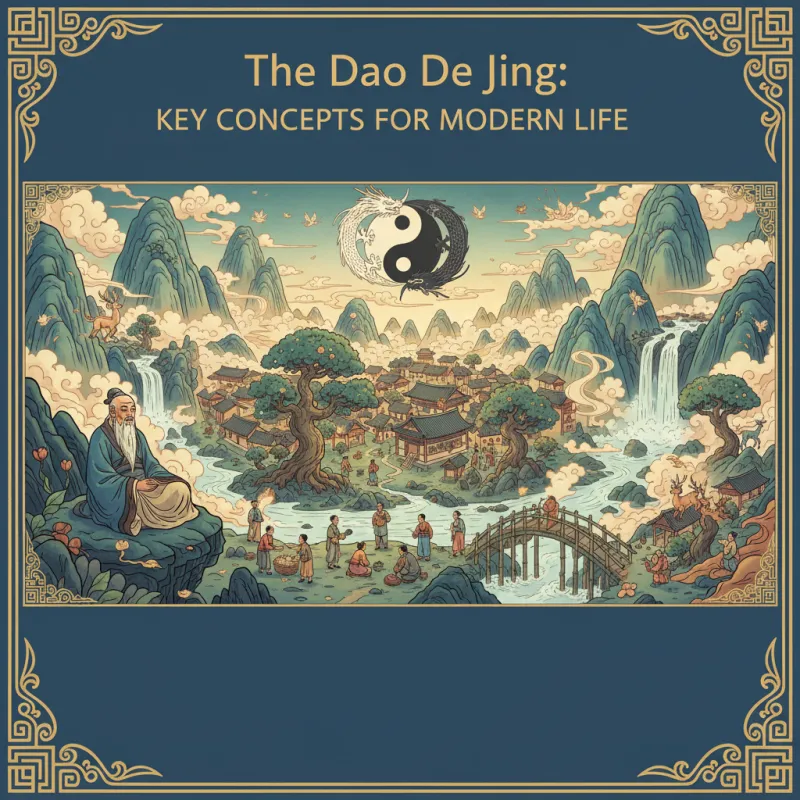
A farmer watches water flow around a rock in his irrigation ditch. Instead of forcing the water through, he notices how it naturally finds the path of least resistance, eventually wearing down even the hardest stone. This observation — simple, almost mundane — contains the entire philosophy of the 道德经 (Dào Dé Jīng), a text so compact you could read it during your lunch break, yet so profound that scholars have spent 2,500 years trying to fully unpack it.
Written sometime in the 6th century BCE (though the dating remains contentious), this 5,000-character masterpiece attributed to Laozi has become the foundational text of Daoism and one of the most translated works in human history. But here's what makes it genuinely radical: it argues that the secret to power, success, and contentment is doing less, not more. In a world obsessed with optimization, productivity, and constant action, the Dao De Jing suggests we've been getting it backwards all along.
The Dao: The Way That Can't Be Named
The opening line of the Dao De Jing is deliberately frustrating: "道可道,非常道" (Dào kě dào, fēi cháng dào) — "The Way that can be spoken is not the eternal Way." Laozi starts by telling you that whatever he's about to explain can't actually be explained. It's the philosophical equivalent of a Zen master hitting you with a stick.
But this isn't just mystical posturing. The 道 (Dào) refers to the fundamental pattern underlying all existence — the way nature operates when left to its own devices. Think of it as the operating system of reality. You can't see it directly, but you can observe its effects everywhere: in how rivers carve valleys, how seasons cycle, how ecosystems balance themselves without a central planner.
The Dao doesn't force or control. It doesn't have preferences or goals. It simply is, and everything else flows from it. This concept influenced not just Chinese philosophy but also traditional Chinese medicine, which views the body as a system that naturally seeks balance when not obstructed.
Wu Wei: The Art of Effortless Action
If the Dao is the operating system, then 无为 (wú wéi) is how you work with it. Usually translated as "non-action" or "effortless action," wu wei doesn't mean sitting around doing nothing. It means acting in harmony with the natural flow of things rather than against it.
Consider a skilled swimmer. A beginner thrashes and fights the water, exhausting themselves. An expert moves with the water, using its properties rather than resisting them. Same effort, vastly different results. That's wu wei.
The Dao De Jing is full of water metaphors for exactly this reason. Chapter 78 states: "Nothing in the world is softer than water, yet nothing is better at overcoming the hard and strong." Water doesn't try to be powerful — it simply follows its nature, and in doing so, it carves canyons and shapes coastlines.
This principle shows up throughout Chinese culture. In martial arts like Tai Chi, practitioners learn to redirect force rather than meet it head-on. In Chinese calligraphy, the most admired strokes appear effortless, as if the brush moved by itself. The goal isn't to eliminate effort but to eliminate unnecessary effort — the friction that comes from working against the grain of reality.
De: The Power of Virtue
The second character in the title, 德 (Dé), is often translated as "virtue," but that's misleading if you're thinking of Victorian morality. Dé is better understood as the power or potency that comes from aligning with the Dao. It's what you accumulate when you stop forcing things.
Think of it this way: a tree doesn't try to grow. It simply grows because that's its nature. In doing so, it develops strength, provides shade, produces fruit. That's Dé — the natural power that emerges from being what you are, fully and without pretense.
Laozi contrasts this with conventional morality, which he sees as a symptom of losing touch with the Dao. Chapter 38 makes this explicit: "When the Dao is lost, there is virtue. When virtue is lost, there is benevolence. When benevolence is lost, there is righteousness. When righteousness is lost, there is ritual." In other words, the more rules and moral codes we need, the further we've strayed from natural harmony.
This isn't advocating amorality. It's suggesting that genuine goodness flows naturally from alignment with the Dao, while forced morality is just a band-aid over deeper dysfunction. A person with Dé doesn't need to be told to be kind — kindness emerges spontaneously from their way of being.
Simplicity and the Uncarved Block
One of the Dao De Jing's most striking images is 朴 (pǔ), the "uncarved block" — a piece of wood before it's been shaped into something specific. This represents the state of pure potential, before society, education, and ambition have carved us into particular shapes.
Laozi argues that civilization, for all its benefits, damages us by imposing artificial distinctions and desires. We learn to want things we didn't naturally want. We develop preferences that create suffering. We carve ourselves into shapes that don't fit our nature, then wonder why we feel uncomfortable.
The solution isn't to become ignorant or primitive. It's to recognize which of our desires and beliefs are genuinely ours and which are carved into us by external forces. Chapter 19 suggests: "Abandon learning and there will be no sorrow. Abandon sageliness and discard wisdom, and the people will benefit a hundredfold."
This sounds anti-intellectual until you realize Laozi is critiquing a specific kind of learning — the accumulation of concepts and theories that distance us from direct experience. He's not against knowledge; he's against knowledge that becomes a substitute for wisdom.
The Paradox of Leadership
Some of the Dao De Jing's most practical advice concerns leadership, which makes sense given that it was likely written for rulers during the Warring States period. But Laozi's leadership philosophy inverts conventional wisdom.
The best leader, according to Chapter 17, is one whose existence the people barely notice. The next best is one they love and praise. Worse is one they fear. Worst is one they despise. The ideal leader creates conditions where things run smoothly without constant intervention — where people say, "We did it ourselves."
This is wu wei applied to governance. Instead of micromanaging or imposing grand visions, the sage leader removes obstacles and lets natural order emerge. They govern by not governing, lead by not leading. Modern management theory has slowly been rediscovering these principles under labels like "servant leadership" and "systems thinking."
Chapter 57 offers specific advice: "The more prohibitions there are, the poorer the people become. The more weapons the state possesses, the more chaotic the nation becomes. The more clever and skillful the people, the more strange things occur." Laozi observed that excessive control creates the very problems it aims to solve — a lesson that remains relevant in our age of surveillance and regulation.
Embracing Contradiction
What makes the Dao De Jing enduringly relevant is its comfort with paradox. It doesn't try to resolve contradictions into neat systems. Instead, it suggests that reality itself is paradoxical, and wisdom lies in holding opposites simultaneously.
Strength comes from softness. Knowledge comes from emptiness. Achievement comes from non-striving. The highest good is like water, which benefits all things without competing. These aren't just poetic flourishes — they're observations about how complex systems actually work.
Modern physics has discovered similar paradoxes: light behaves as both particle and wave. Quantum mechanics reveals that observation affects reality. The universe expands while gravity pulls it together. Perhaps Laozi was onto something when he suggested that the Dao contains all opposites without being diminished by their contradiction.
Living the Dao Today
So what does any of this mean for someone navigating modern life? The Dao De Jing isn't a self-help book with five easy steps. It's more like a lens that changes how you see everything.
Start by noticing where you're forcing things. Where are you swimming against the current out of habit or stubbornness? What would it look like to work with the situation's natural momentum instead?
Practice simplicity. Not as deprivation, but as clarity. What do you actually need versus what you've been told to want? What parts of your life are carved into you by others' expectations?
Embrace the power of restraint. In a culture that celebrates constant action and visible achievement, there's radical power in knowing when to do nothing. Sometimes the most effective intervention is no intervention at all.
The Dao De Jing won't give you a to-do list or a five-year plan. What it offers is something more valuable: a different way of being in the world, one that's been tested across millennia and cultures. In our age of burnout, anxiety, and endless striving, maybe the ancient wisdom of doing less to accomplish more deserves another look.
After all, that rock in the irrigation ditch hasn't moved. But the water that flowed around it? It's already reached the sea.
Related Reading
- The Art of War: Sun Tzu's Lessons Beyond the Battlefield
- Confucianism, Daoism, Buddhism: The Three Pillars of Chinese Thought
- Chinese Proverbs and Their Stories: Wisdom in Four Characters
- Chinese Wisdom Literature: The Proverbs That Run a Civilization
- Confucius Was Not Confucian (And Other Surprises About China's Most Famous Philosopher)
- Exploring Transformation in Chinese Folklore: Legends, Fairy Tales, and Cultural Traditions
- Modern Retellings of Chinese Folklore: Bridging Ancient Legends and Contemporary Culture
Explore Chinese Culture
- Explore feng shui in daily life
- Explore supernatural folklore
- Explore classical Chinese literature