A farmer's horse bolts through the gate and vanishes into the northern steppes. The neighbors arrive with condolences—what terrible luck! But the old man just shrugs. A week later, the horse returns with twelve wild stallions. The neighbors rush over with congratulations—what incredible fortune! The old man shrugs again. His son breaks his leg taming one of the new horses. Bad luck, everyone agrees. Then the army comes through, conscripting every able-bodied young man for a brutal border war. The son with the broken leg stays home. Good luck? Bad luck? The old man has stopped keeping track.
This is 塞翁失马 (Sài wēng shī mǎ)—"The Old Man at the Border Loses His Horse"—and it's one of roughly 5,000 成语 (chéngyǔ) that form the compressed wisdom of Chinese civilization. These four-character idioms are everywhere in Chinese conversation, literature, and thought. They're not just sayings; they're narrative capsules, each one containing an entire story, moral lesson, or philosophical insight that's been polished smooth by centuries of use.
The Architecture of Wisdom
Chengyu are structurally elegant. Four characters, almost always. Not three, not five. The rhythm matters—Chinese is a tonal language, and these four-syllable phrases have a natural cadence that makes them memorable. They're the Twitter of ancient China: maximum meaning in minimum space.
But unlike modern compression, nothing is lost. Each chengyu is a hyperlink to a full story. When someone says 画蛇添足 (huà shé tiān zú), they're not just saying "don't overdo it"—they're invoking an entire narrative about a drinking contest in the Warring States period where a man ruined his perfect snake drawing by adding feet to it. The other contestants pointed out that snakes don't have feet, so his drawing was now invalid. He lost the wine. The lesson crystallized into four characters that Chinese speakers have been using for over 2,000 years.
This is fundamentally different from Western proverbs. "Don't cry over spilled milk" is advice. 画蛇添足 is advice plus story plus cultural memory, all in one compressed package. It's why chengyu are so hard to translate—you're not just translating words, you're translating entire narrative traditions.
Stories That Became Shorthand
The best chengyu come from specific historical moments or classical texts. Take 刻舟求剑 (kè zhōu qiú jiàn)—"Carving the Boat to Seek the Sword." A man from the state of Chu dropped his sword into a river while crossing. Instead of noting the location on the shore, he carved a mark on the side of the boat. When the boat docked, he jumped in at the mark to search for his sword. Obviously, he didn't find it—the boat had moved, the sword hadn't.
This story appears in the Lüshi Chunqiu (吕氏春秋), compiled around 239 BCE. It's about rigidity, about applying old solutions to new situations, about mistaking the map for the territory. Modern Chinese speakers use it to criticize bureaucrats who can't adapt, or anyone stubbornly following outdated methods. Four characters, one story, infinite applications.
Or consider 守株待兔 (shǒu zhū dài tù)—"Guarding the Tree Stump Waiting for Rabbits." A farmer saw a rabbit run into a tree stump and break its neck. Free dinner! So he abandoned his fields and spent every day waiting by that stump for another rabbit to commit suicide. His crops died. He became a laughingstock. The idiom now describes anyone expecting success without effort, or waiting for lucky accidents to repeat themselves. It's from the Han Feizi (韩非子), written around 233 BCE, and it's still perfectly applicable to people buying lottery tickets or waiting for their startup idea to magically succeed.
The Paradox Proverbs
Some chengyu contain their own contradictions, reflecting the complexity of Chinese philosophical thought. 塞翁失马 (Sài wēng shī mǎ), the story that opened this article, is the perfect example. The full version is actually 塞翁失马,焉知非福 (Sài wēng shī mǎ, yān zhī fēi fú)—"The old man at the border lost his horse; how could we know it isn't a blessing?"
This comes from the Huainanzi (淮南子), a 2nd century BCE philosophical text. The story continues beyond what I described: the son's broken leg heals, but now he walks with a limp. Bad luck? He becomes a skilled archer because he can't run, and his archery saves the family during a bandit attack. Good luck? The story could continue forever, each event's value reversing with the next development.
This isn't just about optimism or "looking on the bright side." It's a fundamentally different way of thinking about causation and value. Western thought tends toward linear narratives—this caused that, which led to this outcome. Chinese philosophical traditions, especially Daoist ones, are more comfortable with cyclical patterns and reversals. 塞翁失马 encodes this worldview into four characters. You can't separate the philosophy from the story from the language.
Literary Chengyu and Classical Roots
Many chengyu come directly from classical literature, and knowing them is a marker of education. 东施效颦 (Dōng Shī xiào pín)—"Dong Shi Imitates the Frown"—comes from Zhuangzi (庄子). Xi Shi was one of the legendary beauties of ancient China. When she frowned from heartburn, she looked even more beautiful. Her ugly neighbor, Dong Shi, saw this and started frowning constantly, thinking it would make her beautiful too. Instead, people fled from her. The idiom means blindly imitating others without understanding context, or copying superficial aspects while missing the essence.
This connects to broader themes in Chinese aesthetics about authenticity and natural beauty, concepts explored in Chinese philosophy and daily wisdom. The chengyu isn't just a funny story—it's a compressed argument about the nature of beauty and imitation.
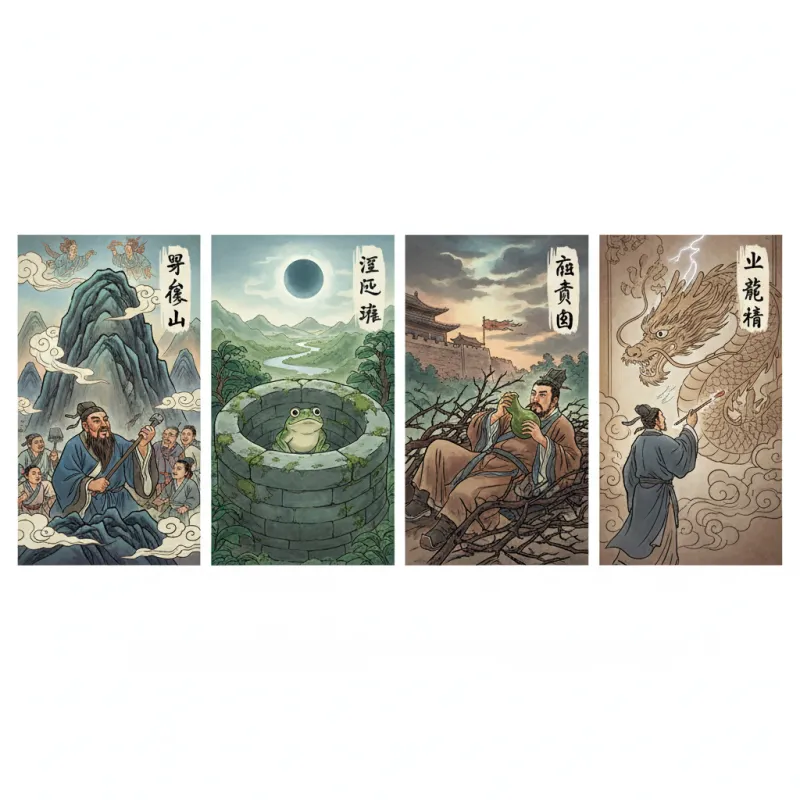
Or take 叶公好龙 (Yè Gōng hào lóng)—"Lord Ye's Love of Dragons." Lord Ye decorated his entire house with dragon imagery. He claimed to love dragons more than anything. Then a real dragon heard about this and came to visit. Lord Ye took one look and ran away terrified. The idiom describes people who claim to love something but can't handle the reality of it. It's perfect for calling out performative enthusiasm or shallow commitments.
The Grammar of Wisdom
Chengyu have specific grammatical structures that native speakers recognize instantly. Many follow a subject-verb-object pattern compressed into four characters. Others are parallel constructions where the first two characters mirror the second two. Some are fragments from classical poetry, their original context long forgotten by most speakers but still carried in the rhythm.
This grammatical precision is why you can't just make up new chengyu. Chinese internet culture tries—there are humorous four-character phrases that mimic chengyu structure—but they don't stick the same way. Real chengyu have been stress-tested by centuries of use. They've survived because they're useful, because they capture something true about human nature or the world.
The educational system reinforces this. Chinese students memorize hundreds of chengyu, along with their source stories. It's not just vocabulary study—it's cultural transmission. When you learn 卧薪尝胆 (wò xīn cháng dǎn)—"Sleeping on Brushwood and Tasting Gall"—you learn about King Goujian of Yue, who endured years of humiliation and self-imposed hardship to eventually defeat his enemies. The idiom means enduring present suffering for future success, but it carries the weight of that specific historical story from the 5th century BCE.
Living Language, Ancient Wisdom
What's remarkable is how naturally chengyu fit into modern conversation. A Chinese speaker might use a dozen in a single discussion without it feeling archaic or forced. They work in business meetings, casual chats, social media posts, and political speeches. This isn't like English speakers constantly quoting Shakespeare—it's more fundamental to how the language operates.
Some chengyu have evolved in meaning. 三人成虎 (sān rén chéng hǔ)—"Three People Make a Tiger"—originally came from a story about how repeated lies become accepted as truth. Three people separately claim there's a tiger in the marketplace, and eventually everyone believes it, even though tigers don't wander into marketplaces. Today it's used to describe how rumors spread, how misinformation becomes consensus, how social proof overrides critical thinking. The ancient story perfectly describes modern phenomena like viral fake news.
Others remain precisely applicable to their original contexts. 纸上谈兵 (zhǐ shàng tán bīng)—"Discussing Military Strategy on Paper"—comes from the story of Zhao Kuo, a general during the Warring States period who had memorized every military text but never fought a real battle. When he finally led troops, his by-the-book tactics led to catastrophic defeat. The idiom means theoretical knowledge without practical experience, and it's just as relevant for modern consultants, academics, or anyone who mistakes reading about something for actually doing it.
The Untranslatable Core
Here's the problem with explaining chengyu in English: I have to use so many words. 画蛇添足 is four syllables in Chinese. My explanation took multiple sentences. This efficiency is part of their power. In conversation, dropping the right chengyu at the right moment demonstrates education, wit, and cultural fluency all at once.
They're also contextually rich in ways that don't translate. When someone uses 塞翁失马, they're not just saying "things might work out"—they're invoking a specific philosophical tradition about the unpredictability of fortune, connecting to Daoist ideas about non-attachment and the limits of human judgment. They're participating in a conversation that's been going on for over 2,000 years.
This is why chengyu matter beyond just being colorful expressions. They're how Chinese culture transmits values, historical memory, and philosophical insights across generations. They're proof that you can pack enormous meaning into minimal space if you have centuries to refine the compression algorithm. And they're a reminder that language isn't just a tool for communication—it's a repository of collective wisdom, with each idiom serving as a key to unlock entire traditions of thought.
The old man at the border is still shrugging, still watching fortune and misfortune chase each other in circles. His story became four characters. Those four characters became a way of thinking. And that way of thinking has shaped how hundreds of millions of people understand luck, loss, and the strange reversals of fate. Not bad for a story about a runaway horse.
Related Reading
- Confucianism, Daoism, Buddhism: The Three Pillars of Chinese Thought
- Chinese Wisdom Literature: The Proverbs That Run a Civilization
- The Art of War: Sun Tzu's Lessons Beyond the Battlefield
- The Dao De Jing: Key Concepts for Modern Life
- Chinese Supernatural Fiction: From Liaozhai to Modern Web Novels
- Modern Retellings of Chinese Folklore: Bridging Ancient Legends and Contemporary Culture
- Chinese Creation Myths: How the World Began
Explore Chinese Culture
- Explore feng shui in daily life
- Explore supernatural folklore
- Explore classical Chinese literature