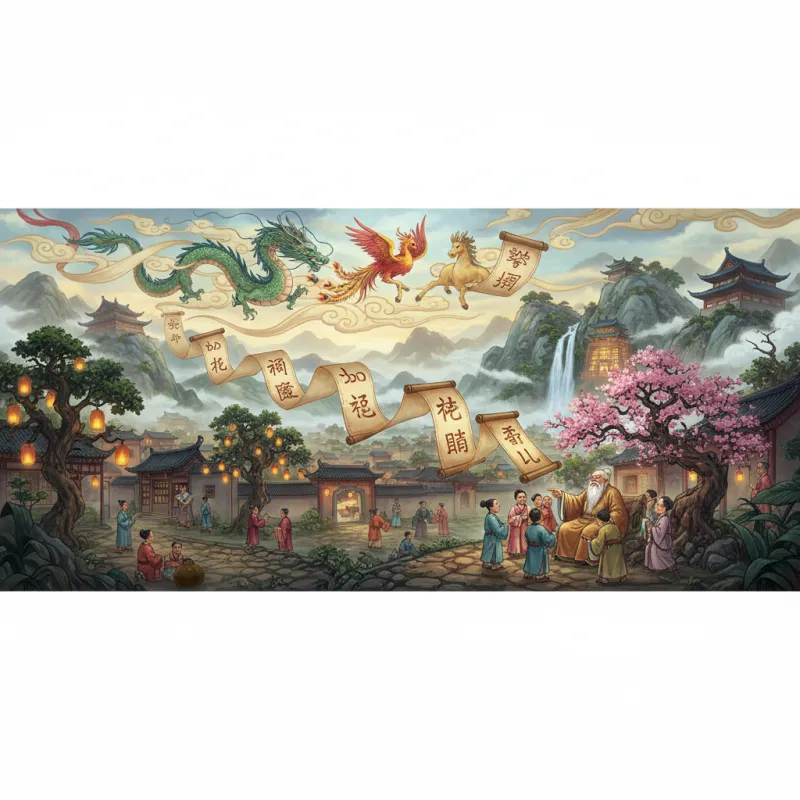
A farmer's horse escapes into the northern territories. His neighbors gather to offer condolences, but the old man shrugs: "Who knows if this is bad luck?" Weeks later, the horse returns with a magnificent wild stallion. The neighbors congratulate him on his fortune, but again he says: "Who knows if this is good luck?" His son tries to tame the new horse, falls, and shatters his leg. More condolences. Same response. Then war breaks out, and every able-bodied young man is conscripted—except the son with the broken leg. This is 塞翁失马 (sàiwēng shīmǎ), and it's not just a story. It's how an entire civilization learned to think about fate.
Chinese culture doesn't run on laws, rules, or commandments. It runs on proverbs. Four-character packages of compressed wisdom that show up in business negotiations, family arguments, political speeches, and WeChat messages. A well-deployed chengyu can end a debate, justify a risky decision, or communicate what would take a Westerner three paragraphs to explain. These aren't decorative. They're the operating system.
The Four-Character Universe
The chengyu (成语, chéngyǔ) is the atomic unit of Chinese wisdom. Exactly four characters. No more, no less. This isn't arbitrary—classical Chinese poetry and philosophy trained readers to think in four-character units, and the format forces maximum compression. Every chengyu carries a backstory, usually from classical texts, historical events, or ancient fables. You're not just using a phrase; you're invoking an entire narrative framework.
画蛇添足 (huà shé tiān zú) literally means "drawing a snake and adding feet." The story: several men compete to draw a snake quickly. The first to finish gets cocky and starts adding feet to his snake. "Look how skilled I am!" But snakes don't have feet. He loses the competition. The lesson crystallizes instantly: don't ruin something good by overdoing it. Quit while you're ahead. Know when to stop. Four characters contain an entire philosophy of restraint that Daoist sages spent chapters explaining.
守株待兔 (shǒu zhū dài tù) — "guarding a tree stump waiting for rabbits." A farmer sees a rabbit run into a tree stump and break its neck. Free dinner. So he abandons his fields and sits by the stump every day, waiting for more rabbits to commit suicide. They don't. His crops die. He starves. The proverb means: don't expect lucky accidents to repeat themselves, don't be passive when you should be active, don't mistake coincidence for a sustainable strategy. It's used in business meetings to shut down proposals that rely on unrealistic assumptions.
Proverbs as Social Technology
These aren't just colorful expressions. They're conflict-resolution tools. In a culture that values harmony and abhors direct confrontation, proverbs let you criticize without attacking. If your business partner proposes an overly complicated plan, you don't say "that's stupid." You say 画蛇添足, and everyone nods. The criticism lands, but no one loses face. The proverb does the work.
亡羊补牢 (wáng yáng bǔ láo) — "the sheep have escaped, so repair the pen." It's never too late to fix a mistake. This shows up constantly in Chinese management culture. A project fails, someone screwed up, and instead of dwelling on blame, someone senior will say 亡羊补牢, and the conversation shifts immediately to solutions. The proverb gives permission to move forward without shame spirals.
井底之蛙 (jǐng dǐ zhī wā) — "a frog at the bottom of a well." The frog thinks the circle of sky above the well is the entire universe. It's used to describe people with limited perspectives who don't realize how much they don't know. But here's the sophisticated part: you can use it on yourself. "I've been 井底之蛙 about this" is a face-saving way to admit you were wrong without groveling. The proverb provides the frame; you just step into it.
The Darker Proverbs
Not all Chinese wisdom is about harmony and patience. Some proverbs are brutally pragmatic, even cynical. They reveal a culture that has survived thousands of years of warfare, famine, and political chaos by being realistic about human nature.
兔死狗烹 (tù sǐ gǒu pēng) — "when the rabbits are dead, the hunting dogs are cooked." Once you're no longer useful, you're discarded. This comes from the story of 范蠡 (Fàn Lí), an advisor who helped the King of Yue defeat his enemies. The moment victory was secured, Fan Li fled, knowing the king would eliminate him. He sent a message to a fellow advisor: "The birds are gone; now they'll put away the bow. The rabbits are dead; now they'll cook the dogs." The other advisor ignored the warning and was executed. The proverb is a warning about power, loyalty, and the shelf life of usefulness. It's quoted in corporate China when discussing layoffs.
明哲保身 (míng zhé bǎo shēn) — "the wise protect themselves." Stay out of trouble. Don't stick your neck out. Keep your head down. This isn't cowardice; it's survival strategy refined over millennia of political purges. During the Cultural Revolution, people who remembered this proverb survived. Those who didn't often didn't. It's the opposite of Western "speak truth to power" culture, and it's deeply embedded in how Chinese institutions function.
The Confucian Core
Many proverbs encode Confucian values so deeply that they're invisible to Chinese speakers—just "common sense." But they're not universal common sense. They're specific cultural programming.
百善孝为先 (bǎi shàn xiào wéi xiān) — "of a hundred virtues, filial piety comes first." Not kindness, not honesty, not courage. Filial piety. Your duty to parents and ancestors trumps everything else. This explains why Chinese adult children feel obligated to support aging parents, why family businesses pass to sons regardless of competence, why individual dreams get sacrificed for family expectations. It's not just culture; it's encoded in the proverbs people hear from childhood.
三人行必有我师 (sān rén xíng bì yǒu wǒ shī) — "when three people walk together, one of them can be my teacher." Confucius said this, and it's become the foundation of Chinese learning culture. Everyone has something to teach you. Stay humble. Keep learning. It sounds nice, but it also creates hierarchies—there's always someone above you to learn from, which means there's always someone above you in status. The proverb reinforces the social order while appearing to celebrate egalitarian learning.
How Proverbs Evolve
New chengyu are still being created, though it's rare for them to achieve the canonical status of classical ones. During the Mao era, revolutionary slogans tried to function as proverbs: 为人民服务 (wèi rénmín fúwù) — "serve the people." But these feel different. They're top-down propaganda, not bottom-up wisdom. Real proverbs emerge from stories, not slogans.
The internet has created a new category: four-character phrases that mimic chengyu structure but are purely contemporary. 喜大普奔 (xǐ dà pǔ bēn) — "happy, big, universal, running" — is internet slang meaning "great news that makes everyone happy." It's not a real chengyu, but it uses the four-character format to signal "this is wisdom" even when it's just meme culture. The format itself carries authority.
Living With Proverbs
If you spend time in Chinese-speaking environments, you'll notice how often proverbs appear in ordinary conversation. A parent tells a child 一分耕耘,一分收获 (yī fēn gēng yún, yī fēn shōu huò) — "one minute of plowing, one minute of harvest" — meaning you get out what you put in. A friend warns another about a sketchy business deal: 天下没有免费的午餐 (tiānxià méiyǒu miǎnfèi de wǔcān) — "there's no free lunch in the world." A grandmother sighs about a grandchild's choices: 儿孙自有儿孙福 (ér sūn zì yǒu ér sūn fú) — "children and grandchildren have their own fortunes."
These aren't literary flourishes. They're how people think. The proverbs provide pre-made frameworks for interpreting experience. Instead of reasoning from first principles every time, you pattern-match your situation to a proverb, and the proverb tells you what to think. It's efficient. It's also limiting—you can only think thoughts that fit existing proverbs.
But here's what's remarkable: the proverbs are often contradictory. 三个臭皮匠,顶个诸葛亮 (sān gè chòu píjiàng, dǐng gè Zhūgě Liàng) says "three mediocre cobblers equal one brilliant strategist"—collective wisdom beats individual genius. But 三个和尚没水喝 (sān gè héshàng méi shuǐ hē) says "three monks have no water to drink"—too many people means no one takes responsibility. Both are "true." You pick the proverb that fits your argument.
This is the real genius of the system. The proverbs don't provide answers. They provide a vocabulary for debate. They let you argue without arguing, criticize without attacking, and change your mind without admitting you were wrong. You just switch proverbs. The wisdom isn't in any individual saying. It's in having a vast library of sayings that cover every situation and its opposite, giving you infinite flexibility while maintaining the appearance of ancient authority.
That's how you run a civilization for 5,000 years. Not with rigid rules, but with flexible wisdom. Not with one truth, but with a thousand proverbs that contradict each other just enough to handle whatever reality throws at you. The old man at the border lost his horse, and he was right to shrug. Good luck, bad luck—who knows? The proverb knows. And so does everyone else.
Related Reading
- The Art of War: Sun Tzu's Lessons Beyond the Battlefield
- Confucianism, Daoism, Buddhism: The Three Pillars of Chinese Thought
- Chinese Proverbs and Their Stories: Wisdom in Four Characters
- The Dao De Jing: Key Concepts for Modern Life
- The Chinese Tea Ceremony: Finding the Dao in Every Cup
- Laozi and the Tao Te Ching: A Practical Guide
- Unveiling the Celestial Tales of Chinese Folklore and Legends
Explore Chinese Culture
- Explore feng shui in daily life
- Explore supernatural folklore
- Explore classical Chinese literature