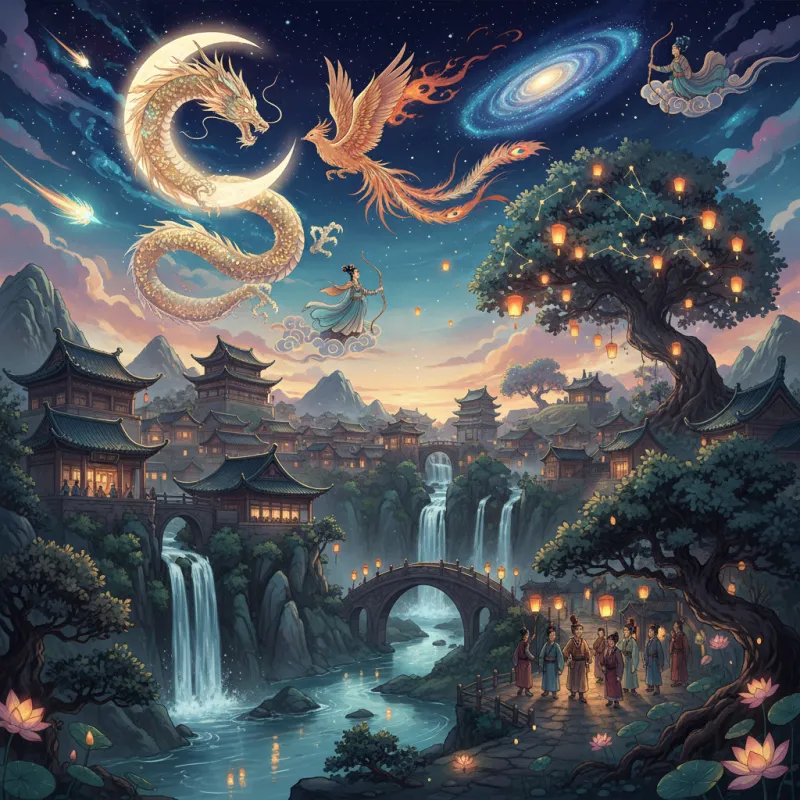
The Weaver Girl wept as she gazed across the Milky Way, her silver shuttle idle in her hands. Once a year—just once—she could cross the celestial river to embrace her mortal husband, the Cowherd, before the magpies dispersed and another year of separation began. This isn't just a romantic tale Chinese grandmothers tell on the seventh night of the seventh lunar month. It's the Qixi Festival's origin story, and it reveals something fundamental about how Chinese civilization has always understood the cosmos: as a mirror of human experience, where gods fall in love, make mistakes, and face consequences that echo through eternity.
When Heaven and Earth Were One Family
Chinese celestial folklore operates on a premise that Western mythology often lacks—the boundaries between heaven, earth, and the underworld are porous, negotiable, even bureaucratic. The Jade Emperor (玉皇大帝, Yù Huáng Dàdì) doesn't rule from some unreachable Olympus. He presides over a celestial administration complete with ministries, reports, and performance reviews. When the Monkey King Sun Wukong caused havoc in heaven during the Ming Dynasty novel Journey to the West, he wasn't storming an alien realm—he was essentially staging a workplace rebellion.
This administrative view of the cosmos reflects the Confucian bureaucracy that governed China for millennia. The Queen Mother of the West (西王母, Xī Wángmǔ), who appears in texts as early as the Classic of Mountains and Seas (山海经, Shān Hǎi Jīng) from the 4th century BCE, transformed over centuries from a fearsome tiger-toothed goddess into a refined celestial hostess serving peaches of immortality at garden parties. Her evolution mirrors China's own journey from shamanic traditions to structured imperial culture.
The Eight Immortals and the Democracy of Divinity
Unlike pantheons where divine status is hereditary, Chinese celestial beings often earned their positions through cultivation, moral achievement, or sheer persistence. The Eight Immortals (八仙, Bā Xiān) are the perfect example—a ragtag group including a crippled beggar, a gender-fluid figure, and a perpetually drunk scholar. They represent Daoist ideals of transcendence through different paths, proving that heaven isn't reserved for the nobly born.
Lü Dongbin, the most famous of the Eight, was a Tang Dynasty scholar who failed the imperial examinations before meeting a Daoist master. His story resonates because it validates alternative paths to greatness—a message that must have comforted countless examination failures throughout Chinese history. When you see his image in temples, sword on his back and fly whisk in hand, you're looking at the patron saint of second chances.
The immortals' adventures, recorded in texts like The Eight Immortals Cross the Sea, read like celestial heist films. Each uses their unique magical implement—a fan, a flute, a lotus flower—to overcome obstacles. This diversity of tools and approaches reflects a pragmatic Chinese philosophy: there are many ways to achieve enlightenment, and rigid orthodoxy is less valuable than results.
Chang'e's Lonely Moon and the Cost of Immortality
The Mid-Autumn Festival wouldn't exist without Chang'e (嫦娥, Cháng'é), the moon goddess whose story is far more complex than the sanitized children's versions suggest. In the earliest accounts from the Han Dynasty, she wasn't a tragic figure but an ambitious woman who stole the elixir of immortality from her husband, the archer Hou Yi, and fled to the moon. Later versions, influenced by Confucian values emphasizing wifely virtue, reframed her as a reluctant immortal who took the elixir to prevent it from falling into evil hands.
This evolution reveals how folklore adapts to serve changing social values. The Tang Dynasty poet Li Shangyin wrote of Chang'e: "The moon goddess should regret stealing the elixir / Facing the blue sea and azure sky, night after night, alone." His sympathy for her isolation reflects a more nuanced understanding—immortality without companionship is a curse, not a blessing. Every mooncake eaten during the Mid-Autumn Festival carries this bittersweet reminder that longevity means outliving everyone you love.
The jade rabbit (玉兔, Yù Tù) who pounds medicine beside Chang'e adds another layer. In Buddhist versions, the rabbit sacrificed itself to feed a hungry traveler (actually a deity in disguise), earning its place on the moon. This cross-pollination between Buddhist and indigenous Chinese traditions shows how celestial folklore became a melting pot of religious and philosophical ideas.
The Four Dragon Kings and Bureaucratic Rain
When Chinese farmers prayed for rain, they weren't appealing to a single storm god but to a regional manager. The Four Dragon Kings (四海龙王, Sì Hǎi Lóng Wáng) governed the seas in each cardinal direction, and their responsibilities included weather regulation, marine life management, and occasionally appearing in human form to test mortals' virtue. The Dragon King of the Eastern Sea, Ao Guang, appears in Journey to the West as a somewhat petty official who reports the Monkey King's theft of the golden-hooped rod to higher authorities—very much like a bureaucrat filing a complaint with HR.
This bureaucratization of nature spirits reflects a distinctly Chinese approach to the divine. Rather than capricious gods who act on whim, celestial beings operate within systems, follow protocols, and can be petitioned through proper channels. Temples dedicated to dragon kings often contain plaques recording successful rain prayers, like performance metrics proving the deity's effectiveness. If the dragon king failed to deliver rain, communities might "punish" his statue by leaving it in the sun—a practice that would be blasphemous in many religious traditions but makes perfect sense in a system where gods are accountable officials.
Nezha: The Rebel Prince Who Became a God
Few celestial figures embody Chinese complexity like Nezha (哪吒, Né Zhā), the child deity who committed suicide to repay his debt to his parents, was reborn from a lotus flower, and became a demon-fighting marshal of heaven. His story, popularized in the Ming Dynasty novel Investiture of the Gods (封神演义, Fēng Shén Yǎn Yì), tackles themes of filial piety, rebellion, and redemption with a sophistication that belies its fantastical elements.
Nezha killed the Dragon King's son, bringing disaster upon his family. To save them, he carved out his own flesh and bones, returning them to his parents—the ultimate act of filial piety taken to its logical, horrifying extreme. His teacher Taiyi Zhenren then reconstructed him from lotus roots and leaves, creating a body untainted by parental debt. This rebirth narrative influenced everything from martial arts films to modern animated features, because it addresses a tension at the heart of Chinese culture: how do you honor your parents while becoming your own person?
Modern depictions often emphasize Nezha's rebellious spirit, making him a symbol of youth challenging corrupt authority. The 2019 animated film Ne Zha became China's highest-grossing animated feature by leaning into this interpretation, proving that celestial tales remain relevant when they speak to contemporary struggles. For more on how divine figures interact with mortal realms, explore the role of deities in Chinese festivals.
The Cowherd and Weaver Girl: Love Across the Cosmos
Returning to where we began—the Qixi Festival's origin story deserves deeper examination because it's fundamentally about class, duty, and the price of crossing boundaries. The Weaver Girl was a celestial princess, daughter of the Jade Emperor, whose job was creating clouds and clothing for the gods. The Cowherd was a mortal farmer, poor and orphaned. Their love story wasn't just romantic; it was revolutionary.
When they married and had children, the Weaver Girl neglected her celestial duties. The Queen Mother of the West—her grandmother in most versions—forcibly separated them, creating the Milky Way as an impassable barrier. Only the magpies' compassion, forming a bridge once yearly, allows their reunion. This tale has been interpreted countless ways: as a warning against neglecting duty, as a critique of rigid class systems, as an explanation for the stars Vega and Altair's positions in the sky.
What strikes me most is the story's refusal to provide a happy ending. They remain separated, meeting once a year for over two millennia of retellings. Chinese folklore often resists the neat resolutions Western fairy tales demand. Life is long, separation is inevitable, and love persists despite cosmic injustice. The magpie bridge isn't a solution—it's a compromise, a small mercy in an unforgiving universe.
Why These Tales Still Matter
Chinese celestial folklore isn't museum pieces—it's living mythology that continues shaping how people understand their place in the cosmos. When Chinese astronauts named their lunar rover "Yutu" (Jade Rabbit), they weren't being quaint; they were asserting cultural continuity, linking cutting-edge technology to ancient stories. When families gather for the Mid-Autumn Festival, they're not just eating mooncakes but participating in a ritual that connects them to centuries of ancestors who gazed at the same moon and told the same stories.
These tales survive because they're flexible enough to absorb new meanings while maintaining their core truths. The Jade Emperor's bureaucratic heaven makes more sense in an age of corporate hierarchies than it did to Tang Dynasty farmers. Nezha's rebellion resonates with every generation that questions inherited authority. Chang'e's isolation speaks to anyone who's achieved their dreams only to find them lonely.
The celestial realm in Chinese folklore isn't an escape from earthly concerns—it's where those concerns are magnified, examined, and sometimes resolved. Gods make mistakes, immortals feel regret, and heaven itself is subject to the same forces of change that govern human society. This isn't a bug in the system; it's the feature that makes these stories endlessly reinterpretable. For insights into how these celestial narratives connect to earthly celebrations, see Chinese festival origins and meanings.
The Weaver Girl is still weeping by the celestial river, the Jade Rabbit still pounds his medicine, and the Eight Immortals still wander between worlds. These stories persist not because they're old, but because they're true in ways that transcend historical accuracy. They map the human heart onto the cosmos and find that the stars, like us, are governed by love, duty, ambition, and the eternal hope that separation isn't final—that bridges, however temporary, can always be built.
Related Reading
- Calligraphy as Meditation Practice
- Exploring the Enigmatic World of Chinese Animal Tales and Their Cultural Significance
- Confucius Was Not Confucian (And Other Surprises About China's Most Famous Philosopher)
Explore Chinese Culture
- Explore feng shui in daily life
- Explore supernatural folklore
- Explore classical Chinese literature