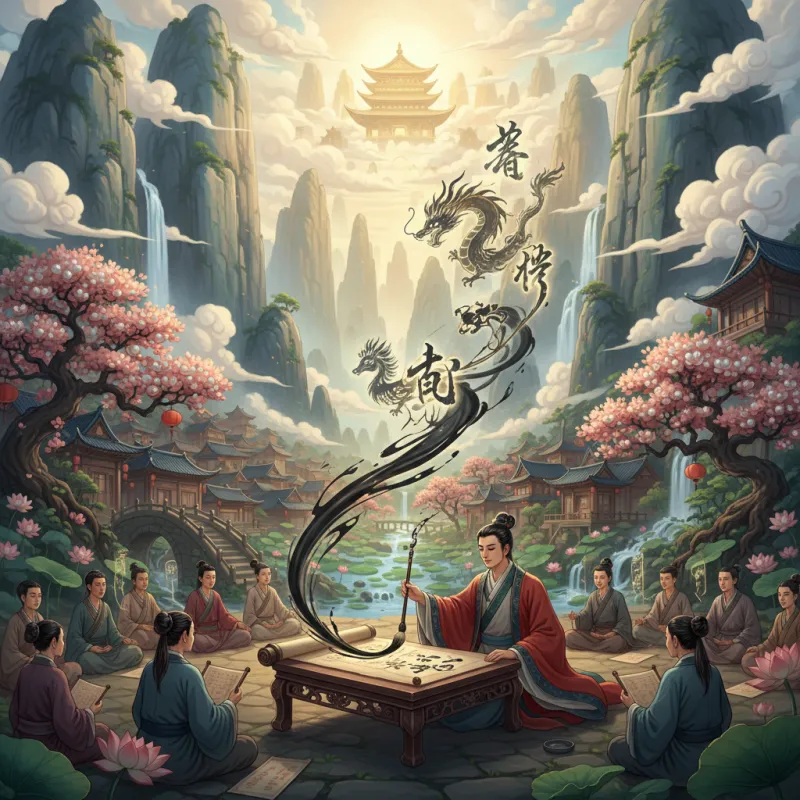
The brush hovers above the paper. Your hand trembles slightly — not from nervousness, but from the effort of holding still while your mind races through tomorrow's meetings, yesterday's arguments, the notification you just heard ping from your phone. Then you touch ink to rice paper, and something unexpected happens: the trembling stops. Not because you willed it to stop, but because in that moment of contact, there's no room for anything except the slow drag of horsehair across fiber, the way black bleeds into white, the ancient character taking shape beneath your hand.
This isn't poetry. It's physiology. Chinese calligraphers have known for over two millennia what Western neuroscience is only now confirming with fMRI scans and cortisol measurements: the act of writing characters with brush and ink fundamentally alters your nervous system. The practice they call 书法 (shūfǎ) — literally "the method of writing" — is simultaneously an art form, a meditation technique, and a form of moving therapy that engages your body and mind in ways that typing, or even pen-and-paper writing, simply cannot replicate.
The Mechanics of Stillness
When Wang Xizhi (王羲之), the 4th-century "Sage of Calligraphy," wrote that "calligraphy is the heart's painting" (书,心画也), he wasn't being metaphorical. He was describing a direct transmission: your internal state flows through your arm, into the brush, onto the paper. Every hesitation, every moment of clarity, every spike of anxiety — it all shows up in the ink.
This is why calligraphy works as meditation. You can't fake it. You can't think your way through it. The brush is merciless in its honesty.
The physical requirements create the mental shift. To write well, you must stand or sit with your spine straight, your shoulder relaxed, your elbow suspended. Your breathing must be steady — any irregularity will show up as a wobble in your stroke. Your grip on the brush must be firm but not tense, what calligraphers call 执笔要实,运笔要虚 (zhíbǐ yào shí, yùnbǐ yào xū) — "hold the brush solidly, move it emptily."
These aren't arbitrary rules. They're a technology for inducing what modern psychology calls "flow state" and what Chan Buddhist monks call 一心不乱 (yīxīn bù luàn) — "one mind, undisturbed." The posture opens your breathing. The breathing steadies your hand. The steady hand quiets your mind. It's a feedback loop that's been refined over centuries.
What the Ancients Knew
Sun Guoting (孙过庭), writing in 687 CE, described five conditions necessary for good calligraphy: the right paper, the right ink, the right mood, the right time, and the right state of mind. But he spent most of his famous Treatise on Calligraphy (书谱) discussing that last condition, because it was the hardest to achieve and the most essential.
He wrote: "When the mind is at peace, the hand follows naturally. When the mind is disturbed, the brush rebels." He wasn't talking about trying to calm your mind before you write. He was describing how the act of writing itself becomes the method of calming.
This understanding runs through the entire tradition. Yan Zhenqing (颜真卿), the 8th-century master whose bold, muscular style revolutionized calligraphy, practiced during the An Lushan Rebellion — one of the bloodiest conflicts in Chinese history. His letters from that period, written while organizing military resistance, show no trace of panic or disorder. The characters are powerful, grounded, completely present. He wasn't escaping the chaos through calligraphy. He was meeting it with a mind trained to stillness through decades of brush practice.
The Song Dynasty scholar-official Su Shi (苏轼) put it more directly: "When I write, I forget my worries. When I stop writing, the worries return. So I keep writing." He understood what modern therapists call "behavioral activation" — the way that engaging in a structured, meaningful activity can interrupt rumination and anxiety spirals.
The Breath, the Brush, the Body
Here's what actually happens when you practice calligraphy as meditation, stripped of romanticism:
You prepare your materials. Grinding the ink stick against the stone, adding water drop by drop, requires five to ten minutes of repetitive motion. Your breathing naturally synchronizes with the circular grinding motion. This is the warm-up, the transition from the scattered attention of daily life to the focused attention of practice.
You load the brush. The way you hold it — thumb and first two fingers forming a triangle, the brush perpendicular to the paper — forces your hand into an unfamiliar position. This unfamiliarity is crucial. Your hand can't fall into automatic patterns. Every stroke requires conscious attention.
You begin with basic strokes. The horizontal line (héng, 横), the vertical line (shù, 竖), the dot (diǎn, 点). These aren't warm-up exercises. They're the foundation of every character, and masters practice them daily. Qi Baishi (齐白石), who lived to 93 and painted until his death, said he practiced basic strokes every morning of his adult life.
The repetition is the point. Not mindless repetition — each stroke is unique, requires full attention — but the kind of repetition that builds what Buddhists call 定 (dìng), "concentration" or "stability." You're training your attention to stay with one thing, to notice when it wanders, to bring it back without judgment.
Why Calligraphy Works Where Other Practices Fail
Many people try meditation and quit because sitting still with their thoughts feels impossible. The mind won't cooperate. It jumps from thought to thought like a monkey in a tree — what Buddhists call 心猿 (xīnyuán), "mind-monkey."
Calligraphy solves this problem by giving the mind something to do. Not something to think about — thinking interferes with good calligraphy — but something to attend to. The texture of the paper. The weight of the brush. The way the ink flows or resists. The shape emerging stroke by stroke.
This is what meditation teachers call "object-based meditation" — using a physical focus to anchor attention. But unlike watching your breath or repeating a mantra, calligraphy produces something tangible. You can see your progress. You can see, literally, when your mind was scattered (the stroke wavers) and when it was focused (the stroke is clean and confident).
The feedback is immediate and non-judgmental. A wobbly line isn't a failure. It's information. It tells you something about your state of mind in that moment. Over time, you develop what calligraphers call 眼力 (yǎnlì) — "eye power" — the ability to see not just the finished character but the process that created it, the sequence of decisions and attentional states that resulted in each stroke.
The Modern Evidence
Neuroscientists studying calligraphy practitioners have found something remarkable: the practice activates both hemispheres of the brain simultaneously. The left hemisphere handles the sequential, analytical aspects — stroke order, character structure, spacing. The right hemisphere processes the visual, spatial, and aesthetic elements — balance, rhythm, overall composition.
This bilateral activation is rare. Most activities favor one hemisphere or the other. But calligraphy, like music, requires both to work together. The result is what researchers call "whole-brain coherence" — a state associated with reduced anxiety, improved focus, and enhanced creativity.
Studies have also measured physiological changes during calligraphy practice: decreased heart rate, lower cortisol levels, increased alpha wave activity in the brain (associated with relaxed alertness), and improved heart rate variability (a marker of nervous system flexibility). These aren't subtle effects. They're measurable within 15-20 minutes of practice.
One study compared calligraphy practice to seated meditation and found similar benefits, with one key difference: participants were more likely to stick with calligraphy. The tangible output — the characters themselves — provided motivation that pure meditation lacked.
Starting Your Own Practice
You don't need to read classical Chinese or understand the history to benefit from calligraphy as meditation. You need a brush, ink, paper, and a willingness to be a beginner.
Start with the Four Treasures of the Study (文房四宝, wénfáng sìbǎo): brush, ink, paper, and inkstone. You can find basic sets online for $30-50. Don't start with expensive materials. Cheap paper is more forgiving, and you'll go through a lot of it.
Begin with basic strokes, not complete characters. The horizontal line. The vertical line. The dot. Practice each one twenty times, paying attention to the beginning (where the brush touches paper), the middle (the movement), and the end (how you lift the brush). This is harder than it sounds. Your attention will wander. That's fine. Notice it wandering. Bring it back.
When you're ready for characters, start with simple ones: 一 (yī, "one"), 二 (èr, "two"), 三 (sān, "three"), 人 (rén, "person"), 大 (dà, "big"). These aren't childish. They're fundamental. Master calligraphers practice them for decades.
Don't aim for beauty. Aim for presence. Aim for the moment when you're so focused on the stroke you're making that everything else disappears. That's 入静 (rùjìng), entering stillness. It might happen in your first session. It might take months. It doesn't matter. The practice is the point.
The Long Game
Zhao Mengfu (赵孟頫), the Yuan Dynasty master, wrote that it takes ten years to learn calligraphy and a lifetime to master it. He wasn't trying to discourage beginners. He was pointing to something essential: calligraphy isn't a skill you acquire and then possess. It's a practice you return to, again and again, each time discovering something new about the characters, the brush, and yourself.
This is why calligraphy works as meditation. It's not a quick fix or a life hack. It's a slow, cumulative practice that changes you in ways you don't notice until you look back and realize that the person who started practicing six months ago — scattered, anxious, unable to sit still — isn't quite the same person holding the brush today.
The characters you write become a record of this transformation. Not in some mystical sense, but in a very practical one. You can see, in the progression of your practice sheets, the moments when you were distracted, the sessions when you found flow, the gradual development of confidence and control. It's like keeping a journal, except instead of words about your experience, you have the direct trace of your attention, preserved in ink.
For more on the historical development of Chinese calligraphy styles, see The Evolution of Chinese Calligraphy Scripts. If you're interested in the tools and materials, check out The Four Treasures of the Study.
The brush is waiting. The paper is blank. Your mind is scattered, busy, full of noise. Touch ink to paper and see what happens. Not what you think should happen, not what you hope will happen, but what actually happens when you give your full attention to a single stroke, then another, then another. That's the practice. That's the meditation. That's 书法 (shūfǎ) — the method of writing that's really a method of being present, one character at a time.
Related Reading
- The Five Scripts of Chinese Calligraphy
- How to Start Learning Chinese Calligraphy
- Chinese Calligraphy: Why Writing Is the Highest Art
- Famous Calligraphers Through History
- Decoding Chinese Internet Culture: From Baidu Tieba to Bilibili
- Unveiling the Rich Tapestry of Chinese Folklore and Festival Origins
- Jade in Chinese Culture: The Stone of Heaven
Explore Chinese Culture
- Explore feng shui in daily life
- Explore supernatural folklore
- Explore classical Chinese literature