The old woman's hands trembled as she placed three sticks of incense before her ancestors' graves, whispering prayers her grandmother had taught her seventy years ago. Around her, families swept tombstones, burned paper offerings, and shared cold food—rituals unchanged for over 2,500 years. This is Qingming Festival (清明节, Qīngmíng Jié), and like most Chinese celebrations, its origins lie buried in layers of folklore, imperial decree, and human tragedy that have fused into something far more complex than a simple "tomb-sweeping day."
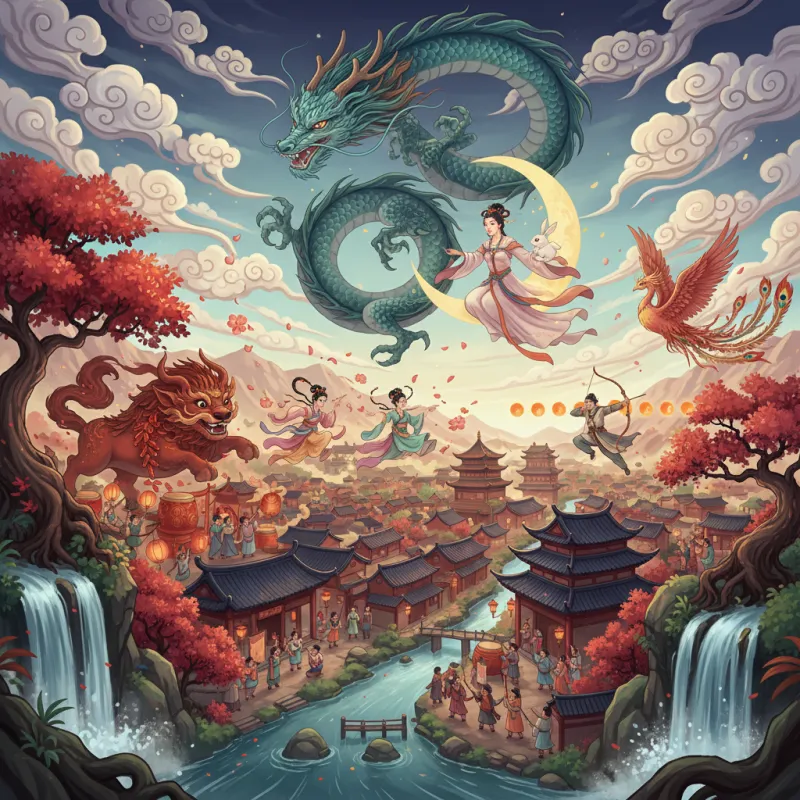
Chinese festivals aren't just dates on a calendar—they're living archives of folklore, each one preserving stories that would otherwise vanish into history's fog. The relationship between folklore and festivals in Chinese culture operates like a two-way street: legends give birth to celebrations, while annual observances keep those legends alive in collective memory. Understanding this symbiosis reveals why Chinese festivals feel so different from their Western counterparts, where religious doctrine often overshadows folk narrative.
When Folklore Becomes Festival: The Mechanics of Cultural Memory
The transformation of folklore into festival follows a predictable pattern in Chinese tradition. First comes the story—usually involving a tragic death, supernatural intervention, or moral lesson. Then comes commemoration, often initiated by local communities or imperial endorsement. Finally, ritual crystallizes into tradition, passed down through generations until the original story becomes inseparable from the celebration itself.
Take the Dragon Boat Festival (端午节, Duānwǔ Jié), celebrated on the fifth day of the fifth lunar month. Most people know it commemorates Qu Yuan (屈原), the patriotic poet-minister who drowned himself in the Miluo River in 278 BCE after his state of Chu fell to Qin forces. But here's what the simplified version misses: the festival predates Qu Yuan by centuries. Archaeological evidence suggests dragon boat races and zongzi (粽子, sticky rice dumplings) were already part of southern Chinese summer solstice rituals. Qu Yuan's story didn't create the festival—it hijacked an existing one, giving ancient agricultural rites a compelling narrative that resonated with Confucian values of loyalty and righteousness.
This pattern repeats throughout Chinese festival origins. The folklore doesn't always come first; sometimes it arrives later to explain practices people were already doing. The Mid-Autumn Festival's moon worship traditions existed long before the legend of Chang'e (嫦娥) fleeing to the moon became the festival's defining myth. The story gave meaning to the mooncakes and lanterns, transforming seasonal harvest celebrations into something emotionally resonant.
The Qingming Paradox: When Multiple Legends Collide
Qingming Festival presents one of the most fascinating cases of folklore layering in Chinese tradition. The festival we celebrate today actually represents the merger of three separate ancient observances: Qingming (a solar term marking spring's arrival), Hanshi Festival (寒食节, Hánshí Jié, or Cold Food Festival), and Shangsi Festival (上巳节, Shàngsì Jié, a spring purification ritual).
The Cold Food Festival carries the most compelling folklore. According to the Zuo Zhuan (左传), during the Spring and Autumn Period (770-476 BCE), a loyal retainer named Jie Zitui (介子推) followed his exiled lord, Duke Wen of Jin, for nineteen years. When the duke finally regained his throne, Jie refused rewards and retreated to the mountains with his mother. The duke, wanting to force Jie out to honor him, ordered the mountain set ablaze. Jie and his mother perished in the flames. Overcome with remorse, the duke decreed that no fires should be lit on the anniversary of Jie's death—hence "cold food."
Here's where it gets interesting: historians debate whether Jie Zitui ever existed. Some scholars argue he's a folk invention, a cautionary tale about the dangers of excessive loyalty or governmental overreach. Yet his story became so embedded in cultural consciousness that by the Tang Dynasty (618-907 CE), the Cold Food Festival had become one of China's most important holidays, eventually absorbing the Qingming solar term and its tomb-sweeping customs.
What we see in Qingming is folklore's power to reshape reality. Whether Jie Zitui lived or not matters less than what his story accomplished: it gave people a narrative framework for understanding seasonal transitions, honoring the dead, and contemplating loyalty's limits. The festival became a vessel for multiple meanings, each layer of folklore adding depth without erasing what came before.
The Cowherd and Weaver Girl: When Astronomy Meets Romance
The Qixi Festival (七夕节, Qīxī Jié), celebrated on the seventh day of the seventh lunar month, demonstrates how Chinese folklore ingeniously blends astronomical observation with human emotion. The festival centers on the legend of Niulang (牛郎, the Cowherd) and Zhinü (织女, the Weaver Girl), two lovers separated by the Milky Way and allowed to reunite only once a year when magpies form a bridge across the celestial river.
The earliest written version appears in the Classic of Poetry (诗经, Shījīng) from around 1000 BCE, though the full romantic narrative developed during the Han Dynasty (206 BCE-220 CE). What makes this folklore particularly sophisticated is its astronomical accuracy: the stars Altair (Niulang) and Vega (Zhinü) actually do appear closest together around the seventh lunar month, separated by the "river" of the Milky Way. Ancient Chinese astronomers observed this celestial phenomenon and wove it into a story that explained why these bright stars seemed to yearn toward each other across the darkness.
The festival's rituals reflect the legend's themes. Young women would demonstrate their weaving skills and pray to Zhinü for dexterity and good marriages. Spider webs found on Qixi morning were considered auspicious signs. The folklore didn't just create a festival—it created a cultural institution that reinforced gender roles, celebrated craftsmanship, and connected earthly concerns with cosmic patterns.
Imperial Endorsement: How Governments Weaponized Folklore
Chinese festivals didn't evolve in a vacuum—emperors and officials actively shaped which folklore survived and which faded. The Lantern Festival (元宵节, Yuánxiāo Jié) illustrates this perfectly. While folk traditions of lighting lanterns to ward off evil spirits existed in various regions, Emperor Ming of Han (28-75 CE) transformed it into a state-sponsored celebration after converting to Buddhism. He ordered lanterns lit in the imperial palace and temples to honor Buddha, effectively Buddhicizing an existing folk practice.
Later dynasties added layers of folklore to justify the festival. One popular legend claims the Jade Emperor planned to destroy a town by fire, but a clever official warned the townspeople to light lanterns and set off firecrackers, making it appear the town was already burning. The deception worked, and the town was spared. This story—almost certainly invented centuries after the festival's establishment—gave people a narrative that emphasized cleverness and community cooperation, values any government would want to promote.
The Lunar New Year traditions show similar patterns of imperial manipulation. While the festival's roots lie in agricultural cycles and ancestor worship, various dynasties added folklore about the monster Nian (年兽, Niánshòu) to explain why people used red decorations and loud noises. The Nian legend probably emerged during the Song Dynasty (960-1279 CE), long after the festival's core practices were established. But it gave children a thrilling story and adults a convenient explanation for customs whose original meanings had been forgotten.
Regional Variations: When Folklore Fragments
One aspect often overlooked in discussions of Chinese festivals is regional diversity. China's vast geography means the same festival can carry completely different folklore depending on location. The Dragon Boat Festival in southern China emphasizes Qu Yuan, but in northern regions, some communities associate it with Wu Zixu (伍子胥), another loyal minister who died tragically. In parts of Jiangsu and Zhejiang provinces, the festival honors Cao E (曹娥), a filial daughter who drowned searching for her father's body.
These regional variations aren't contradictions—they're evidence of folklore's adaptability. Communities take national festivals and localize them, grafting their own legends onto existing frameworks. This process keeps folklore alive and relevant. A festival celebrating a Chu Dynasty poet might not resonate in regions that were once Chu's enemies, but the same festival honoring a local hero creates genuine emotional connection.
The Ghost Festival (中元节, Zhōngyuán Jié) shows this regional fragmentation clearly. In Buddhist-influenced areas, it's primarily about feeding hungry ghosts and performing merit for deceased relatives. In Daoist regions, it celebrates the birthday of the Earth Official who pardons sins. In some coastal communities, it incorporates maritime folklore about drowned sailors. Same date, same basic structure, but the folklore shifts to match local concerns and beliefs.
Modern Transformations: Folklore in the Age of Commercialization
Contemporary China presents a paradox: festivals are more widely celebrated than ever, yet their folkloric foundations are increasingly shallow. The Mid-Autumn Festival has become synonymous with mooncake sales, while the romantic Qixi Festival now competes with the imported Valentine's Day. Young urbanites might celebrate these festivals enthusiastically without knowing the legends that birthed them.
Yet folklore proves remarkably resilient. The internet has spawned new versions of old legends—Chang'e becomes a feminist icon who chose the moon over an abusive husband; Qu Yuan's suicide is reinterpreted as mental health awareness. These reinterpretations might make traditionalists uncomfortable, but they demonstrate folklore's essential nature: it evolves or dies. The stories that survive are those that remain useful, that speak to contemporary concerns while maintaining connection to the past.
Some festivals are experiencing folklore revivals. The Qixi Festival, nearly forgotten by the 1990s, has resurged as China seeks cultural alternatives to Western holidays. The government promotes it as "Chinese Valentine's Day," but young people are rediscovering the original Niulang and Zhinü legend, finding in it themes of long-distance relationships and work-life balance that resonate with modern experiences. The folklore hasn't changed, but its interpretation has, proving that ancient stories can still speak to contemporary lives.
The Enduring Power of Festival Folklore
What makes Chinese festival folklore so enduring isn't its historical accuracy—many of these legends are demonstrably false or heavily embellished. Their power lies in their utility. They give people frameworks for understanding seasonal changes, processing grief, celebrating love, and maintaining cultural continuity across generations. When that old woman places incense at her ancestors' graves during Qingming, she's not thinking about whether Jie Zitui really existed. She's participating in a ritual that connects her to her grandmother, her community, and a cultural tradition stretching back millennia.
The relationship between folklore and festivals in Chinese culture reveals something profound about how societies preserve memory. Written history records what happened; folklore records what it meant. Festivals transform that meaning into embodied practice, ensuring that even when the original context vanishes, the emotional and cultural essence survives. As long as people gather to celebrate, tell stories, and pass traditions to their children, Chinese folklore will continue shaping festivals, and festivals will continue keeping folklore alive—a symbiotic relationship that has endured for thousands of years and shows no signs of ending.
Related Reading
- Delving into Chinese Water Legends: Tales of Spirits and Serpents
- Modern China Through the Lens of Its Ancient Past
- Wuxia vs. Xianxia vs. Xuanhuan: Chinese Fantasy Genres Explained
Explore Chinese Culture
- Explore feng shui in daily life
- Explore supernatural folklore
- Explore classical Chinese literature