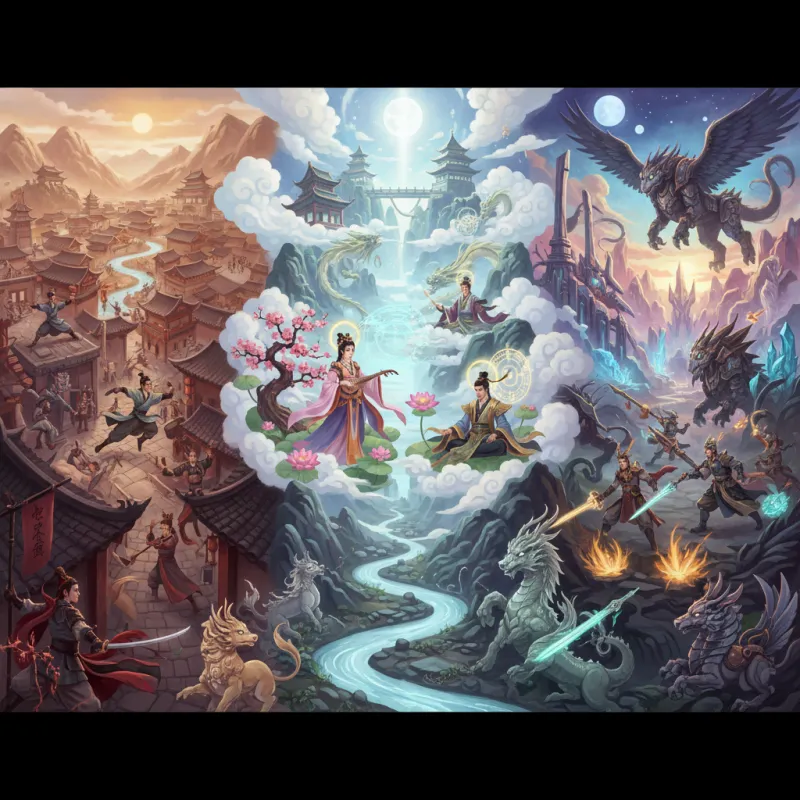
You've just finished a wuxia novel where heroes leap across rooftops and duel with swords. Next, you pick up a xianxia story where cultivators split mountains and ascend to godhood. Then someone recommends a xuanhuan tale mixing Chinese mythology with Western magic systems. Wait—aren't these all just "Chinese fantasy"? Not quite. These three genres represent fundamentally different approaches to power, mortality, and what it means to be a hero in Chinese fiction.
The Historical Roots: Where It All Began
Wuxia (武侠, wǔxiá) emerged first, with roots stretching back to Tang Dynasty (618-907 CE) tales of wandering swordsmen and righteous outlaws. But the modern wuxia we know today crystallized in early 20th century newspaper serials. Writers like Liang Yusheng and Jin Yong transformed martial arts fiction into sophisticated literature, creating the template that would spawn its fantastical descendants.
The genre explosion happened in the 1990s and 2000s, when Chinese web novels democratized storytelling. Suddenly, anyone could publish serialized fiction online, and readers hungry for more fantastical power systems pushed beyond wuxia's human limitations. Xianxia and xuanhuan emerged from this creative fermentation, each taking different elements from wuxia's DNA and amplifying them to extremes.
Wuxia: The Grounded Warrior
In wuxia, heroes are still fundamentally human. Yes, they can leap onto rooftops and deflect arrows, but they bleed, age, and die. The power system revolves around neigong (内功, nèigōng)—internal energy cultivation—and mastery of martial techniques. A wuxia master like Guo Jing from Jin Yong's Legend of the Condor Heroes spends decades perfecting the Eighteen Dragon-Subduing Palms, but he's not going to fly to the moon or live for millennia.
The settings ground themselves in recognizable Chinese history. Jin Yong set his novels during the Song Dynasty, the Ming-Qing transition, or other specific historical periods. Real locations matter—Shaolin Temple, Mount Hua, the Yangtze River. Even when the history is fictionalized, it maintains internal consistency with the real world's physics and geography.
What drives wuxia stories is the jianghu (江湖, jiānghú)—literally "rivers and lakes," but meaning the martial arts underworld where heroes operate outside official authority. Themes revolve around loyalty to one's master, righteous revenge, protecting the weak, and the tension between personal freedom and social duty. The conflicts are human-scale: clan rivalries, political intrigue, forbidden love, and the eternal question of what justice means when the law is corrupt.
For readers interested in how these martial arts connect to actual Chinese combat traditions, explore our guide to Chinese martial arts history.
Xianxia: The Immortal Cultivator
Xianxia (仙侠, xiānxiá) takes the "xia" (hero) from wuxia but replaces "wu" (martial) with "xian" (immortal). This isn't just a power upgrade—it's a philosophical shift. Xianxia draws from Daoist cultivation practices, Buddhist cosmology, and Chinese mythology to create worlds where humans can transcend mortality itself through cultivation.
The power system is structured and hierarchical: Qi Condensation, Foundation Establishment, Golden Core, Nascent Soul, and so on, with each realm representing a fundamental transformation of existence. A cultivator in I Shall Seal the Heavens by Er Gen doesn't just get stronger—they literally reconstruct their body, soul, and relationship with the universe. At high levels, they can create pocket dimensions, reincarnate, and manipulate the laws of reality.
Settings abandon historical pretense for pure fantasy. Xianxia worlds feature multiple realms (mortal realm, spirit realm, immortal realm), ancient sects controlling sacred mountains, secret dimensions filled with spiritual treasures, and cosmologies where the universe itself has cultivation levels. Geography serves the story's power progression rather than historical accuracy.
The core theme is self-improvement through cultivation—a solitary path where the protagonist must overcome tribulations (both literal lightning tribulations and metaphorical ones) to advance. Relationships often take a backseat to the pursuit of the Dao (道, dào). Where wuxia asks "What does it mean to be a righteous hero?", xianxia asks "What does it mean to transcend human limitations?" The answer usually involves a lot of alchemy, meditation, and fighting over spiritual herbs.
Xuanhuan: The Anything-Goes Fantasy
Xuanhuan (玄幻, xuánhuàn) translates roughly to "mysterious fantasy," and that vagueness is intentional. This genre is the wild child of Chinese fantasy, mixing Chinese elements with Western fantasy, science fiction, and whatever else sounds cool. Think of it as Chinese fantasy's experimental playground.
Power systems in xuanhuan are eclectic. You might find cultivation alongside Western-style magic levels, genetic modifications, or video game-inspired stat systems. Battle Through the Heavens by Tian Can Tu Dou features Dou Qi (斗气, dòuqì) cultivation that feels more like a shonen anime power system than traditional Chinese cultivation. The focus is on creating exciting progression mechanics rather than adhering to any particular cultural framework.
Settings range from alternate historical Chinas to completely invented fantasy worlds to modern Earth with hidden supernatural elements. Some xuanhuan novels feature transmigration—protagonists from our world entering fantasy realms, often bringing modern knowledge or game-like systems. This meta-awareness distinguishes xuanhuan from the more earnest worldbuilding of xianxia.
Thematically, xuanhuan prioritizes entertainment and wish-fulfillment. The protagonist often starts weak but possesses some unique advantage (a mysterious ring, a system, reincarnated memories) that enables rapid power growth. Where wuxia explores honor and xianxia explores transcendence, xuanhuan explores "What if I could become the strongest through clever exploitation of this world's rules?"
The Power Ceiling: Where Heroes Stop
The clearest distinction between these genres is their power ceiling. In wuxia, the strongest masters might defeat a hundred soldiers, but they can't topple kingdoms single-handedly. Dugu Qiubai from Jin Yong's novels is considered invincible, yet he's still bound by human limitations—he ages, he can be poisoned, he needs to eat.
Xianxia cultivators at peak levels become cosmic entities. They create universes, manipulate time, and exist beyond conventional death. The protagonist of Desolate Era by I Eat Tomatoes eventually becomes powerful enough to threaten the structure of reality itself. The power scaling is exponential and often absurd by wuxia standards.
Xuanhuan occupies a flexible middle ground. Some xuanhuan novels feature god-tier powers rivaling xianxia, while others keep things closer to wuxia's enhanced-human level. The power ceiling serves the story rather than following genre conventions.
Which Genre Is Right for You?
Choose wuxia if you want grounded historical fantasy with complex characters navigating moral ambiguity. The best wuxia novels read like literary fiction that happens to feature sword fights. Jin Yong's works remain the gold standard—start with The Legend of the Condor Heroes for classic adventure or Demi-Gods and Semi-Devils for philosophical depth.
Choose xianxia if you crave epic power progression and don't mind protagonists who spend chapters in meditation caves. The genre rewards patience—early arcs might feel slow, but the payoff when your protagonist finally breaks through to the next realm is genuinely thrilling. Coiling Dragon by I Eat Tomatoes offers accessible entry into xianxia's conventions.
Choose xuanhuan if you want variety and aren't precious about cultural authenticity. These novels often move faster than xianxia and aren't afraid to subvert tropes. Martial God Asura exemplifies xuanhuan's anything-goes attitude, though be warned—it's controversial for its extreme violence and moral flexibility.
The Blurred Lines
In practice, these genres overlap more than purists admit. Modern wuxia sometimes incorporates light fantasy elements. Some xianxia novels feature jianghu politics that feel very wuxia. Xuanhuan borrows freely from both. Grandmaster of Demonic Cultivation by Mo Xiang Tong Xiu blends wuxia's historical aesthetics with xianxia's cultivation system, creating something that defies easy categorization.
The genre labels matter less than understanding what each tradition brings to the table. Wuxia contributes grounded character drama and moral complexity. Xianxia offers structured progression and cosmic scope. Xuanhuan provides creative freedom and meta-textual play. The best Chinese fantasy novels, regardless of label, synthesize these elements into something greater than their genre constraints.
For deeper exploration of the philosophical concepts underlying these genres, see our article on Daoist concepts in Chinese fantasy.
Beyond the Big Three
These three genres dominate, but Chinese fantasy includes other variations worth mentioning. Shenmo (神魔, shénmó) focuses on gods and demons, drawing from classical novels like Journey to the West. Qihuan (奇幻, qíhuàn) attempts to create Chinese-style high fantasy distinct from Western traditions. Kehuan (科幻, kēhuàn) is science fiction, though it sometimes blends with xuanhuan in stories featuring cultivation in space or technological immortality.
The genre landscape continues evolving. Contemporary authors experiment with combining Chinese fantasy elements with romance, horror, mystery, and slice-of-life. The rigid genre boundaries that once defined these categories are dissolving as writers and readers become more sophisticated.
What remains constant is the core appeal: stories about individuals striving to transcend their limitations, whether those limitations are human mortality, social injustice, or the laws of the universe itself. Whether your hero wields a sword in historical China, cultivates immortality in a fantasy realm, or exploits a game-like system in an invented world, they're all asking the same fundamental question—how far can one person go?
Related Reading
- The Ultimate Guide to Chinese Martial Arts Fiction (Wuxia)
- Wuxia in the Modern World: How Martial Arts Culture Went Global
- Best Wuxia Novels Available in English: A Reader's Guide
- Cultivation Web Novels: The Genre Taking Over the Internet
- Unraveling the Rich Tapestry of Chinese Animal Tales in Folklore
- Chinese Animation: From Ink Wash Classics to Global Hits
- The Chinese Language: Why It Is Both Impossible and Beautiful
Explore Chinese Culture
- Explore feng shui in daily life
- Explore supernatural folklore
- Explore classical Chinese literature