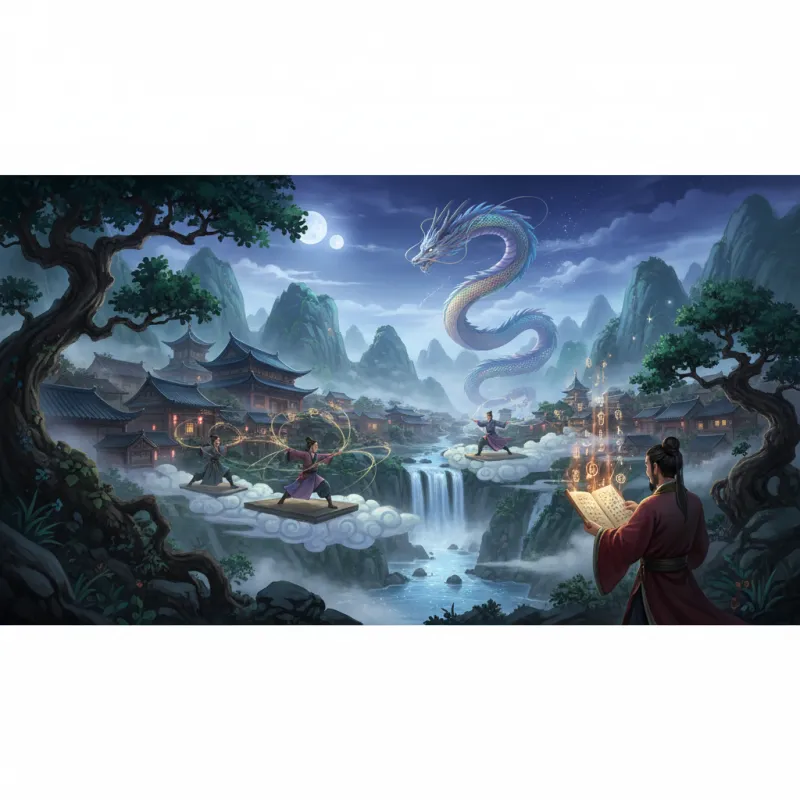
A 19-year-old in Jakarta just spent 14 hours straight reading about a trash-tier outer disciple who found a heaven-defying cultivation manual in a cave. She hasn't eaten. She's called in sick to work. Her eyes are bloodshot, but she can't stop — the protagonist just broke through to Foundation Establishment and is about to slap the face of the young master who humiliated him three hundred chapters ago. This is cultivation web novel addiction, and it's a global pandemic with no cure in sight.
What Makes Cultivation Novels Different from Regular Fantasy
You've probably read Western fantasy. You know the drill: hero gets a magic sword, fights the dark lord, saves the kingdom. Cultivation novels (修真小说, xiūzhēn xiǎoshuō) operate on completely different logic. The protagonist doesn't just get stronger through plot convenience — they systematically progress through defined cultivation realms, each requiring years of meditation, resource gathering, and life-or-death breakthroughs. Think of it as a video game RPG system meets Daoist philosophy meets shonen anime power scaling, all wrapped in thousands upon thousands of chapters.
The typical cultivation novel follows a young cultivator ascending through realms like Qi Condensation (凝气, níng qì), Foundation Establishment (筑基, zhù jī), Golden Core (金丹, jīn dān), Nascent Soul (元婴, yuán yīng), and beyond — sometimes extending to dozens of realms across multiple worlds. Each breakthrough is a mini-climax. Each realm represents a fundamental transformation of the body and soul. Western fantasy gives you a hero's journey. Cultivation novels give you a hero's eternal grind.
The genre's roots trace back to Chinese wuxia martial arts fiction, but cultivation novels crank everything up to cosmic proportions. Where wuxia heroes might master a legendary sword technique, cultivation protagonists reshape reality itself. The power creep is intentional and glorious — by chapter 2,000, your protagonist might be casually destroying galaxies while the author introduces yet another higher realm where they're back to being a weakling.
The Formula That Hooks Millions
Every cultivation novel follows a template so reliable you could set your watch by it. Protagonist starts weak or crippled. Gets a cheat ability — a mysterious ring, a system, reincarnation with memories intact, a heaven-defying bloodline. Faces arrogant young masters who look down on him. Slaps their faces (metaphorically and sometimes literally). Attracts beautiful jade-like beauties who become his harem. Offends a powerful sect or clan. Escapes, gets stronger, returns for revenge. Repeat at increasingly higher power levels.
This formula should be boring. It should be predictable. Yet readers devour it like spiritual pills that boost cultivation speed. Why? Because the formula is a feature, not a bug. Cultivation novels are comfort food fiction. You know the protagonist will win. You know the arrogant young master will regret his actions. You know justice will be served, even if it takes 500 chapters. In an uncertain world, there's something deeply satisfying about a universe that operates on clear rules where hard work (and lucky encounters) always pays off.
The best cultivation novels play with the formula while respecting it. "Reverend Insanity" (蛊真人, Gǔ Zhēnrén) features a genuinely evil protagonist who manipulates everyone around him. "Lord of the Mysteries" blends cultivation with Lovecraftian horror and Victorian aesthetics. "Forty Millenniums of Cultivation" is basically cultivation meets sci-fi mecha battles. But even these innovative works maintain the core progression system that defines the genre.
The Translation Explosion and Platform Wars
Ten years ago, reading cultivation novels in English meant hunting down fan translations on sketchy forums. Today, it's a multi-million dollar industry. Webnovel (owned by Chinese tech giant Tencent) has thousands of translated titles and pays translators professional rates. Wuxiaworld started as one guy's hobby project in 2014 and became a legitimate media company. Royal Road hosts thousands of Western authors writing cultivation-inspired originals.
The translation quality varies wildly. Professional translators on major platforms produce readable, polished work. Fan translators working for donations might update daily but with grammar that makes your eyes bleed. Machine translations — increasingly powered by AI — can pump out chapters at inhuman speed but often produce incomprehensible word salad where "young master" becomes "small lord" and cultivation realms get randomly renamed every few chapters.
This has created a strange ecosystem where readers develop tolerance for mediocre translation if the underlying story is good enough. I've seen comment sections where readers debate whether a particular translator's interpretation of a cultivation technique name is more accurate than another translator's version. The community has developed its own glossary of terms — everyone knows what "face-slapping" means, what a "jade beauty" looks like, why you should never offend someone's master or sect.
The platform wars are real. Webnovel's paywall system frustrates readers who remember when everything was free. Wuxiaworld's licensing deals mean some novels disappear mid-translation. Royal Road's Western cultivation novels often feel like they're written by people who've only read other Western cultivation novels, creating a telephone game effect where each iteration drifts further from the Chinese source material. Yet somehow the genre keeps growing, keeps attracting new readers who fall down the rabbit hole and emerge 3,000 chapters later wondering where their life went.
Why Cultivation Novels Are Basically Crack
The addiction mechanism is simple: cultivation novels are designed for binge reading. Chapters are short — typically 1,500-2,500 words. Each chapter ends on a micro-cliffhanger. The protagonist is always one breakthrough away from the next power level. One more chapter becomes ten more chapters becomes an all-night reading session where you're hate-reading because the protagonist made a stupid decision but you need to see how he gets out of it.
The progression system triggers the same dopamine hits as leveling up in video games. Every breakthrough, every new technique learned, every treasure obtained feels like tangible progress. Western fantasy novels might have one or two major power-ups across an entire trilogy. Cultivation novels have dozens across thousands of chapters. It's a constant drip-feed of achievement and advancement.
The length itself becomes addictive. A 4,000-chapter novel represents years of daily updates, a parasocial relationship between reader and author (and translator). You're not just reading a story — you're part of a community that discusses theories, complains about filler arcs, and celebrates when the protagonist finally gets revenge on that bastard who killed his family back in chapter 47. The comment sections are half the entertainment.
Critics call cultivation novels repetitive, formulaic, poorly written power fantasies for teenage boys. They're not wrong. But they're missing the point. Cultivation novels aren't trying to be literary fiction. They're trying to be the textual equivalent of potato chips — you can't eat just one chapter. The "poorly written" criticism especially misses how translation flattens the original prose, and how the serial format prioritizes momentum over polish.
The Cultural DNA Behind the Madness
Understanding cultivation novels requires understanding Chinese philosophical concepts that don't translate cleanly to English. The idea of cultivation (修炼, xiūliàn) itself comes from Daoist practices of refining the body and spirit to achieve immortality. The realms aren't arbitrary — they reflect traditional Chinese concepts of energy transformation and spiritual development. When a protagonist "condenses their Qi," they're engaging with ideas about life force (气, qì) that have existed in Chinese thought for millennia.
The emphasis on filial piety, sect loyalty, and face-saving comes directly from Confucian values. The revenge cycles that drive many plots reflect traditional Chinese concepts of justice and honor. The hierarchical power structures — where offending someone powerful means your entire clan gets exterminated — mirror historical Chinese social organization. Even the obsession with rare medicinal herbs and alchemy connects to traditional Chinese medicine and Daoist immortality practices.
This cultural foundation gives cultivation novels a distinct flavor that Western fantasy lacks. The Chinese mythology woven throughout — references to the Jade Emperor, Buddhist concepts of karma and reincarnation, legendary beasts like dragons and phoenixes — creates a rich backdrop that feels exotic to Western readers while being deeply familiar to Chinese audiences. It's why Chinese cultivation novels feel different from Western LitRPG or progression fantasy, even when they share similar mechanics.
The genre also reflects modern Chinese anxieties and aspirations. The protagonist who starts from nothing and rises through pure effort mirrors the Chinese dream of upward mobility. The emphasis on resources, connections, and background reflects real-world concerns about inequality and privilege. The escape into fantasy worlds where merit (plus lucky encounters) determines success offers wish fulfillment in a society where success often depends on factors beyond individual control.
The Western Cultivation Novel Invasion
Western authors have started writing their own cultivation novels, creating a subgenre that blends Eastern cultivation concepts with Western storytelling sensibilities. These "progression fantasy" or "cultivation-inspired" novels often feature more character development, less face-slapping, and protagonists who aren't sociopathic murderers. They also tend to be shorter — a mere 500,000 words instead of 5 million.
Some purists hate this development, arguing that Western cultivation novels miss the point by sanding off the genre's rough edges. Why read a cultivation novel where the protagonist agonizes over killing enemies? The whole appeal is watching someone ruthlessly climb the power ladder while crushing anyone who gets in their way. Others appreciate the innovation, the way Western authors experiment with cultivation mechanics while avoiding the worst genre tropes.
The best Western cultivation novels understand what they're adapting. "Cradle" by Will Wight is basically a love letter to Chinese cultivation novels, complete with sacred arts, advancement levels, and a protagonist who starts as the weakest person in his clan. "Street Cultivation" by Sarah Lin transplants cultivation into a modern urban setting where people cultivate to pay rent. "The Path of Ascension" features a cultivation system based on scientific principles rather than mystical energy.
The cross-pollination goes both ways. Chinese authors are increasingly aware of their international audience and sometimes adjust their writing accordingly. Some novels include more explanation of cultural concepts that Chinese readers would take for granted. Others tone down the nationalism and racism that pervades many Chinese web novels. The genre is evolving in real-time, shaped by a global readership that spans dozens of countries and cultures.
Why This Genre Isn't Going Anywhere
Cultivation novels have staying power because they've tapped into something fundamental about human psychology — the desire for clear progression, for justice, for the fantasy that hard work and determination can overcome any obstacle. In a world where success often feels arbitrary and unfair, cultivation novels offer a universe with transparent rules where effort always pays off (eventually, after many tribulations and lucky encounters).
The genre's serialized format also makes it perfectly suited for the internet age. Daily updates create reading habits. The sheer volume of content means you can always find something new. The low barrier to entry — anyone can write and post a cultivation novel — ensures constant innovation alongside the formulaic dross. For every ten generic "trash protagonist gets a system" novels, there's one genuinely creative work that pushes the genre forward.
The community aspect can't be understated. Cultivation novel readers are passionate, engaged, and willing to spend money on their hobby. They debate power scaling, create wikis documenting cultivation realms, write fanfiction, and commission art of their favorite characters. This active fandom sustains the ecosystem, supporting translators and authors who might otherwise give up.
As Chinese soft power grows globally, cultivation novels serve as cultural ambassadors, introducing international readers to Chinese concepts and storytelling traditions. A teenager in Mexico who starts reading cultivation novels might develop an interest in Chinese festivals or Daoist philosophy. The genre creates cultural bridges, even if those bridges are built on face-slapping and jade beauties.
The Verdict: Embrace the Madness
Should you read cultivation novels? If you value tight plotting, literary prose, and stories that respect your time, absolutely not. If you want to experience the unique pleasure of watching a protagonist go from trash to godhood across 3,000 chapters of increasingly absurd power escalation, welcome to your new addiction.
Start with something accessible — "Coiling Dragon" for classic cultivation, "Cradle" if you want a Western take, "Lord of the Mysteries" if you want something genuinely innovative. Don't expect high art. Expect entertainment, progression, and the satisfaction of watching arrogant young masters get what's coming to them. Expect to lose entire weekends to "just one more chapter." Expect to develop strong opinions about cultivation realm naming conventions.
The cultivation novel genre is messy, repetitive, often poorly written, and absolutely glorious in its excess. It's taken over the internet because it gives readers exactly what they want: endless content, clear progression, and the fantasy that anyone can become a god if they're willing to cultivate hard enough. That's a powerful drug, and millions of readers worldwide are happily addicted.
Just don't blame me when you're 2,000 chapters deep into a novel about a reincarnated demon emperor at 3 AM on a work night, unable to stop because the protagonist is about to break through to Soul Formation and you absolutely need to see what happens next.
Related Reading
- Best Wuxia Novels Available in English: A Reader's Guide
- Wuxia in the Modern World: How Martial Arts Culture Went Global
- The Ultimate Guide to Chinese Martial Arts Fiction (Wuxia)
- Wuxia vs. Xianxia vs. Xuanhuan: Chinese Fantasy Genres Explained
- Chinese Philosophy for Beginners: Confucius, Laozi, and Zhuangzi Walk Into a Bar
- The Century of Humiliation: How China Remembers
- Legendary Heroes of Chinese Folklore: Tales That Shaped Culture and Identity
Explore Chinese Culture
- Explore feng shui in daily life
- Explore supernatural folklore
- Explore classical Chinese literature