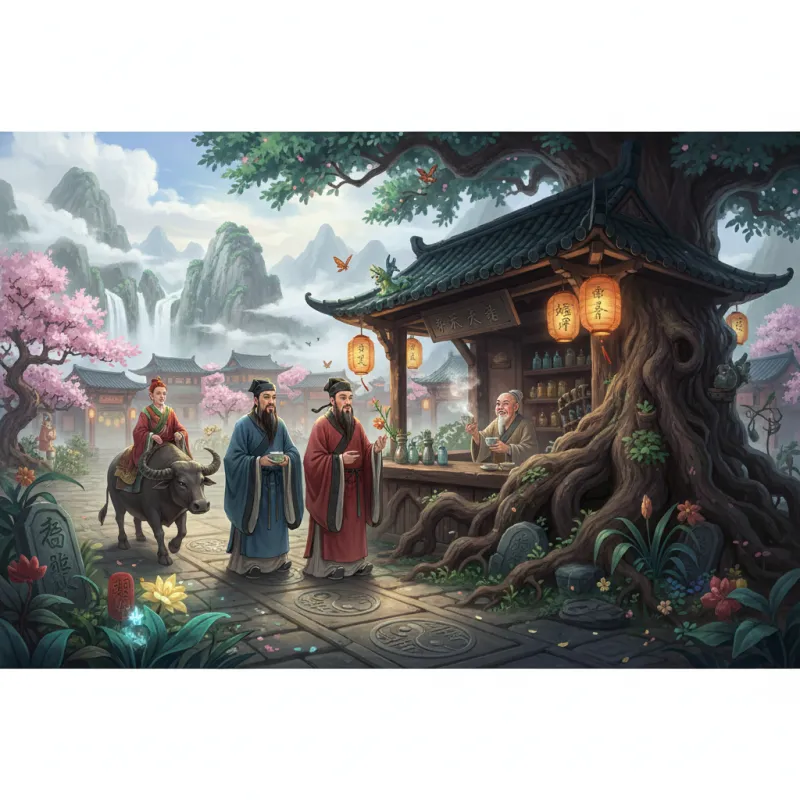
Picture this: Three old men walk into a teahouse in ancient China. The first insists everyone should follow proper etiquette and bow correctly. The second suggests they're all wasting their time and should just go home. The third asks whether the tea is actually tea or just our idea of tea, then laughs and orders wine instead. This isn't a joke setup—it's basically what happened when Confucius, Laozi, and Zhuangzi shaped Chinese thought for the next 2,500 years.
The Practical Turn: Why Chinese Philosophy Feels Different
If you've ever cracked open Plato or Descartes, you know Western philosophy loves a good abstract puzzle. What is truth? Can we prove we exist? How many angels fit on a pinhead? Chinese philosophy took a hard left turn from all that. The foundational question wasn't "what is real?" but "how do I stop screwing up my life?"
This practical bent emerged from China's Warring States period (475-221 BCE), when seven kingdoms were busy destroying each other and everyone needed answers fast. Philosophers weren't tenured professors debating in ivory towers—they were consultants pitching their ideas to desperate rulers. If your philosophy couldn't help someone govern better, maintain relationships, or find peace amid chaos, nobody wanted to hear it.
The result? Chinese philosophy reads less like academic treatises and more like self-help books written by brilliant, occasionally sarcastic old men who'd seen some things.
Confucius: The Eternal Optimist Who Believed in Homework
Confucius (孔子, Kǒngzǐ, 551-479 BCE) was basically that teacher who genuinely believes you can be better if you just apply yourself. Born during social collapse, he looked around at the chaos and thought: "You know what would fix this? Better manners and more studying."
This sounds absurd until you understand what he meant by "manners." Confucius wasn't obsessed with which fork to use. He believed that ritual (礼, lǐ) was how humans practiced being good. Bowing to your parents wasn't just etiquette—it was rehearsing respect until respect became your nature. Do it enough times, and you wouldn't need to think about being respectful. You'd just be respectful.
His teachings, collected in the Analects (论语, Lúnyǔ), read like a greatest-hits compilation of a very long teaching career. Students ask questions, Confucius answers, usually with another question or a pointed observation. When someone asked about the single word that could guide your whole life, Confucius said: reciprocity (恕, shù). Don't do to others what you wouldn't want done to you. Sound familiar? He said it five centuries before Jesus.
The core of Confucian thought is ren (仁), often translated as "benevolence" or "humaneness," but really meaning something like "being a decent human in relation to other humans." You cultivate ren through education, self-reflection, and practicing those rituals until virtue becomes second nature. Confucius believed anyone could become a junzi (君子)—a "gentleman" or "exemplary person"—through effort. No divine grace required, no mystical enlightenment needed. Just work.
His critics (and he had many) thought this was naive. How can ritual and education fix a broken world? Confucius would probably say: what's your better idea?
Laozi: The Mysterious Dropout Who Wrote One Book and Vanished
If Confucius was the earnest teacher, Laozi (老子, Lǎozǐ) was the cryptic hermit who showed up, dropped some wisdom bombs, and disappeared into the mountains. We're not even sure he existed. The Daodejing (道德经, Dàodéjīng), attributed to him, might have been written by multiple people over centuries. But the legend is too good: Laozi was a court archivist who got fed up with civilization, decided to leave, and was stopped at the border by a guard who said, "You can't leave until you write down what you know." So Laozi wrote 5,000 characters of the most paradoxical, beautiful, frustrating philosophy ever composed, then rode off on a water buffalo and was never seen again.
The Daodejing is about the Dao (道, Dào)—"the Way"—which is the fundamental nature of reality. Except you can't really describe it. The opening line famously states: "The Dao that can be spoken is not the eternal Dao." Great start, Laozi. Very helpful.
But here's what he's getting at: reality has a natural flow, a way things want to go. Water flows downhill. Babies don't need lessons in breathing. Trees don't stress about growing. The universe has its own intelligence, and humans keep screwing things up by overthinking and overcontrolling everything.
Laozi's solution? Wu wei (无为, wú wéi)—"non-action" or "effortless action." This doesn't mean doing nothing. It means acting in harmony with the natural flow rather than forcing things. The best ruler governs so subtly that people think they're governing themselves. The best teacher teaches without lecturing. The softest water wears down the hardest stone, not through force but through persistence and yielding.
This was a direct shot at Confucius and his rituals and rules. Laozi thought all that structure was exactly the problem. You can't force people to be good through education and etiquette. You can only create conditions where goodness emerges naturally. It's the difference between training a tree with wires and stakes versus planting it in good soil and letting it grow.
Zhuangzi: The Comedian Who Dreamed He Was a Butterfly
If Laozi was cryptic, Zhuangzi (庄子, Zhuāngzǐ, 369-286 BCE) was completely unhinged—in the best way. He took Daoist ideas and ran them through a funhouse mirror of parables, jokes, and thought experiments that still mess with your head today.
The most famous: Zhuangzi dreamed he was a butterfly, fluttering around, happy and free. When he woke up, he wasn't sure if he was Zhuangzi who dreamed he was a butterfly, or a butterfly now dreaming he was Zhuangzi. This isn't just a cute story—it's a genuine philosophical problem about the nature of identity and reality.
Zhuangzi's writings are full of these moments. He tells stories about useless trees that survive because nobody wants to cut them down, about a cook whose knife never dulls because he cuts along the natural grain of the meat, about a man who mourns his wife's death by singing and drumming because he realizes death is just another transformation in the endless cycle of change.
His philosophy is more radical than Laozi's. Where Laozi suggested working with the natural flow, Zhuangzi questioned whether our categories and distinctions mean anything at all. Is life really better than death? Is being useful better than being useless? Is human perspective more valid than a butterfly's? Maybe we're all just making up stories and taking them too seriously.
When Zhuangzi's wife died, his friends found him singing and banging on a pot. Shocked, they asked how he could be so disrespectful. He explained that at first he grieved, but then he realized she had simply returned to the natural state before birth. Why mourn one transformation and not another? This is either profound wisdom or deeply weird coping—possibly both.
Zhuangzi's ultimate goal was xiaoyao (逍遥, xiāoyáo)—"free and easy wandering"—a state of complete spiritual freedom where you're not trapped by social conventions, personal attachments, or even your own perspective. You become like the Daoist sage who can ride the wind and clouds, not because of magic powers, but because he's stopped clinging to fixed ideas about how things should be.
The Eternal Argument: Structure vs. Flow
These three philosophers represent a fundamental tension that still plays out today. Confucius says: build good habits, follow proven wisdom, cultivate virtue through practice. Laozi says: stop trying so hard, trust the natural way, less is more. Zhuangzi says: your categories are arbitrary, your goals are questionable, have you considered just vibing?
It's the same argument happening in modern life. Should you have a detailed morning routine or go with the flow? Should you follow traditional career paths or trust your intuition? Should you optimize everything or question whether optimization itself is the problem?
The beautiful thing is that Chinese culture never picked a winner. All three schools influenced Chinese thought, art, government, and daily life. A Confucian official might govern by the rules during the day, practice Daoist meditation in the evening, and read Zhuangzi's wild stories before bed. You can see this synthesis in Chinese landscape painting, where human structures exist in harmony with natural forms, or in traditional tea ceremony, which combines Confucian ritual with Daoist spontaneity.
What This Means for Your Life (The Part Where Ancient Wisdom Gets Practical)
Here's why this matters beyond historical curiosity: these philosophers were grappling with the same questions you face. How much should you plan versus adapt? When should you follow rules versus trust your instincts? How do you find meaning in a chaotic world?
Confucius would tell you to focus on what you can control—your own character, your relationships, your daily practices. Build a life on solid principles. Be the person who shows up, does the work, and treats people with respect. It's not flashy, but it works.
Laozi would tell you to stop forcing things. Notice where you're swimming against the current. Find the path of least resistance that still gets you where you need to go. Sometimes the answer is to want less, control less, worry less.
Zhuangzi would tell you that your problems might not be problems. Your failures might be successes. Your limitations might be freedoms. He'd probably also tell you to stop taking his advice so seriously and go watch clouds for a while.
The real wisdom is knowing which philosopher you need in any given moment. Struggling with discipline? Channel Confucius. Burning out from overwork? Listen to Laozi. Taking yourself too seriously? Zhuangzi's got you.
The Teahouse Ending
Back to our three old men in the teahouse. Confucius orders tea and drinks it with proper ceremony, grateful for the tradition that brings people together. Laozi orders tea but barely touches it, content just to sit. Zhuangzi orders wine, spills it, laughs, and orders tea instead, then questions whether he's really thirsty or just thinks he should be.
They're all right. They're all wrong. They're all trying to answer the same question: how do you live well in a world that doesn't come with instructions?
The answer, like most things in Chinese philosophy, is both simpler and more complicated than you'd expect. You study the masters, you practice what resonates, you adapt to circumstances, and you keep walking the path. The Dao that can be spoken isn't the eternal Dao, but we keep speaking it anyway, because what else are we going to do?
That's the real lesson these three philosophers teach: wisdom isn't about finding the one true answer. It's about holding multiple perspectives, knowing when to apply which approach, and being humble enough to admit that a butterfly might understand something you don't.
Related Reading
- The Complete Guide to Chinese Culture: Everything You Need to Know
- Mencius on Human Nature: Are We Born Good?
- Wu Wei: The Taoist Art of Doing Nothing (and Getting Everything Done)
- Confucius: The Key Teachings That Shaped East Asia
- Laozi and the Tao Te Ching: A Practical Guide
- Discovering the Rich Tapestry of Chinese Folklore: Myths, Legends, and Traditions
- Unraveling the Rich Tapestry of Chinese Animal Tales in Folklore
- Chinese Internet Culture: Memes, Slang and Digital Life
Explore Chinese Culture
- Explore feng shui in daily life
- Explore supernatural folklore
- Explore classical Chinese literature