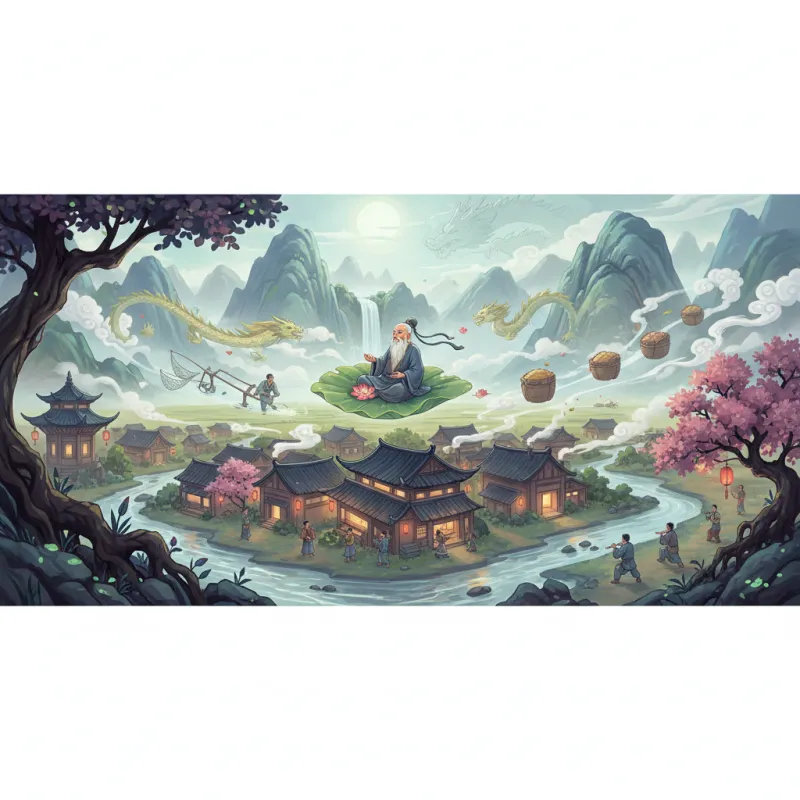
The best swordsman in ancient China never drew his blade. According to the Zhuangzi (莊子), when a master named Zhao Wenzi asked the legendary swordsman Liezi about his technique, Liezi replied that he had forgotten how to fight. His opponent, sensing nothing to attack, would simply walk away. This wasn't pacifism or cowardice—it was 无为 (wú wéi), the Taoist art of accomplishing everything by forcing nothing.
What Wu Wei Actually Means (And Why Everyone Gets It Wrong)
Most English translations render wú wéi as "non-action" or "doing nothing," which is like translating "jazz" as "organized noise"—technically defensible, catastrophically misleading. The character 无 (wú) means "without" or "lacking," and 为 (wéi) means "action" or "doing," but the compound doesn't mean sitting on your couch eating dumplings while life passes by. It means action without strain, effort without force, doing without the exhausting interference of your ego's agenda.
The Dao De Jing (道德經), written around the 6th century BCE by the possibly-mythical Laozi, puts it plainly: "The sage does nothing, yet nothing remains undone" (聖人無為而無不為). This sounds like mystical nonsense until you watch a skilled cook dice vegetables—the knife seems to move itself, finding the natural seams in the food. That's wú wéi. The cook isn't "doing nothing," but neither is she muscling through the task. She's aligned her action with the grain of reality.
Compare this to Confucian thought, which emphasizes 礼 (lǐ)—ritual propriety and deliberate cultivation of virtue. While Confucius advocated conscious effort to become a superior person, Daoists argued that too much trying creates the very problems you're attempting to solve. It's the difference between Confucian self-cultivation and Daoist spontaneity, though the two traditions influenced each other more than their adherents liked to admit.
The Water That Wears Down Stone
Laozi's favorite metaphor for wú wéi was water. "Nothing in the world is softer than water," he wrote, "yet nothing is better at overcoming the hard and strong." Water doesn't attack a rock—it simply flows around it, over it, through its cracks. Given enough time, the rock becomes sand. Water never "tries" to erode stone; erosion is simply what happens when water acts according to its nature.
This isn't passivity. A river carves canyons. Ocean waves reshape coastlines. But water never forces—it finds the path of least resistance and follows it with patient, relentless consistency. The Daoist sage operates the same way, responding to circumstances rather than imposing predetermined plans on an uncooperative universe.
During the Warring States period (475-221 BCE), when China was fragmenting into violence, this philosophy had obvious appeal. The Zhuangzi tells of a butcher named Ding who served the ruler Wen Hui. After watching Ding carve an ox with balletic precision, the ruler asked about his technique. Ding explained that he no longer saw the ox as a solid object—he perceived the spaces between joints, the natural hollows where his blade could pass without resistance. "A good cook changes his knife once a year—he cuts. A mediocre cook changes his knife once a month—he hacks. I've had this knife for nineteen years, and its blade is still sharp as the day it was forged."
Wu Wei in Action: From Governance to Gongfu
The political implications of wú wéi were radical. If the best action is effortless action, then the best government is minimal government. The Dao De Jing advocates for rulers who govern so lightly that citizens barely notice they exist: "When the work is done and affairs are settled, the people say, 'We did it ourselves.'" This wasn't libertarian ideology—it was a critique of the Legalist school's harsh laws and the Confucian emphasis on moral instruction. Both approaches, Daoists argued, created resistance by trying to force human nature into unnatural shapes.
The Han Dynasty (206 BCE - 220 CE) initially embraced wú wéi as state policy during the reign of Emperor Wen, implementing light taxation and minimal interference in local affairs. The economy recovered from decades of war. But as the dynasty matured, Confucian bureaucracy gradually displaced Daoist restraint—a pattern that would repeat throughout Chinese history.
In martial arts, wú wéi became foundational. Taijiquan (太極拳), developed during the Ming Dynasty, explicitly teaches practitioners to "overcome hardness with softness" (以柔克剛). When an opponent pushes, you don't push back—you yield, redirect, and use their force against them. The legendary martial artist Yang Luchan (1799-1872) supposedly never injured his opponents; he simply moved in ways that made their attacks collapse into emptiness. Whether the stories are true matters less than what they reveal about the ideal: perfect defense requires no defense, because there's nothing to attack.
Traditional Chinese Medicine applies the same principle. Rather than aggressively attacking disease, practitioners aim to restore the body's natural balance, allowing health to emerge spontaneously. The doctor who understands yin and yang doesn't force the body into health—she removes obstacles and lets the body heal itself.
The Paradox of Trying Not to Try
Here's where wú wéi gets philosophically interesting and practically frustrating: you can't achieve effortless action by trying to be effortless. The moment you consciously attempt wú wéi, you've already failed. It's like trying to fall asleep—the harder you try, the more awake you become. The Daoist solution is 自然 (zìrán), often translated as "naturalness" or "spontaneity." You cultivate wú wéi not through effort but through practice that eventually becomes second nature.
The Zhuangzi illustrates this with the story of a swimmer who navigates a dangerous waterfall. When asked how he survives, he explains: "I enter with the inflow and emerge with the outflow, follow the Way of the water rather than impose my own way, and thus I survive." He's not calculating angles or fighting currents—he's become so attuned to the water that his movements arise spontaneously from the situation itself.
This is why Daoist texts often seem contradictory. They tell you to practice wú wéi, but practicing implies effort, and effort contradicts wú wéi. The resolution is that you practice until practice dissolves into spontaneity. The musician practices scales until music flows without thought. The calligrapher practices strokes until the brush moves by itself. The sage practices wú wéi until there's no one left who's practicing.
Why Modern Life Makes Wu Wei Nearly Impossible (And Why We Need It More Than Ever)
Contemporary culture is fundamentally anti-wú wéi. We celebrate "hustling," "grinding," and "crushing it"—metaphors of violence and force. We're told that success requires relentless effort, that rest is laziness, that if you're not exhausted you're not trying hard enough. The result is epidemic burnout, anxiety, and the nagging sense that we're pushing boulders uphill while life flows past us.
The Daoist critique remains relevant: we create most of our problems by trying too hard to solve them. The insomniac who desperately pursues sleep pushes it further away. The anxious person who fights anxiety feeds it. The writer who forces words produces garbage. Sometimes the most productive thing you can do is stop doing and start allowing.
But wú wéi isn't an excuse for laziness or abdication. It's not "going with the flow" if the flow leads off a cliff. It requires deep understanding of situations, keen perception of natural patterns, and the wisdom to distinguish between obstacles that need circumventing and those that need confronting. The farmer practices wú wéi by planting in spring, but she still has to plant. The water wears down stone, but it has to keep flowing.
Practicing the Unpracticeable
So how do you cultivate wú wéi without trying to cultivate it? The Daoist answer is indirect: pay attention to nature, notice where you're forcing, and gradually learn to recognize the difference between effort and strain. Watch how trees grow without trying to grow, how your breath breathes without being breathed, how your heart beats without being beaten.
Start small. Notice when you're gripping the steering wheel too tightly, when you're using more force than necessary to type, when you're pushing a conversation instead of letting it unfold. These micro-moments of unnecessary effort are where wú wéi practice begins. Not by trying harder to relax, but by simply noticing the tension and allowing it to release.
The Dao De Jing ends with a paradox that captures the entire teaching: "The way to do is to be." Not to do nothing, but to align doing with being so completely that action becomes as natural as breathing. The swordsman who never draws his blade. The cook whose knife never dulls. The ruler whose people govern themselves. The life that accomplishes everything by forcing nothing.
That's wú wéi. Not the absence of action, but action so perfectly aligned with reality that it feels like the universe is doing the work. Which, according to Daoists, it always was.
Related Reading
- The Complete Guide to Chinese Culture: Everything You Need to Know
- Confucius Was Not Confucian (And Other Surprises About China's Most Famous Philosopher)
- Zhuangzi's Butterfly Dream: What Is Reality?
- Confucius: The Key Teachings That Shaped East Asia
- Yin and Yang Explained: Beyond the Black and White Symbol
- Calligraphy as Meditation Practice
- Real Chinese Martial Arts: Beyond the Movie Myths
- Chinese Proverbs and Their Stories: Wisdom in Four Characters
Explore Chinese Culture
- Explore feng shui in daily life
- Explore supernatural folklore
- Explore classical Chinese literature