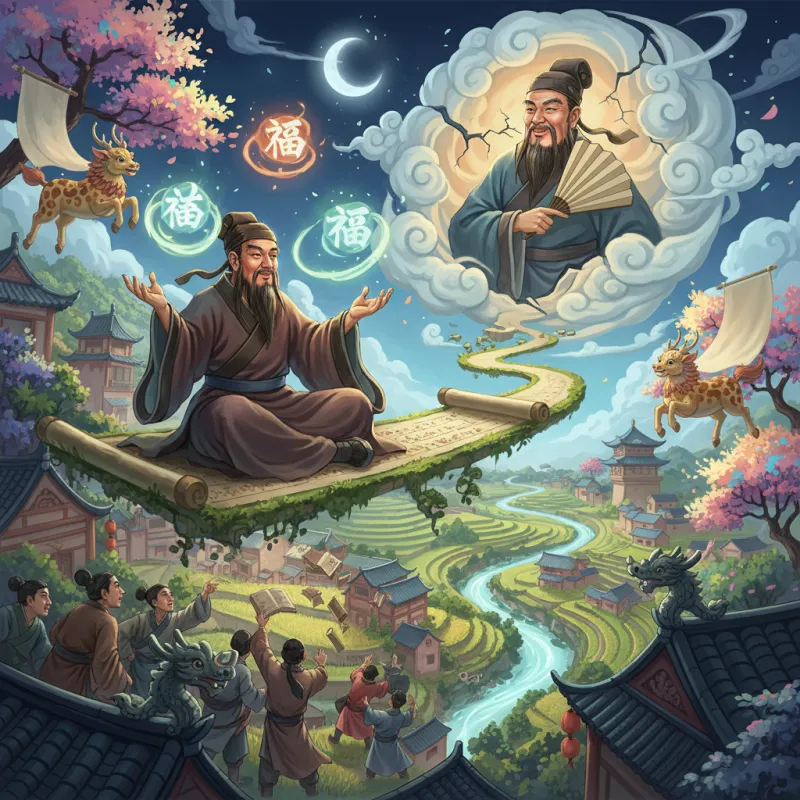
The imperial examination system that dominated China for over a millennium tested candidates on their mastery of Confucian texts. Pass the exams, and you could rise from peasant to prime minister. Fail, and you'd spend your life in obscurity. Millions of men memorized the Analects, the Mencius, and the Doctrine of the Mean, believing they were absorbing the wisdom of the great sage Confucius. But here's the uncomfortable truth: Confucius himself would have failed these exams spectacularly. The man who became "Confucianism" spent his entire career as a political failure, questioned authority constantly, and advocated for ideas that directly contradicted what later emperors claimed he taught.
The Wandering Failure
Confucius (孔子, Kǒngzǐ, 551-479 BCE) wasn't a philosopher by choice. He was a frustrated politician. Born in the state of Lu during the chaotic Spring and Autumn period, when the Zhou dynasty had collapsed into dozens of warring states, Confucius believed he had the solution to China's problems: moral leadership. Not military might, not clever strategy, but rulers who led by ethical example.
So he did what any ambitious advisor would do — he went job hunting. For roughly thirteen years, from his fifties into his sixties, Confucius traveled from state to state with his disciples, offering his services to any ruler who would listen. He pitched his vision of government by virtue to the Duke of Wei, the rulers of Chen, Cai, and Chu. He was polite, persistent, and utterly unsuccessful.
Why didn't anyone hire him? Because Confucius was impractical. He told rulers they needed to be moral exemplars when they wanted to know how to crush their enemies. He insisted on ritual propriety when they needed military strategy. One ruler kept him waiting for years, dangling the possibility of a position, then gave the job to someone else. Another listened politely, then ignored every suggestion. Confucius died having never implemented his political vision, convinced he had failed his life's mission.
The irony is almost painful: the man whose ideas would shape Chinese government for two millennia never successfully governed anything.
What Confucius Actually Said
Strip away two thousand years of imperial interpretation, and Confucius sounds surprisingly radical. He believed that anyone could become a superior person (君子, jūnzǐ) through education and self-cultivation — not through birth or social status. This was revolutionary in an age of rigid aristocracy.
When asked about governance, Confucius didn't preach blind obedience. He said rulers must earn legitimacy through virtue. If a ruler governed badly, he lost the Mandate of Heaven (天命, tiānmìng). This concept would later justify numerous rebellions and dynastic changes, though imperial Confucians tried to downplay this inconvenient detail.
Confucius also questioned tradition constantly. Yes, he valued ritual (禮, lǐ), but not empty ritual. In the Analects, he criticizes people who perform ceremonies without understanding their meaning. "If a man is not humane, what is the use of ritual?" he asks. This is not the voice of rigid conservatism — it's someone demanding that tradition serve human flourishing, not the other way around.
Most surprisingly, Confucius admitted ignorance freely. When asked about spirits and the afterlife, he replied: "We don't yet know how to serve the living, how can we serve the dead?" This pragmatic agnosticism disappeared in later Confucianism, which became entangled with elaborate ancestor worship and cosmic philosophy that Confucius himself never discussed.
How Confucius Became "Confucianism"
The transformation began with Confucius's followers, particularly Mencius (孟子, Mèngzǐ) and Xunzi (荀子, Xúnzǐ), who developed his ideas in different directions. Mencius emphasized human goodness; Xunzi stressed the need for social control. Both claimed to represent authentic Confucianism.
Then came the Han dynasty (206 BCE - 220 CE). Emperor Wu needed an ideology to legitimize his rule and unify his vast empire. Buddhism hadn't arrived yet. Daoism was too individualistic and anti-authoritarian. But Confucianism — or rather, a carefully edited version of it — was perfect. Emphasize the parts about social hierarchy, loyalty to superiors, and respect for authority. Downplay the bits about rulers needing to earn legitimacy and the right to rebel against bad government.
The scholar Dong Zhongshu did the heavy lifting, creating a cosmic Confucianism that connected human society to the natural order. The emperor became the Son of Heaven, the essential link between earth and sky. Questioning the emperor meant disrupting cosmic harmony. This metaphysical framework appears nowhere in the Analects.
By the Song dynasty (960-1279 CE), Neo-Confucian scholars like Zhu Xi had created an elaborate philosophical system incorporating Buddhist and Daoist concepts. They claimed this was what Confucius really meant all along. The simple ethical teachings of a failed politician had become a comprehensive worldview governing everything from cosmology to family structure.
The Three Bonds That Confucius Never Mentioned
The most famous Confucian doctrine is the Three Bonds (三綱, sāngāng): ruler over subject, father over son, husband over wife. These hierarchical relationships supposedly form the foundation of Confucian society. There's just one problem: Confucius never said this.
The Three Bonds appear in the Classic of Rites (禮記, Lǐjì), compiled centuries after Confucius died. They reflect Han dynasty political needs, not the teachings of the historical Confucius. In the Analects, Confucius discusses relationships as reciprocal. Yes, children should respect parents — but parents must be worthy of respect. Yes, subjects should serve rulers — but rulers must govern justly.
The difference is crucial. Reciprocal relationships allow for criticism and correction. Hierarchical bonds demand absolute obedience. Imperial Confucianism chose hierarchy because it served state power. The actual Confucius was more nuanced, more humane, and far less useful to autocrats.
This distortion had real consequences. For centuries, Chinese women were told that Confucius mandated their subordination to men. The practice of foot binding, which crippled millions of women, was justified as Confucian propriety. Yet Confucius never discussed foot binding (it didn't exist in his time) and said relatively little about women at all. The oppression was real, but calling it "Confucian" was historical revisionism.
The Examination Hell
Nothing illustrates the gap between Confucius and Confucianism better than the imperial examination system. Starting in the Sui dynasty (581-618 CE) and reaching its full form under the Song, these exams tested candidates on their ability to memorize and interpret Confucian classics. Success meant government position, wealth, and prestige. Failure meant shame and poverty.
Candidates spent decades memorizing texts, learning to write in the rigid "eight-legged essay" format, and absorbing orthodox interpretations. Creativity was punished. Original thinking was dangerous. The goal was perfect reproduction of approved ideas.
Confucius would have hated this. He valued independent thinking and questioned received wisdom. "Learning without thought is labor lost; thought without learning is perilous," he said. The examination system demanded learning without thought — pure memorization of what others had decided Confucius meant.
The system also contradicted Confucius's belief in moral education. The exams tested literary skill and memory, not ethical character. Plenty of examination graduates were corrupt officials who could quote the Analects while embezzling state funds. Confucius had warned against exactly this: people who knew the words but missed the meaning.
Reclaiming the Human Confucius
Modern scholars have worked to separate the historical Confucius from imperial Confucianism. It's not easy. We have no writings directly from Confucius — only the Analects, compiled by disciples after his death. Every text has been filtered through centuries of interpretation.
But a human figure does emerge: a man who cared deeply about ethics and education, who believed in human potential, who questioned authority while respecting tradition, and who died thinking he had failed. He was neither the rigid conservative of imperial propaganda nor the proto-democrat some modern interpreters claim. He was a product of his time, with blind spots we can recognize today, but also with insights that remain valuable.
Understanding this distinction matters. When people criticize "Confucianism" for authoritarianism or patriarchy, they're often criticizing the imperial system, not the man. When they praise "Confucian values" like education and family loyalty, they're often praising ideas that predate Confucius or that he shared with other ancient thinkers.
The real Confucius was more interesting than the myth — more human, more contradictory, more alive. He was a teacher who admitted ignorance, a traditionalist who questioned tradition, a political failure whose ideas conquered an empire. He wasn't Confucian. He was just Confucius, trying to figure out how humans could live together ethically in a chaotic world. Two and a half millennia later, we're still working on the same problem.
For more on how Chinese philosophical traditions evolved, see The Daoist Sage Who Never Existed and Why Chinese Philosophy Isn't Really Philosophy.
Related Reading
- Confucius: The Key Teachings That Shaped East Asia
- Mencius on Human Nature: Are We Born Good?
- Chinese Philosophy for Beginners: Confucius, Laozi, and Zhuangzi Walk Into a Bar
- Laozi and the Tao Te Ching: A Practical Guide
- Wu Wei: The Taoist Art of Doing Nothing (and Getting Everything Done)
- The Enchanting World of Chinese Folklore: Legends and Cultural Traditions
- Modern Retellings of Chinese Folklore: Bridging Ancient Legends and Contemporary Culture
- Tea and Zen: The Spiritual Connection
Explore Chinese Culture
- Explore feng shui in daily life
- Explore supernatural folklore
- Explore classical Chinese literature