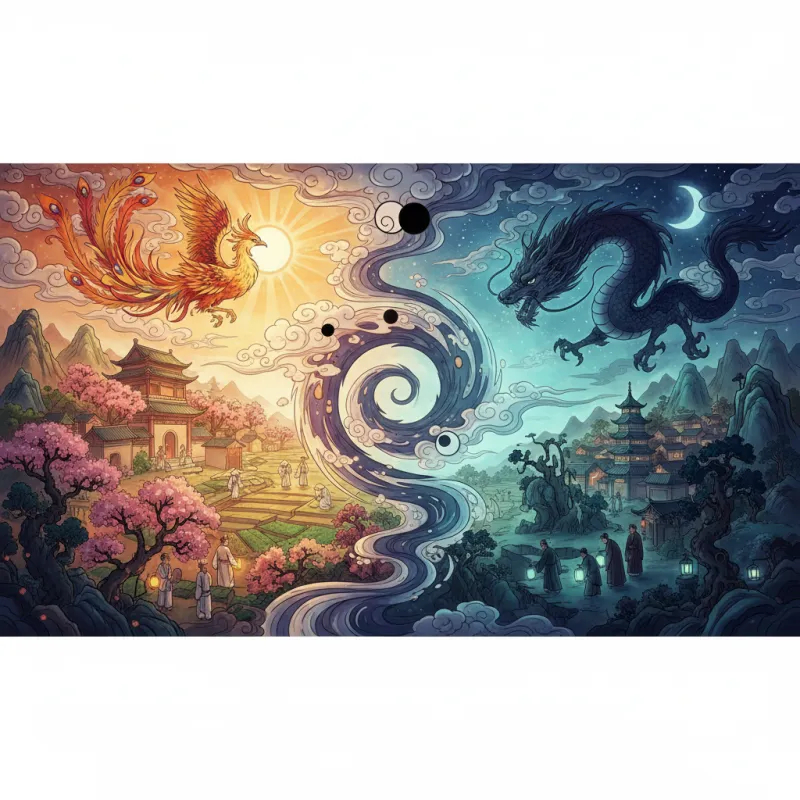
You've probably seen the symbol a thousand times—that swirling circle of black and white, each half containing a dot of its opposite color. It's on T-shirts, coffee mugs, corporate logos for "synergy." But here's what most people miss: 阴阳 (Yīn Yáng) isn't about balance. It's about transformation. The ancient Chinese philosophers who developed this framework weren't trying to create a pretty symbol for dorm room posters. They were attempting to describe the fundamental pattern of reality itself—and they believed everything from your liver function to the rise and fall of dynasties followed the same relentless cycle.
The Original Meaning: Shade and Sunlight
The characters themselves tell you where this started. 阴 (Yīn) originally meant the shady side of a hill. 阳 (Yáng) meant the sunny side. That's it. No mysticism, no cosmic forces—just an observation that one side of a mountain gets sun while the other doesn't. But here's the crucial insight that ancient Chinese thinkers had around the 5th century BCE: the shady side doesn't stay shady. As the sun moves across the sky, what was dark becomes light. What was cold becomes warm. The mountain hasn't changed, but everything about it has transformed.
This observation became the foundation for an entire worldview. The 易经 (Yì Jīng, Book of Changes), compiled during the Western Zhou Dynasty (1046–771 BCE), doesn't actually use the term "Yin-Yang" much—it talks about 阴爻 (yīn yáo, broken lines) and 阳爻 (yáng yáo, solid lines) that combine into hexagrams. But the principle is there: nothing is static, everything transforms into its opposite, and this transformation follows observable patterns. By the time of the Warring States period (475–221 BCE), the 阴阳家 (Yīn Yáng Jiā, Yin-Yang School) had systematized these observations into a full cosmological theory.
What Yin and Yang Actually Describe
Here's where Western interpretations usually go wrong. Yin and Yang aren't "good and evil" or even "male and female" in any fixed sense. They're relative descriptors of qualities in relationship to each other. Water is Yin compared to fire, but Yang compared to ice. A woman's body is generally Yin, but her activity and movement are Yang. Summer is Yang, but a cool summer morning has Yin qualities within that Yang season.
The classical associations go like this: Yin is dark, cold, wet, passive, interior, descending, contracting, and associated with earth, moon, night, winter, and north. Yang is bright, hot, dry, active, exterior, ascending, expanding, and associated with heaven, sun, day, summer, and south. But—and this is critical—nothing is purely one or the other. The 太极图 (Tàijí Tú), that famous symbol, shows this with the dots: within the black Yin swirl sits a white Yang dot, and within the white Yang swirl sits a black Yin dot. Maximum Yin contains the seed of Yang. Maximum Yang contains the seed of Yin.
This isn't poetic metaphor. Traditional Chinese medicine, which still treats millions of people today, bases its entire diagnostic system on Yin-Yang theory. A fever isn't just "too hot"—it's excess Yang or deficient Yin, and the treatment differs depending on which. Insomnia might be Yin deficiency (not enough cooling, calming energy to balance Yang activity) or Yang excess (too much active energy preventing rest). The 黄帝内经 (Huángdì Nèijīng, Yellow Emperor's Classic of Internal Medicine), compiled around 300–200 BCE, devotes entire chapters to how Yin and Yang govern the body's organs, fluids, and functions.
The Five Phases: Where Yin-Yang Gets Complicated
Just when you think you've got it figured out, Chinese philosophy adds another layer: 五行 (Wǔ Xíng), usually translated as "Five Elements" but more accurately "Five Phases" or "Five Movements." Wood, Fire, Earth, Metal, and Water aren't static substances—they're stages in the Yin-Yang cycle of transformation. Wood (spring, growth, Yang emerging from Yin) generates Fire (summer, maximum Yang). Fire generates Earth (late summer, the pivot point). Earth generates Metal (autumn, Yin emerging from Yang). Metal generates Water (winter, maximum Yin). Water generates Wood, and the cycle continues.
Each phase has Yin and Yang aspects within it. Fire is the most Yang phase, but even fire has Yin qualities—think of embers versus flames. Water is the most Yin phase, but rushing water has Yang qualities of movement and force. This framework gets applied to everything: organs (liver is Wood, heart is Fire), emotions (anger is Wood, joy is Fire), flavors (sour is Wood, bitter is Fire), directions, colors, sounds, and even political systems.
The 吕氏春秋 (Lǚshì Chūnqiū, Spring and Autumn Annals of Master Lü), compiled around 239 BCE, uses Five Phase theory to explain why dynasties rise and fall. Each dynasty, it argues, corresponds to one of the phases and will inevitably be conquered by the phase that "controls" it in the cycle. The Qin Dynasty claimed to be Water phase, which conquers Fire—conveniently, they'd just overthrown the Zhou Dynasty, which they associated with Fire. This wasn't just philosophical speculation; it determined state rituals, official colors, and policy decisions.
Why the Symbol Looks Like That
The 太极图 (Tàijí Tú) in its current form—the black and white swirling circle—doesn't appear in ancient texts. The earliest known version shows up during the Song Dynasty (960–1279 CE), more than a thousand years after Yin-Yang theory was already well-established. The Daoist philosopher 周敦颐 (Zhōu Dūnyí, 1017–1073 CE) popularized a diagram showing the 太极 (Tàijí, Supreme Ultimate) generating Yin and Yang, which generate the Five Phases, which generate all things.
But the iconic swirling version we know today? That seems to have evolved from diagrams used in 内丹 (nèidān, internal alchemy) practices—Daoist meditation techniques for cultivating immortality. The swirl represents movement, the eternal rotation from Yin to Yang and back again. The curve isn't arbitrary; it shows that the transition is gradual, not sudden. As Yang reaches its maximum (the widest part of the white section), it's already beginning to transform into Yin. As Yin reaches its maximum, Yang is already emerging.
The dots are the genius part. They remind you that nothing is absolute. At the peak of summer (maximum Yang), the seeds of autumn (Yin) are already present. At the depth of winter (maximum Yin), spring (Yang) is already stirring. This matches observable reality: the longest day of the year (summer solstice, maximum Yang) is when days start getting shorter. The shortest day (winter solstice, maximum Yin) is when days start getting longer. The ancient Chinese were paying attention.
Where Western Interpretation Goes Wrong
When Yin-Yang theory reached the West in the 19th and 20th centuries, it got filtered through some unfortunate assumptions. Victorian-era scholars, steeped in dualistic thinking (good/evil, spirit/matter, civilized/savage), interpreted Yin and Yang as opposing forces in conflict. New Age movements in the 1960s-70s softened this to "complementary opposites" but still missed the core insight: Yin and Yang aren't separate things that need to be balanced. They're phases of a single process of transformation.
Think of it like this: is ice the opposite of steam? In one sense, yes—one is solid and cold, the other is gas and hot. But they're both water, just at different phases of the same substance responding to temperature change. Yin and Yang work the same way. They're not two forces pushing against each other; they're two phases of 气 (qì, vital energy or life force) in its eternal cycle of transformation. You can't have one without the other because they're not actually separate.
This is why the common advice to "balance your Yin and Yang" is somewhat misleading. You can't balance them like weights on a scale because they're constantly transforming into each other. What you can do is recognize where you are in the cycle and adjust accordingly. Feeling exhausted and depleted? That's excess Yin or deficient Yang—you need warming, activating practices. Feeling anxious and overheated? That's excess Yang or deficient Yin—you need cooling, calming practices. But tomorrow, next week, next season, you'll be somewhere else in the cycle.
Living With Yin and Yang Today
So what's the practical application of all this ancient philosophy? More than you might think. Traditional Chinese medicine practitioners still use Yin-Yang diagnosis daily. Acupuncture points are classified as Yin or Yang, and treatments aim to guide the transformation of qi through the body's natural cycles. Martial arts like 太极拳 (Tàijí Quán, Tai Chi) are literally named after the concept—the practice trains you to move with the transformation from Yin to Yang, yielding when Yang force comes at you, advancing when Yin space opens up.
Even Chinese cooking follows Yin-Yang principles. Foods are classified as heating (Yang) or cooling (Yin), and traditional recipes aim for harmony between them. Ginger (Yang) balances crab (Yin). Warming lamb (Yang) is served with cooling mint (Yin). This isn't superstition—it's an empirical system developed over millennia of observation about how different foods affect the body. Modern nutritional science is starting to catch up, discovering that yes, some foods do increase metabolic heat while others have cooling, anti-inflammatory effects.
The deeper lesson is about accepting transformation as the fundamental nature of reality. Nothing stays the same. Success contains the seeds of failure. Failure contains the seeds of success. Youth transforms into age. Activity requires rest. Rest enables activity. Fighting against this cycle causes suffering; moving with it creates what the Chinese call 和 (hé)—not balance, but harmony. Not a static state, but a dynamic flow.
The 太极图 isn't telling you to find perfect balance and stay there. It's telling you that perfect balance is impossible because everything is always moving, always transforming. The wisdom is in recognizing where you are in the cycle and responding appropriately. That's what the ancient philosophers meant, and that's what the symbol has been trying to tell us all along—if we'd stop putting it on coffee mugs long enough to actually look at what it's showing us.
Related Reading
- Chinese Philosophy for Beginners: Confucius, Laozi, and Zhuangzi Walk Into a Bar
- Laozi and the Tao Te Ching: A Practical Guide
- Wu Wei: The Taoist Art of Doing Nothing (and Getting Everything Done)
- Mencius on Human Nature: Are We Born Good?
- Confucius Was Not Confucian (And Other Surprises About China's Most Famous Philosopher)
- Legendary Heroes of Chinese Folklore: Tales That Shaped Culture and Identity
- Discovering Love Legends of Chinese Folklore: Tales of Passion and Destiny
- Acupuncture: What Science Actually Says
Explore Chinese Culture
- Explore feng shui in daily life
- Explore supernatural folklore
- Explore classical Chinese literature