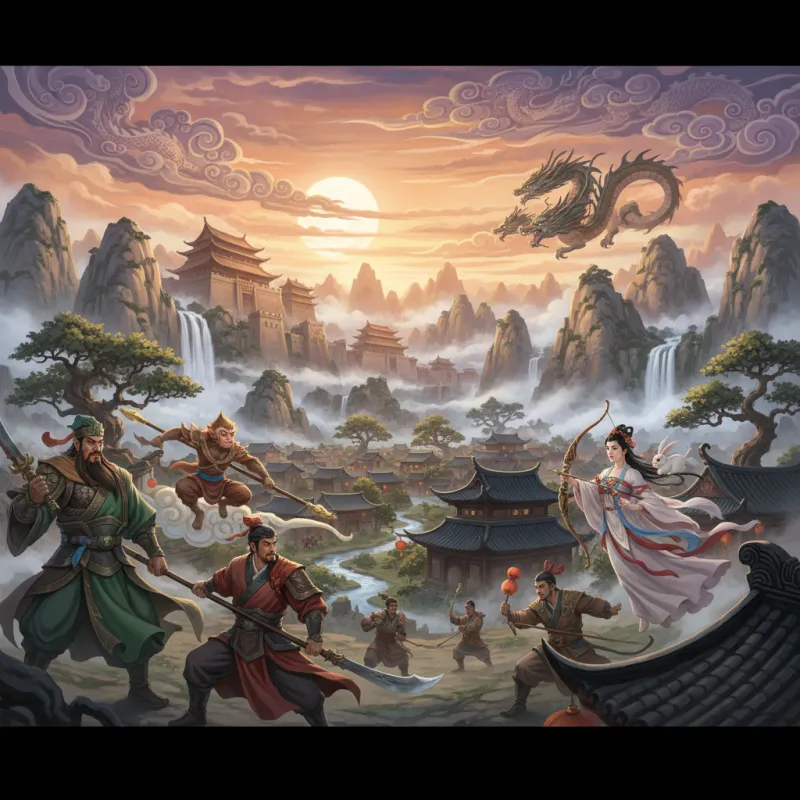
When Guan Yu (關羽, Guān Yǔ) refused to abandon his sworn brothers despite being offered wealth, power, and the hand of a beautiful woman, he wasn't just making a dramatic choice—he was crystallizing a value system that would echo through Chinese culture for two millennia. The legendary heroes of Chinese folklore aren't simply characters in entertaining stories. They're architectural blueprints for identity, walking embodiments of virtues so deeply embedded in the cultural psyche that even today, a businessman might keep a statue of Guan Yu in his office, or a parent might invoke Mulan's name when teaching their daughter about courage.
The Architecture of Chinese Heroism
What makes a hero in Chinese folklore fundamentally differs from Western archetypes. While Achilles pursued personal glory and Odysseus prized cunning self-preservation, Chinese heroes operate within a web of relationships and obligations. The concept of yi (義, yì)—often translated as righteousness or loyalty—sits at the core of heroic identity, but it's more nuanced than simple allegiance. It's about knowing your place in the cosmic and social order and fulfilling those duties even when it costs everything.
Take the Romance of the Three Kingdoms (三國演義, Sānguó Yǎnyì), written by Luo Guanzhong in the 14th century but depicting events from the 3rd century CE. The novel's heroes—Liu Bei, Guan Yu, and Zhang Fei—swear brotherhood in the Peach Garden, pledging to "die on the same day" despite being born on different ones. This oath becomes more binding than blood, more sacred than imperial decree. When Guan Yu is captured by Cao Cao and treated with extraordinary generosity, he still returns to Liu Bei the moment he learns his brother's whereabouts. Cao Cao, understanding yi, lets him go. Both men are heroes in this moment—one for keeping faith, the other for recognizing that some bonds transcend political advantage.
Women Warriors and the Subversion of Gender Norms
The story of Hua Mulan (花木蘭, Huā Mùlán) first appeared in the Ballad of Mulan during the Northern Wei dynasty (386-534 CE), and it's been retold, reimagined, and reinterpreted ever since. What's remarkable isn't just that a woman disguised herself as a man to take her elderly father's place in the army—it's that the original ballad treats this as simultaneously extraordinary and natural. Mulan excels in combat for twelve years, returns home, resumes her identity as a daughter, and her comrades are shocked. "We traveled together for twelve years," they say, "but didn't know Mulan was a girl."
The tale walks a fascinating tightrope. Mulan is celebrated for her xiao (孝, xiào)—filial piety—in protecting her father, a traditionally feminine virtue. But she's equally praised for her martial prowess and strategic brilliance, traditionally masculine domains. She doesn't reject femininity or masculinity; she transcends the binary when duty calls, then steps back into her role when the crisis passes. This flexibility, this prioritization of family obligation over rigid gender performance, reveals something profound about how Chinese folklore constructs heroism.
Other female warriors populate the tradition: the Yang family women in The Generals of the Yang Family (楊家將, Yángjiā Jiàng), who take up arms when their men fall in battle; the White Snake (Bái Shé Zhuàn, 白蛇傳), who floods a monastery to save her husband. These aren't exceptions that prove the rule—they're integral to understanding that heroism in Chinese culture isn't gendered in the way Western traditions often assume. For more on powerful female figures, see Divine Feminine Figures in Chinese Mythology.
The Monkey King and Rebellious Heroism
Sun Wukong (孫悟空, Sūn Wùkōng), the Monkey King from Journey to the West (西遊記, Xīyóu Jì), represents a different heroic archetype entirely—one that challenges authority rather than upholds it. Born from a stone, he learns magic, acquires the legendary staff Ruyi Jingu Bang, and declares himself "Great Sage Equal to Heaven." He crashes the Jade Emperor's peach banquet, eats the pills of immortality, and generally wreaks havoc until Buddha himself traps him under a mountain for five hundred years.
What's fascinating is that this rebel becomes a hero not by continuing his rebellion but by channeling it toward a righteous purpose. Released to protect the monk Xuanzang on his journey to India to retrieve Buddhist scriptures, Sun Wukong's incredible powers—his seventy-two transformations, his cloud-somersault that covers 108,000 li—serve a higher cause. He's still irreverent, still questions authority, still solves problems through creative violence. But now his strength protects the vulnerable rather than serving his ego.
Wu Cheng'en wrote Journey to the West in the 16th century, during the Ming dynasty, but the novel draws on much older folk tales and Buddhist legends. The Monkey King's journey from chaos to enlightenment mirrors Buddhist concepts of taming the "monkey mind," but it also speaks to something deeply Chinese: the idea that even rebellious energy, properly directed, serves social harmony. Sun Wukong doesn't stop being himself; he becomes the best version of himself.
Historical Heroes and Mythic Amplification
The line between history and myth blurs productively in Chinese hero tales. Guan Yu was a real general who died in 220 CE, but by the Ming dynasty, he'd been deified as Guandi (關帝, Guāndì), the God of War and patron saint of soldiers, police officers, and—intriguingly—businessmen. Temples dedicated to him dot the Chinese diaspora worldwide. His red face in opera and art symbolizes loyalty; his long beard represents dignity; his Green Dragon Crescent Blade embodies righteous violence.
This mythic amplification serves a purpose. When the historical Guan Yu becomes the divine Guandi, his virtues become accessible as spiritual ideals. You can pray to him, make offerings, ask for his protection. The hero transcends his historical moment and becomes eternally present, eternally relevant. This process happened with other figures too: Yue Fei (岳飛, Yuè Fēi), the Song dynasty general who fought against Jin invaders and was executed on false charges in 1142, became a symbol of patriotic loyalty. His mother supposedly tattooed four characters on his back: jing zhong bao guo (精忠報國, jīng zhōng bào guó)—"serve the country with utmost loyalty."
The historical accuracy matters less than the moral truth these stories convey. Did Yue Fei's mother really tattoo him? Probably not. Does the story capture something essential about maternal influence and patriotic duty? Absolutely. For more on how historical figures become legendary, see Epic Battles in Chinese Folklore.
The Water Margin and Outlaw Heroes
The Water Margin (水滸傳, Shuǐhǔ Zhuàn), attributed to Shi Nai'an and written in the 14th century, presents 108 outlaws who gather at Mount Liang to resist corrupt officials during the Song dynasty. These aren't conventional heroes—they're bandits, murderers, rebels. Yet the novel treats them as righteous because they oppose a system that has betrayed its own principles.
Characters like Song Jiang (宋江, Sòng Jiāng), the "Timely Rain," or Wu Song (武松, Wǔ Sōng), who kills a tiger with his bare hands, operate in moral gray zones. They break laws but uphold justice. They kill but protect the innocent. This tradition of the youxia (遊俠, yóuxiá)—the wandering knight-errant who lives outside official structures but maintains a personal code of honor—runs deep in Chinese culture, influencing everything from martial arts novels to contemporary action films.
What makes these outlaw heroes compelling is their complexity. They're not purely good or evil; they're human beings navigating impossible situations in a corrupt world. When the system fails, they create their own justice. When officials betray the people, they become the people's protectors. This resonates across dynasties and into the present because the tension between individual conscience and institutional authority never fully resolves.
The Enduring Power of Hero Tales
These stories persist because they do cultural work that statistics and philosophy cannot. When a parent tells a child about Mulan, they're not just entertaining them—they're transmitting values about family duty, courage, and the flexibility of gender roles. When someone keeps a Guan Yu statue in their shop, they're invoking a tradition of righteous business dealings and loyalty to partners. When a martial arts student learns about the Water Margin heroes, they're connecting to a lineage of resistance against injustice.
The legendary heroes of Chinese folklore shaped culture and identity by providing models for behavior, frameworks for understanding virtue, and narratives that make abstract values concrete. They show that loyalty might require sacrifice, that righteousness sometimes means breaking rules, that heroism isn't about individual glory but about fulfilling your role in the larger social fabric. These aren't dusty relics of the past—they're living traditions that continue to inform how people understand themselves and their obligations to others.
In a globalized world where cultural identity feels increasingly fluid and contested, these hero tales offer anchors. They say: this is what we value, this is who we aspire to be, this is the tradition we inherit and reinterpret for each generation. The stories change in the telling—Mulan becomes a Disney princess, the Monkey King appears in video games, Guan Yu watches over restaurants in San Francisco—but the core values they embody remain recognizable, adaptable, and profoundly influential. That's not just cultural preservation; it's cultural evolution, and these legendary heroes continue to shape identity precisely because they're flexible enough to meet each era's needs while maintaining their essential character.
Related Reading
- Exploring Enchanting Chinese Folklore: Legends and Fairy Tales for Children
- Unveiling the Celestial Tales of Chinese Folklore and Legends
- Unraveling China's Trickster Tales: Lore, Legends, and Cultural Impact
Explore Chinese Culture
- Explore feng shui in daily life
- Explore supernatural folklore
- Explore classical Chinese literature