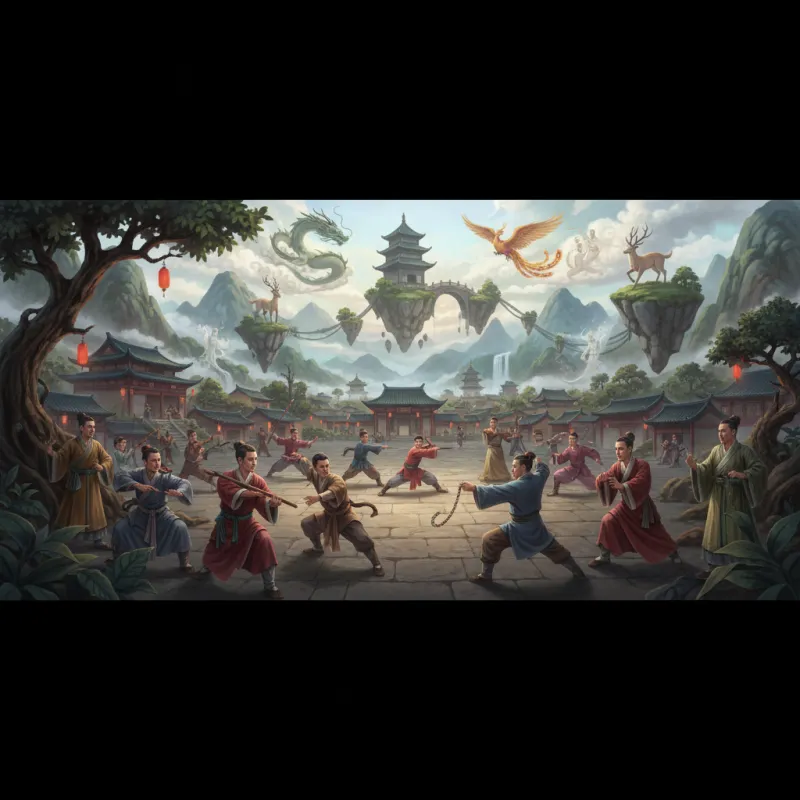
The first time I watched a real kung fu master demonstrate his art, I was profoundly disappointed. No flying kicks. No dramatic poses held for three seconds while the camera circled. Just a middle-aged man in sweatpants moving through forms with the quiet intensity of someone performing a sacred ritual. His punches made a sharp whoosh through the air, his stances were low and stable, and when he demonstrated applications with a student, the movements were so fast and economical that I almost missed them. This, I realized with a mixture of deflation and fascination, was what 武术 (Wǔshù, martial arts) actually looked like.
The Brutal Reality of Traditional Training
Chinese martial arts training has historically been an exercise in controlled suffering. The romantic notion of the wise master gently guiding students through elegant movements dissolves quickly when you examine actual training regimens. Traditional schools practiced 站桩 (zhànzhuāng, standing pole) — holding static postures for thirty minutes or more until your legs trembled and sweat poured down your face. Students would strike wooden posts wrapped in rope until their knuckles bled, then soak their hands in medicinal wine and do it again the next day.
The 少林寺 (Shàolín Sì, Shaolin Temple) monks, whose martial arts have been mythologized beyond recognition, followed training schedules that began at 5 AM and included hours of conditioning exercises that would make modern CrossFit enthusiasts weep. They practiced 铁头功 (tiětóu gōng, iron head skill) by repeatedly striking their heads against progressively harder surfaces. They developed 铁砂掌 (tiěshā zhǎng, iron sand palm) by thrusting their hands into buckets of heated sand mixed with iron filings thousands of times daily.
This wasn't training for performance or sport — it was preparation for actual combat in an era when martial artists might need to defend themselves or their communities against bandits, rival schools, or military forces. The conditioning was designed to turn the human body into something harder, faster, and more resilient than nature intended.
What Different Styles Actually Emphasize
The diversity within Chinese martial arts is staggering, and each major style developed in response to specific geographical, cultural, and practical needs. 太极拳 (Tàijíquán, Tai Chi) is perhaps the most misunderstood — Westerners see elderly people moving slowly in parks and assume it's gentle exercise. But the martial applications of Taiji involve using circular movements to redirect incoming force, striking vital points with precise timing, and employing 发劲 (fājìn, explosive force) that can send an opponent flying backward. The slow practice is training the nervous system to move with perfect efficiency; the actual fighting applications are anything but slow.
形意拳 (Xíngyìquán, Form-Intent Boxing) takes the opposite approach — direct, linear attacks with no wasted motion. Practitioners train five basic fist techniques based on the five elements of Chinese philosophy until they can execute them with devastating power from any position. The style was favored by bodyguards and military trainers because it could be learned relatively quickly and was brutally effective in real confrontations.
八卦掌 (Bāguàzhǎng, Eight Trigram Palm) emphasizes constant circular movement and the ability to fight multiple opponents simultaneously. Practitioners walk in circles around a pole for hours, training their bodies to change direction instantly while maintaining balance and power. The footwork is so distinctive that experienced martial artists can identify a Bagua practitioner just by watching them walk across a room.
Southern styles like 咏春拳 (Yǒngchūnquán, Wing Chun) developed in the cramped conditions of southern China's urban environments, where there wasn't room for wide stances or sweeping movements. The techniques are compact, focused on close-range combat, and designed to end fights quickly. The famous 木人桩 (mùrén zhuāng, wooden dummy) training device wasn't invented for movies — it was a practical tool for practicing techniques when training partners weren't available.
The Lost Art of Full-Contact Challenge Matches
Before martial arts became sanitized for sport and performance, Chinese martial artists settled disputes through 打擂台 (dǎ lèitái, challenge matches) — full-contact fights with minimal rules. These weren't friendly sparring sessions. They were brutal affairs where reputations, students, and sometimes lives were on the line. A martial arts school's credibility depended entirely on its ability to win these challenges.
The most famous challenge match in modern Chinese martial arts history occurred in 1954 when 吴公仪 (Wú Gōngyí), a Taiji master, fought 陈克夫 (Chén Kèfū), a White Crane kung fu practitioner, in Macau. The fight was so violent — with both men bleeding profusely and the crowd nearly rioting — that the government banned public challenge matches afterward. This single event marked the beginning of Chinese martial arts' transformation from combat systems into performance arts and sports.
During the Republican era (1912-1949), the 中央国术馆 (Zhōngyāng Guóshùguǎn, Central Martial Arts Academy) held full-contact tournaments that were legendary for their brutality. Fighters competed on a raised platform called a 擂台 (lèitái), and the rules were simple: no biting, no eye gouging, and you lost if you were knocked off the platform, knocked unconscious, or surrendered. Everything else was permitted. Broken bones were common, deaths were not unheard of, and the winners were celebrated as national heroes.
Why Modern Kung Fu Looks Different
The transformation of Chinese martial arts from combat systems into performance arts happened gradually but decisively throughout the 20th century. The Communist government's establishment of 武术套路 (wǔshù tàolù, martial arts forms) as a standardized sport in the 1950s prioritized aesthetic performance over fighting effectiveness. Judges scored competitors on the height of their jumps, the precision of their movements, and the difficulty of their acrobatics — not on whether the techniques would work in actual combat.
This created a generation of martial artists who were phenomenal athletes and performers but had never hit another person or been hit themselves. The 长拳 (chángquán, long fist) practiced in modern wushu competitions bears only superficial resemblance to the combat-oriented long fist styles of the past. The movements are bigger, higher, and more dramatic because they're designed to impress judges, not to fight opponents.
The rise of 散打 (sàndǎ, free fighting) in the 1980s represented an attempt to preserve the combat aspects of Chinese martial arts, but even this was heavily influenced by kickboxing and Muay Thai. Traditional techniques that were too dangerous for sport — eye strikes, throat attacks, joint breaks — were eliminated. What remained was effective but no longer distinctly Chinese in character.
Meanwhile, traditional martial arts schools faced a crisis of relevance. Why spend years learning to fight with techniques developed for 19th-century combat when you could learn MMA or Brazilian Jiu-Jitsu and be competition-ready in months? Some traditional schools adapted by incorporating modern training methods and pressure testing. Others retreated further into mysticism and performance, making increasingly dubious claims about 气功 (qìgōng, energy work) and no-touch knockouts.
The Uncomfortable Truth About Effectiveness
The question that haunts traditional Chinese martial arts is simple and brutal: does it work? The answer is complicated and depends entirely on how the art is trained. A Taiji practitioner who has spent decades practicing forms but never sparred will lose to an amateur boxer with six months of training. A Xingyi practitioner who regularly pressure-tests techniques against resisting opponents can be devastatingly effective.
The problem isn't the techniques themselves — many traditional Chinese martial arts techniques are biomechanically sound and tactically viable. The problem is that most modern practitioners train them as cultural preservation or moving meditation rather than as fighting systems. They practice 套路 (tàolù, forms) endlessly but never develop the timing, distance management, and psychological resilience that only come from actual fighting.
The rise of MMA has been particularly humbling for traditional martial arts. When 徐晓冬 (Xú Xiǎodōng), an MMA fighter, challenged and defeated several traditional kung fu masters in 2017, it sparked a national controversy in China. Some defended traditional martial arts by claiming the masters were too old or that the rules were unfair. Others acknowledged what combat sports practitioners had known for decades: if you don't regularly spar against resisting opponents, your martial art is a dance, not a fighting system.
This doesn't mean traditional Chinese martial arts are worthless — it means they need to be trained the way they were originally intended, with full-contact sparring, conditioning, and realistic application practice. Some schools never stopped training this way, and their practitioners can hold their own against fighters from any style. But these schools are increasingly rare, overshadowed by performance wushu and mystical qi gong.
What's Worth Preserving
Despite the challenges facing traditional Chinese martial arts, there's genuine value worth preserving beyond mere cultural nostalgia. The sophisticated understanding of body mechanics in styles like Taiji and Bagua offers insights that complement modern sports science. The emphasis on 内功 (nèigōng, internal training) — developing power through relaxation and proper structure rather than muscular tension — produces a quality of movement that's both efficient and sustainable as practitioners age.
The philosophical frameworks underlying Chinese martial arts, drawn from Daoism, Buddhism, and Confucianism, provide a context for training that goes beyond winning fights. The concept of 武德 (wǔdé, martial virtue) emphasizes using martial skills responsibly, respecting opponents, and cultivating character alongside technique. In an era when combat sports sometimes celebrate trash-talking and aggression, this ethical dimension offers a valuable counterbalance.
The diversity of Chinese martial arts also represents centuries of experimentation with human movement and combat strategy. Each style is essentially a different hypothesis about the most effective way to fight, developed and refined over generations. Some of these hypotheses have been proven wrong by modern competition, but others contain insights that haven't been fully explored or integrated into contemporary fighting systems.
The challenge is separating what works from what doesn't, what's essential from what's theatrical, and what's genuinely traditional from what's been invented for tourists and movies. This requires honest assessment, pressure testing, and a willingness to acknowledge when techniques or training methods are obsolete. It also requires recognizing that "traditional" doesn't automatically mean "better" — but it doesn't automatically mean "worse" either.
The Path Forward
The future of Chinese martial arts lies not in choosing between tradition and modernity but in integrating the best of both. Some schools are already doing this, maintaining traditional forms and philosophy while incorporating modern training methods like sparring, strength and conditioning, and video analysis. They teach students to appreciate the cultural and historical context of their art while also ensuring they can actually use it.
For practitioners interested in exploring authentic Chinese martial arts, the key is finding schools that balance respect for tradition with honest assessment of effectiveness. Look for instructors who have actually used their skills in full-contact competition or real confrontations, not just those who can perform beautiful forms. Seek out schools where students regularly spar and pressure-test techniques, where conditioning is taken seriously, and where claims about the art's capabilities are grounded in demonstrable reality rather than legend.
The gap between movie kung fu and real kung fu will always exist — cinema requires drama, spectacle, and visual excitement that real martial arts training rarely provides. But understanding what Chinese martial arts actually are, how they're really trained, and what they can genuinely accomplish makes them no less fascinating. In some ways, the reality is more impressive than the fantasy: not because practitioners can fly, but because they've dedicated themselves to the patient, unglamorous work of mastering something genuinely difficult. That's the real 功夫 (gōngfu) — not supernatural powers, but skill achieved through hard work and time.
For those interested in exploring related aspects of Chinese martial culture, see our articles on Chinese Sword Arts and Their Symbolism and The Philosophy Behind Internal Martial Arts.
Related Reading
- Chinese Martial Arts in the Real World: What Actually Works
- Tai Chi for Beginners: Your First Steps into Moving Meditation
- Bruce Lee's Legacy: How One Man Changed Global Culture
- Tai Chi: The Martial Art That Conquered the World's Parks
- Exploring the Rich Tapestry of Chinese Folklore, Legends, and Fairy Tales
- The Chinese Language: Why It Is Both Harder and Easier Than You Think
- Tea and Zen: The Spiritual Connection
Explore Chinese Culture
- Explore feng shui in daily life
- Explore supernatural folklore
- Explore classical Chinese literature