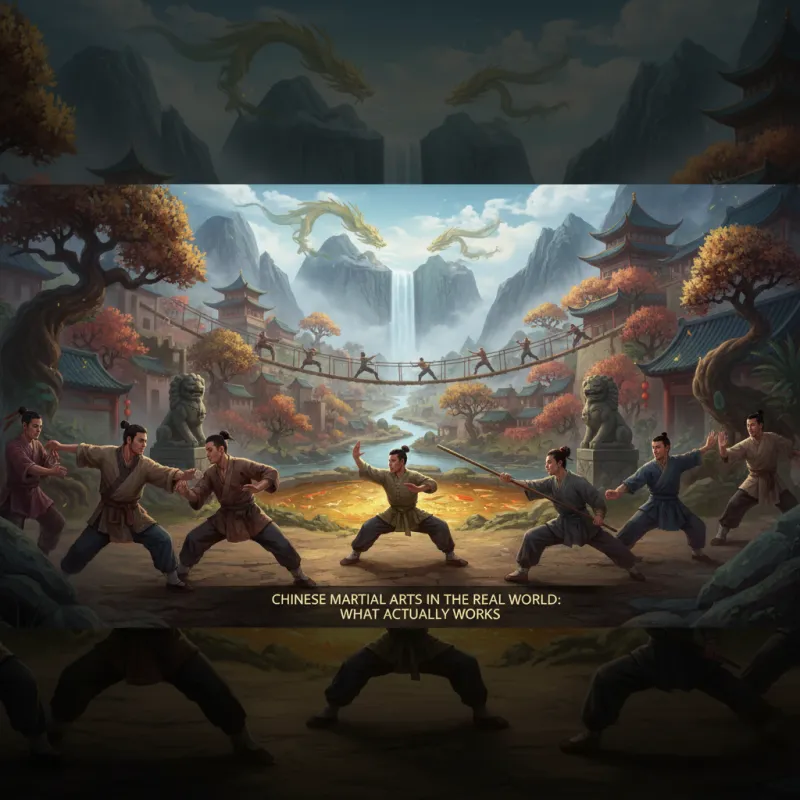
The elderly man in the park moves like water flowing uphill. His hands trace invisible circles, his weight shifts with the patience of continental drift. Tourists photograph him, assuming they're witnessing ancient combat wisdom. They're half right. What they're actually seeing is the world's most successful marketing campaign for a fighting system that stopped being about fighting sometime around 1950.
What Survived the Cultural Revolution
Chinese martial arts faced an extinction event in the 20th century. The Cultural Revolution didn't just attack traditional culture—it specifically targeted martial arts masters as representatives of feudal thinking. Schools closed. Lineages broke. Masters who survived did so by teaching watered-down versions or fleeing to Hong Kong, Taiwan, and eventually the West.
What emerged afterward was a bifurcated tradition. On one side: wushu (武术, wǔshù), the government-sanctioned performance art with backflips and splits. On the other: whatever fragments of practical fighting knowledge survived in private transmission. The gap between these two versions is the gap between a dance recital and a street fight.
The styles that retained practical application did so by staying underground or adapting quickly. Sanda (散打, sàndǎ)—Chinese kickboxing—emerged as the military and police combat system precisely because it abandoned mysticism for measurable results. You can't fake whether a technique works when soldiers' lives depend on it.
The Styles That Actually Fight
Sanda is what happens when you strip Chinese martial arts down to what works under pressure. It's kickboxing with throws, developed by the Chinese military in the 1920s and refined ever since. Sanda fighters compete internationally and hold their own. Why? Because the training method involves actually hitting people and getting hit back. This sounds obvious, but it disqualifies about 90% of traditional Chinese martial arts schools.
Shuai Jiao (摔跤, shuāijiāo) is Chinese wrestling, with documented history going back 4,000 years. It's pure grappling—no strikes, just throws and takedowns. Shuai jiao practitioners compete in lei tai (擂台, lèitái) matches and consistently demonstrate that their techniques work against resisting opponents. The Mongolian and Manchu dynasties particularly valued it, which is why it survived as a practical system rather than becoming theatrical.
Wing Chun (咏春, yǒngchūn) has a complicated reputation. The style itself contains practical close-range striking and trapping techniques. The problem is that most Wing Chun schools train exclusively through chi sao (黏手, chīsǎo)—"sticky hands" drills—without ever pressure-testing against non-Wing Chun attacks. The few Wing Chun practitioners who cross-train in sparring-heavy systems can make it work. The rest are learning an elaborate form of patty-cake.
Bajiquan (八极拳, bājíquán) remains the bodyguard style of choice for Chinese security services. It specializes in explosive, close-range power generation—exactly what you need when protecting someone in a crowd. The training is brutal and the techniques are designed to end fights in seconds. You won't see many Bajiquan schools because the style never commercialized well. It's too violent for the health-and-wellness market.
The Tai Chi Problem
Tai Chi (太极拳, tàijíquán) deserves its own reckoning. It's the most practiced martial art on Earth, with an estimated 250 million practitioners. It's also the most misunderstood.
Original Chen-style Tai Chi, developed in the 17th century, was a legitimate fighting system. The forms contained applications—strikes, throws, joint locks—hidden within the slow movements. Practitioners trained push hands (推手, tuīshǒu) with genuine martial intent. Then Yang Luchan brought it to Beijing in the 1850s, and the commercialization began.
By the early 20th century, Tai Chi had split into health practice and martial practice. The health version exploded in popularity because it offered elderly people and intellectuals a way to exercise without the violence of actual combat training. The martial version continued in small lineages but became increasingly rare.
Today's typical Tai Chi class teaches choreography. Students learn forms—sometimes beautiful, always slow—without understanding what the movements represent. They practice push hands as a sensitivity drill, not as combat preparation. They're told they're learning a martial art, but they're actually learning moving meditation. Which is fine! Moving meditation has tremendous health benefits. But it's not fighting.
The delusion becomes dangerous when Tai Chi masters believe their own mythology. In 2017, MMA fighter Xu Xiaodong began challenging traditional martial arts masters to fights. He demolished a Tai Chi master in ten seconds. The video went viral. The Chinese government censored Xu and restricted his travel, but the damage was done. The emperor had no clothes, and everyone had seen.
The Testing Problem
Here's the uncomfortable truth: most Chinese martial arts schools don't test their techniques against resistance. They practice forms, they practice drills, they practice applications with compliant partners. They never spar. They never compete. They never find out what actually works when someone is trying to hurt them.
This isn't unique to Chinese martial arts—it's a problem across traditional martial arts generally. But Chinese martial arts have a particular vulnerability because of the cultural reverence for lineage and tradition. Questioning whether a technique works can be seen as disrespecting the master or the ancestors. This creates an environment where ineffective techniques persist for generations.
The solution is simple but culturally difficult: pressure testing. If you want to know whether a technique works, you have to try it against someone who doesn't want it to work. This is why combat sports—boxing, wrestling, Muay Thai, Brazilian Jiu-Jitsu, MMA—produce reliable fighters. They test constantly. Every sparring session is a laboratory experiment.
Some Chinese martial arts schools have embraced this approach. They spar regularly, they compete, they cross-train. These schools produce competent fighters. But they're the minority. Most schools remain trapped in the traditional model, teaching techniques that look impressive but crumble under pressure.
What Actually Transfers
Despite the problems, certain elements of Chinese martial arts training have genuine value:
Stance training builds leg strength and structural integrity. Standing in horse stance (马步, mǎbù) for extended periods is miserable, but it develops the kind of rooted power that transfers to any physical activity. Modern strength training can achieve similar results faster, but stance training works.
Sensitivity drills like push hands and chi sao develop tactile awareness and reflexive response. These skills are real and useful—but only if you also train against non-cooperative opponents. Sensitivity without pressure testing produces people who are very good at sensitivity drills and nothing else.
Breathing and relaxation techniques from internal styles (内家拳, nèijiāquán) have applications beyond fighting. The ability to remain calm under stress, to breathe efficiently during exertion, to relax unnecessary muscles while engaging necessary ones—these are valuable skills for any athlete or anyone facing high-pressure situations.
Philosophical frameworks around martial arts practice can provide useful mental models. The Daoist concepts underlying Tai Chi, the Buddhist influences in Shaolin kung fu, the strategic thinking in styles like Xingyi (形意拳, xíngyìquán)—these offer ways of thinking about conflict, adaptation, and self-cultivation that extend beyond physical combat. Just don't confuse philosophy with fighting ability.
The Path Forward
Chinese martial arts face a choice: evolve or become museum pieces. Some styles are choosing evolution. Sanda continues to develop as a competitive sport. Some traditional schools are incorporating sparring and cross-training. A new generation of practitioners is less interested in lineage politics and more interested in what actually works.
The irony is that this evolution returns Chinese martial arts to their roots. Historical martial arts were practical because they had to be. Warriors who trained ineffective techniques died. The mystification came later, as martial arts became cultural artifacts rather than survival tools.
If you want to learn Chinese martial arts for fighting, find a school that spars regularly and competes. If you want to learn for health, cultural connection, or moving meditation, find a school that's honest about what it offers. The problems arise when schools promise fighting ability but deliver only choreography.
The real wisdom of Chinese martial arts isn't in the techniques themselves—it's in the training methodology of constant refinement through testing. That principle works whether you're practicing Sanda or studying the philosophy behind internal martial arts. The moment you stop testing is the moment you start believing your own mythology.
And as Xu Xiaodong demonstrated, mythology doesn't survive contact with reality.
Related Reading
- Tai Chi for Beginners: Your First Steps into Moving Meditation
- Tai Chi: The Martial Art That Conquered the World's Parks
- Real Chinese Martial Arts: Beyond the Movie Myths
- Bruce Lee's Legacy: How One Man Changed Global Culture
- Temple Etiquette: How to Visit Chinese Temples
- Chinese Proverbs and Their Stories: Wisdom in Four Characters
- Delving into Chinese Water Legends: Tales of Spirits and Serpents
Explore Chinese Culture
- Explore feng shui in daily life
- Explore supernatural folklore
- Explore classical Chinese literature