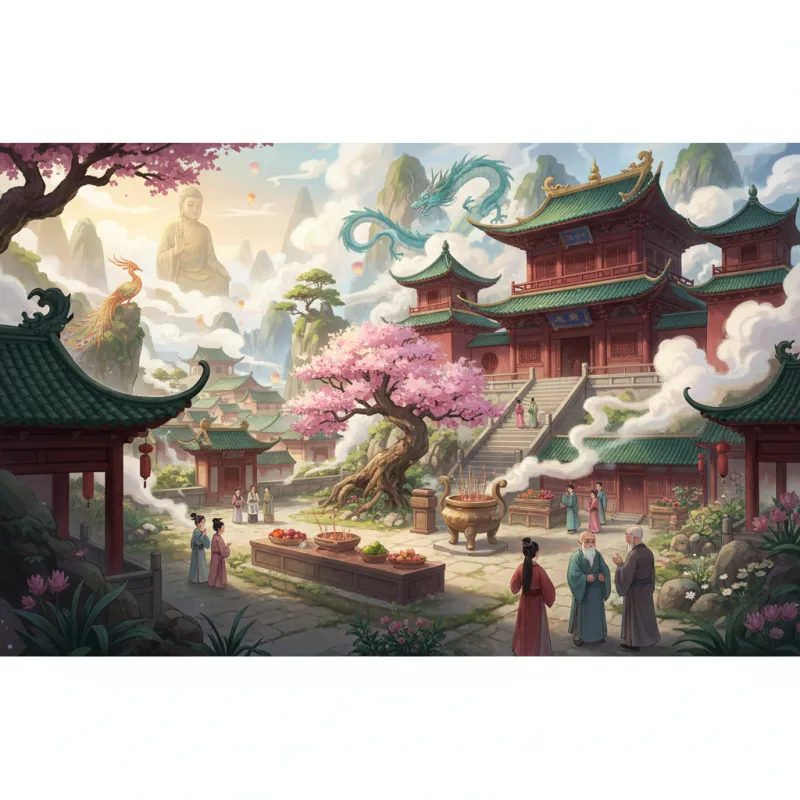
The incense smoke curls thick enough to taste. You're standing in the courtyard of a thousand-year-old temple, watching a woman in designer heels prostrate herself three times before a gilded Buddha, while a monk in gray robes sweeps fallen leaves with methodical precision. You want to light incense, make an offering, maybe take a photo—but you're paralyzed by a simple question: what are the rules here?
Chinese temples operate on a complex system of unwritten protocols that most visitors violate within their first five minutes. Step on the threshold, enter through the wrong door, point your feet at a deity, or hold your incense incorrectly, and you'll either offend the divine powers or scandalize the elderly worshippers—possibly both. Yet these same temples welcome millions of visitors annually, from devout pilgrims to curious tourists, and somehow the system works.
The gap between sacred space and public space in China is thinner than in the West. Temples aren't hushed sanctuaries where you whisper and tiptoe. They're active ritual sites where people bargain with gods, burn paper money, shake fortune sticks, and argue about whose turn it is to light the incense. Understanding temple etiquette isn't about memorizing arbitrary rules—it's about reading the grammar of Chinese religious life.
The Threshold Rule and Spatial Hierarchy
Every Chinese temple has a raised threshold at each doorway, typically 15-20 centimeters high. You must step over it, never on it. This isn't superstition—it's cosmology made architectural.
The threshold (门槛, ménkǎn) marks the boundary between the profane outer world and the sacred inner space. In traditional belief, deities and spirits reside just above the threshold, and stepping on it is equivalent to stepping on their shoulders. More practically, the raised threshold also serves to keep out wandering ghosts, who according to folk belief cannot cross elevated barriers.
But the threshold rule has a second layer: which foot crosses first matters. The general principle is right foot for entering, left foot for exiting, though this varies by temple tradition. Buddhist temples often follow the "right foot enters, left foot exits" pattern because right is associated with the auspicious and proper path. Daoist temples (道观, dàoguàn) sometimes reverse this, following the Daoist principle of valuing the left side.
The door itself has hierarchy. Most temple halls have three doors: a central door and two side doors. The central door is reserved for the deity, monks, or in some temples, only for major ceremonies. Visitors should use the side doors. If you're entering through the left door (from your perspective facing the temple), step over the threshold with your left foot first. Right door, right foot first. This maintains the spatial logic—you're already oriented toward one side, so you continue that orientation through your body.
Watch the locals. At major temples like Beijing's Lama Temple (雍和宫, Yōnghégōng) or Hangzhou's Lingyin Temple (灵隐寺, Língyǐn Sì), you'll see elderly worshippers pause before each threshold, gather their robes or bags, and step over with deliberate care. Young people increasingly ignore this rule, but the older generation still considers it fundamental respect.
Incense Etiquette: The Language of Smoke
Lighting incense (烧香, shāoxiāng) is the most common ritual act in Chinese temples, and the most frequently bungled by visitors. The standard offering is three sticks of incense, representing the Three Jewels in Buddhism (Buddha, Dharma, Sangha) or the harmony of Heaven, Earth, and Humanity in Daoism.
Purchase your incense outside the temple or from the temple shop—never bring your own, as temples have specific incense that's been blessed or approved. The thick, bundled incense you see some worshippers carrying isn't standard; those are special offerings for major requests or vows.
Light all three sticks together from the large communal burner or candle station. Don't use a lighter if you can avoid it—fire from the temple's eternal flame is considered more auspicious. Once lit, hold the incense at chest level with both hands, sticks pointing upward. Never hold them at face level or above your head; this is considered disrespectful, as if you're putting yourself above the deity.
Face the main altar and bow three times, holding the incense steady. The bow is from the waist, not a full prostration. After the third bow, walk to the large incense burner (香炉, xiānglú) in the courtyard and insert your incense sticks vertically into the ash. Don't throw them in, don't lay them horizontally, and don't stick them in at wild angles. The incense should stand upright, like a forest of prayers.
Here's what most guides won't tell you: the position where you place your incense in the burner has meaning in folk practice. The center is most auspicious but also most crowded. Some worshippers believe placing incense on the side facing the main hall is more direct communication with the deity. Others follow a clockwise pattern around the burner for different types of requests. These are folk elaborations rather than official doctrine, but they're part of the living practice.
One critical rule: never blow out the incense flame. Wave your hand to extinguish it, or let it burn down naturally. Blowing is considered using your breath—your life force—to extinguish a sacred offering. It's inauspicious and disrespectful.
Prostration and Prayer: The Full Body Conversation
The full prostration (磕头, kētóu, or 拜, bài) is the deepest form of respect in Chinese temples. You'll see worshippers performing elaborate sequences: three prostrations, nine prostrations, or even 108 prostrations for serious vows.
The basic three-prostration sequence works like this: Stand before the altar with feet together and hands in prayer position (合十, héshí) at chest level. Bow from the waist. Kneel on both knees simultaneously—never one knee at a time, which is the Western proposal posture and has no place in Chinese ritual. Place your hands flat on the ground, then lower your forehead to touch the ground between your hands. Rise back to kneeling position. Repeat three times, then stand.
The hand position during prostration is specific: palms should face upward when your forehead touches the ground, as if you're receiving blessings from above. Some traditions have you turn your palms downward, pressing the earth. Watch what others do in that specific temple.
Women and men traditionally prostrate differently in some temples. Women keep their knees together; men separate their knees shoulder-width apart. This isn't strictly enforced anymore, but older worshippers still follow it.
You don't have to prostrate. A simple bow with hands in prayer position is perfectly acceptable for visitors. But if you're making a serious request—praying for health, success in exams, a good marriage—the full prostration shows sincerity. Chinese religious practice is transactional: the more effort you put into the ritual, the more seriously your request is taken.
One note about prayer cushions (拜垫, bàidiàn): if the temple provides them, use them. If not, prostrate directly on the ground. Don't bring your own cushion or use your jacket as padding. The discomfort is part of the offering.
Photography, Donations, and Commercial Boundaries
The photography question has no universal answer. Some temples prohibit all photography inside halls. Others allow it but forbid flash. Still others permit everything except photographing the main Buddha statue directly.
The general principle: if you see signs prohibiting photography, respect them. If there are no signs, observe what others are doing. Never photograph monks without permission—they're not tourist attractions. Never photograph people in the act of worship. The woman prostrating herself in tears before Guanyin doesn't need to end up on your Instagram.
The most respectful approach: photograph architecture and decorative elements, but not the main altar statues. If you must photograph a Buddha or deity statue, do it from an angle, not straight-on. Direct frontal photography is considered confrontational in Chinese visual culture—you're staring down the deity.
Donations (功德, gōngdé, literally "merit") are expected but not mandatory. Every temple has donation boxes, usually near the entrance and at major altars. There's no fixed amount. Drop in what feels appropriate—10 yuan is fine for a casual visit, 100 yuan or more if you're making a specific request or have received a blessing you're grateful for.
Beware the commercial traps. Some temples, especially tourist-heavy ones, have aggressive monks or temple workers who will pressure you to buy expensive incense, make large donations, or purchase blessed items at inflated prices. Real monks don't hustle. If someone in robes is giving you a hard sell, they're likely a scammer. Legitimate temples have clearly marked prices for incense and items, and donations are voluntary.
The fortune-telling services (求签, qiúqiān) are a gray area. Shaking the fortune stick container until one stick falls out is traditional practice and usually free. But the interpretation service—where a temple worker or monk explains your fortune—often costs money. This is legitimate in some temples, a tourist trap in others. If you're genuinely interested in Chinese fortune-telling traditions, do it at a temple with a serious reputation, not at a tourist site.
Dress Code and Physical Conduct
Chinese temples are surprisingly relaxed about dress code compared to churches or mosques. You don't need to cover your head, remove your shoes, or wear long sleeves. But there are boundaries.
Avoid shorts that are too short, tank tops that are too revealing, or clothing with offensive imagery. The standard is "respectful casual"—what you'd wear to meet your partner's parents for the first time. Monks and nuns wear robes, but laypeople wear ordinary clothes. You'll see worshippers in everything from business suits to farmer's work clothes.
Shoes stay on. Unlike Japanese temples or Islamic mosques, Chinese temples don't require shoe removal. The exception is if you're entering a monk's private quarters or a special meditation hall—but tourists rarely access these spaces.
Physical conduct has stricter rules. Don't point at Buddha statues or deities. Don't turn your back to the main altar when taking photos or talking. Don't sit with your legs stretched out toward an altar—this is pointing with your feet, which is deeply disrespectful. If you need to sit and rest, sit to the side, not directly facing the altar.
Don't touch religious objects unless they're clearly meant for public interaction. Some temples have prayer wheels, gongs, or bells that visitors can use—these will be obvious and often have instructions. But don't touch altar offerings, ritual implements, or decorative items. The gilt Buddha statue is not there for you to rub for luck, despite what you might see other tourists doing.
Eating and drinking inside temple halls is forbidden. The courtyard is usually fine, but not inside the worship spaces. Smoking is absolutely prohibited throughout the temple grounds, despite the irony of incense smoke filling the air.
Timing, Festivals, and When to Visit
Chinese temples operate on a different schedule than Western churches. There's no "service time" when everyone gathers. Temples are open from early morning (usually 6 or 7 AM) until evening (5 or 6 PM), and people come and go throughout the day according to their own schedules.
The busiest times are the 1st and 15th of each lunar month, considered especially auspicious for temple visits and offerings. If you want to experience authentic worship culture, visit on these days. If you want peace and quiet for contemplation, avoid them.
Major Buddhist festivals transform temples into carnival-like celebrations. The Buddha's Birthday (佛诞, Fódàn, usually in May), Guanyin's Birthday (观音诞, Guānyīn Dàn, celebrated three times a year), and Chinese New Year bring massive crowds, special ceremonies, and elaborate offerings. Visiting during these times gives you the full sensory experience—chanting, drums, ceremonial processions—but expect crowds and chaos.
Early morning visits offer something different. Arrive at 6 or 7 AM and you'll see the temple at its most authentic: monks performing morning chants, elderly devotees doing their daily prostrations, the incense burners still relatively empty. The tourist crowds haven't arrived yet. This is when the temple feels like a living religious site rather than a cultural attraction.
Some temples have vegetarian restaurants (素食, sùshí) that serve lunch to visitors. This is an excellent way to experience Chinese Buddhist food culture and support the temple financially. The food is simple but often surprisingly good—temple cooks have centuries of tradition in making vegetables interesting.
The Unspoken Contract: Respect Without Belief
Here's the paradox of Chinese temple etiquette: you don't have to believe any of it for the rules to matter.
Chinese religious practice is orthopraxy, not orthodoxy. What you do matters more than what you believe. You can be a complete atheist and still follow temple etiquette out of cultural respect. You can be a Christian or Muslim and still light incense as a gesture of cultural participation. The Chinese approach to religion is inclusive and pragmatic—the gods don't check your theological credentials at the door.
But this cuts both ways. If you're going to participate, participate correctly. Don't light incense "ironically." Don't prostrate yourself for a photo op. Don't treat the temple like a theme park. The people around you—whether they're devout Buddhists, casual folk religion practitioners, or elderly people maintaining traditions they learned from their grandparents—are engaging in something meaningful to them.
The most important rule isn't about thresholds or incense or prostrations. It's about recognizing that you're entering a space where the boundary between the everyday and the sacred is thin, where people come to negotiate with forces larger than themselves, where hope and fear and gratitude take physical form in smoke and prayer and ritual.
Step over the threshold carefully. Not because you'll anger the gods if you don't, but because that small act of attention—that moment of adjusting your behavior to respect someone else's sacred space—is what makes it possible for temples to remain open, welcoming, and alive in the modern world.
When you leave, exit through a side door, step over the threshold with your left foot first, and don't look back until you've fully exited the temple grounds. Not because of superstition, but because the transition from sacred to profane space deserves a moment of acknowledgment. You're returning to the ordinary world, but you're carrying something with you—the smell of incense in your clothes, the memory of candlelight on gold, the echo of a prayer you didn't understand but somehow felt.
Related Reading
- Must-Visit Cultural Sites in China: A Heritage Traveler's List
- The Sacred Mountains of China: Where Heaven Meets Earth
- Best Chinese Museums: A Cultural Explorer's Guide
- Ancient Towns of China Worth Visiting
- Traditional Chinese Medicine: What Western Science Gets Wrong About Getting It Wrong
- Discovering the Rich Tapestry of Chinese Folklore: Myths, Legends, and Traditions
- Unveiling the Rich Tapestry of Chinese Folklore and Festival Origins
Explore Chinese Culture
- Explore feng shui in daily life
- Explore supernatural folklore
- Explore classical Chinese literature