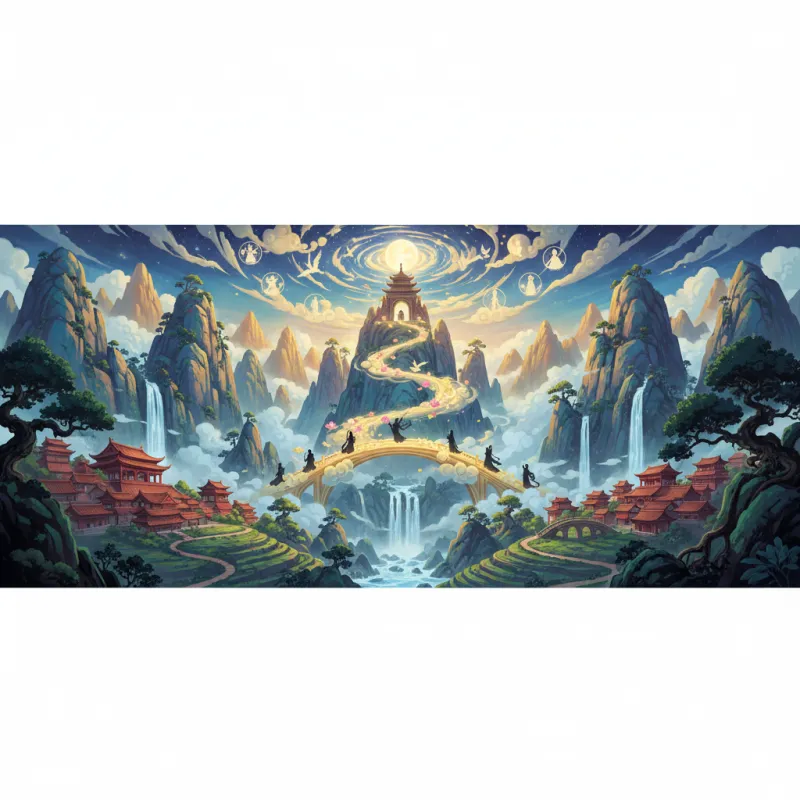
The stone steps beneath your feet have been worn smooth by two thousand years of pilgrims, emperors, and seekers. Your lungs burn in the thin air. Mist swirls around ancient pines that somehow grow from bare rock. Somewhere above, hidden in clouds, waits the summit — and according to Chinese cosmology, the very axis where heaven pivots above earth. You're climbing one of China's sacred mountains, and you're walking in the footsteps of civilization itself.
The Five Sacred Peaks: Where Emperors Met Heaven
Long before Buddhism arrived in China, the 五岳 (Wǔ Yuè, Five Great Mountains) already anchored the spiritual geography of the empire. These weren't chosen randomly — they mark the cardinal directions and center of the ancient Chinese world, forming a cosmic mandala across the landscape. Mount Tai in the east, Heng Shan in the north, Hua Shan in the west, Heng Shan in the south (yes, two mountains share the same name but different characters), and Song Shan in the center.
Mount Tai (泰山, Tài Shān) in Shandong Province holds the throne as the most revered. For over two millennia, emperors climbed its 6,660 stone steps to perform 封禅 (Fēngshàn) ceremonies — elaborate rituals announcing their mandate from heaven. The first emperor to do this was Qin Shi Huang in 219 BCE, though the tradition likely stretches back centuries earlier. Seventy-two emperors followed, each leaving inscriptions, temples, and monuments. Today, you can still see the calligraphy of emperors carved into cliff faces, their characters weathered but defiant.
The western peak, Hua Shan (华山, Huà Shān) in Shaanxi, earned its reputation as the most dangerous. Its granite faces rise nearly vertical, and the traditional pilgrimage route includes the infamous 长空栈道 (Chángkōng Zhàndào, Plank Walk in the Sky) — wooden boards bolted to a sheer cliff face above a thousand-meter drop. Daoist hermits chose this mountain precisely because its inaccessibility offered protection from worldly distractions. The险 (xiǎn, danger) of Hua Shan became inseparable from its sanctity.
Buddhism's Four Sacred Realms
When Buddhism flowed into China along the Silk Road, it didn't displace mountain worship — it absorbed it. The 四大佛教名山 (Sì Dà Fójiào Míngshān, Four Great Buddhist Mountains) became associated with four bodhisattvas, each mountain serving as their earthly dwelling place. This wasn't metaphor. Pilgrims genuinely believed they might encounter these enlightened beings manifesting in human or animal form.
Mount Wutai (五台山, Wǔtái Shān) in Shanxi belongs to Manjushri, the bodhisattva of wisdom. Its five flat peaks (台, tái, means terrace or platform) rise above the tree line into an alpine zone rare in eastern China. Over fifty monasteries cluster on its slopes, some dating to the Tang Dynasty. The mountain's reputation drew pilgrims from across Asia — Tibetan, Mongolian, and Chinese Buddhists all consider it sacred, making it perhaps the most cosmopolitan religious site in traditional China.
Emei Shan (峨眉山, Éméi Shān) in Sichuan, home to Samantabhadra, bodhisattva of practice and meditation, rises 3,099 meters from subtropical forests to snow-capped summit. The biodiversity is staggering — you ascend through multiple climate zones, encountering monkeys in the lower forests and rare alpine plants near the peak. The 金顶 (Jīndǐng, Golden Summit) temple complex, rebuilt multiple times after fires, gleams with gold-plated tiles visible for kilometers.
Putuo Shan (普陀山, Pǔtuó Shān), an island off Zhejiang's coast, breaks the pattern — it's the only sacred mountain that's actually an island. Guanyin, the bodhisattva of compassion, chose this location according to legend after attempting to travel to Japan but being stopped by a storm. The island's beaches, caves, and temples create an atmosphere distinct from the other peaks. Pilgrims arrive by ferry, and the sound of waves mixes with temple bells.
Jiuhua Shan (九华山, Jiǔhuá Shān) in Anhui serves as the earthly realm of Ksitigarbha, the bodhisattva who vowed to save all beings from hell. The mountain gained its Buddhist identity relatively late — in 794 CE when a Korean prince named Kim Gyo-gak came to meditate in its caves. After his death, his body reportedly didn't decay, and he was recognized as an incarnation of Ksitigarbha. His mummified remains are still preserved in a temple on the mountain.
The Daoist Peaks: Mountains of Immortality
Separate from both the Five Great Mountains and the Buddhist peaks, Daoism developed its own sacred geography. The 道教名山 (Dàojiào Míngshān, Famous Daoist Mountains) number in the dozens, but several stand out for their historical and spiritual significance.
Wudang Shan (武当山, Wǔdāng Shān) in Hubei became the center of internal martial arts, where the legendary Zhang Sanfeng supposedly created Tai Chi. The mountain's temples, built during the Ming Dynasty, represent some of China's finest religious architecture. The 金殿 (Jīndiàn, Golden Hall) at the summit was cast entirely from bronze and gilded — it has survived centuries without a single nail or wooden beam.
Qingcheng Shan (青城山, Qīngchéng Shān) near Chengdu claims to be the birthplace of organized Daoism. Zhang Daoling, founder of the Celestial Masters school, established his first community here in 142 CE. The mountain's name means "Green City Mountain," and it lives up to it — the forests are so dense that even at midday, the paths remain shaded and cool. Unlike the stark granite peaks of the east, Qingcheng Shan feels intimate, almost secretive, with temples hidden in bamboo groves.
Why Mountains? The Logic of Sacred Geography
The Chinese obsession with mountains isn't arbitrary. In a civilization that developed in river valleys and plains, mountains represented the unknown, the dangerous, the liminal. They generated weather — clouds formed on peaks, rain fell from mountains. They marked boundaries between kingdoms and climate zones. They were, quite literally, closer to heaven.
The concept of 仙境 (Xiānjìng, immortal realm) always involved mountains. Daoist immortals didn't live in the sky — they lived on remote peaks, sustained by mist and dew, practicing alchemy in caves. The 神仙 (Shénxiān, immortals) of Chinese mythology are mountain dwellers, not sky gods. This differs fundamentally from Western religious geography, where heaven is definitively above, separate from earth. In Chinese cosmology, heaven and earth interpenetrate, and mountains are the places where this interpenetration is most accessible.
The aesthetic tradition of 山水画 (Shānshuǐ Huà, landscape painting) emerged directly from this spiritual geography. Painters didn't depict mountains as mere scenery — they attempted to capture the 气 (qì, vital energy) that flows through peaks and valleys. The greatest landscape paintings feel like spiritual diagrams, maps of enlightenment rendered in ink and mist. To understand Chinese art, you must first understand Chinese mountains.
Pilgrimage: The Journey as Transformation
Climbing a sacred mountain isn't tourism — it's 朝圣 (Cháoshèng, pilgrimage), a ritual journey meant to transform the climber. The physical ordeal matters. The burning legs, the gasping breath, the sweat — these aren't obstacles to the spiritual experience, they are the spiritual experience. You're not supposed to take a cable car to enlightenment.
Traditional pilgrims followed strict protocols. They might fast before ascending, wear special clothing, chant sutras or Daoist scriptures at designated spots, and perform prostrations at temples along the route. Some pilgrims climbed at night to reach the summit for sunrise, believing the first light of day held special power. Others climbed during specific festivals, when the mountains were believed to be most spiritually potent.
The practice continues today, though mixed with modern tourism. On Mount Tai, you'll see elderly pilgrims in traditional dress climbing alongside college students in sneakers. Some still carry incense and offerings; others carry selfie sticks. The sacred and secular coexist, sometimes awkwardly, but the mountains absorb it all with the same indifference they've shown for millennia.
The Mountains Today: Sacred Sites in a Modern Nation
China's sacred mountains face the paradox of preservation through commercialization. Cable cars, hotels, entrance fees, and tourist infrastructure have made these peaks accessible to millions — but at what cost? The 灵气 (Língqì, spiritual atmosphere) that drew seekers for centuries can feel diluted by crowds and commerce.
Yet the mountains endure. Stand on the summit of Hua Shan at dawn, even surrounded by other visitors, and you'll feel what the ancients felt — the world dropping away below, the sky opening above, the sense of standing at a threshold between realms. The rocks don't care about ticket prices. The mist still swirls. The pines still grow from impossible cracks in granite.
Some mountains have fared better than others. Wutai Shan maintains active monastic communities, with monks who've spent decades in mountain hermitages. Emei Shan's biodiversity remains largely intact, protected by its sacred status. Others have become more theme park than temple, their spirituality reduced to photo opportunities.
The question facing China's sacred mountains isn't whether they'll survive — mountains are patient — but whether their sacred character will survive the modern age. Can a mountain remain holy when ten thousand people climb it daily? Can enlightenment coexist with souvenir shops? The answer, perhaps, depends less on the mountains than on the climbers.
Planning Your Own Sacred Journey
If you're drawn to experience these mountains yourself, timing matters. Avoid major Chinese holidays when crowds can be overwhelming. Spring and autumn offer the best weather and visibility. Summer brings rain and mist — atmospheric but potentially dangerous on steep paths. Winter climbing requires serious preparation but offers solitude.
Choose your mountain based on what you seek. For history and imperial grandeur, Mount Tai. For danger and Daoist mysticism, Hua Shan. For Buddhist atmosphere and architectural beauty, Wutai Shan or Emei Shan. For island serenity, Putuo Shan. For martial arts heritage, Wudang Shan.
Prepare physically — these aren't casual hikes. Thousands of stone steps await. Bring water, snacks, and layers of clothing. The temperature drops significantly with altitude. Consider staying overnight on the mountain to experience sunrise, traditionally the most auspicious time.
Most importantly, approach with the right mindset. You're not conquering a mountain — you're entering a sacred space that has absorbed the prayers, meditations, and aspirations of countless seekers. Walk with awareness. Notice the worn stone, the ancient trees, the way light filters through mist. The mountains have been waiting for you, patient as stone, for longer than you can imagine.
The path upward is also the path inward. Every step on these sacred slopes is a step toward understanding why, for thousands of years, Chinese civilization has looked to mountains as the places where earth touches heaven, where the human meets the divine, where transformation becomes possible. The mountains are still there, still sacred, still waiting. The only question is whether you're ready to climb.
Related Reading
- Must-Visit Cultural Sites in China: A Heritage Traveler's List
- Ancient Towns of China Worth Visiting
- Best Chinese Museums: A Cultural Explorer's Guide
- Temple Etiquette: How to Visit Chinese Temples
- Delving into Chinese Water Legends: Tales of Spirits and Serpents
- Unveiling the Rich Tapestry of Chinese Folklore and Festival Origins
- Discovering Chinese Creation Myths: Legends that Shape a Nation's Cultural Identity
Explore Chinese Culture
- Explore feng shui in daily life
- Explore supernatural folklore
- Explore classical Chinese literature