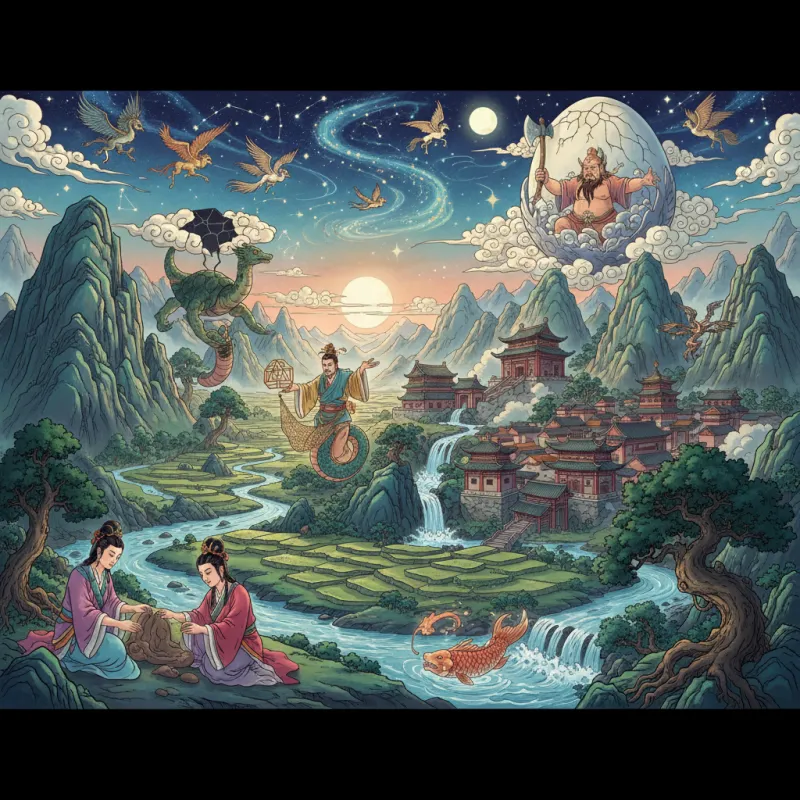
When the universe was nothing but a cosmic egg floating in absolute darkness, a hairy giant slept inside for 18,000 years. His name was Pangu (盘古, Pángǔ), and when he finally woke up, he was not happy about his cramped accommodations. What happened next—his violent separation of heaven and earth—became the foundational story that would shape how over a billion people understand their place in the cosmos.
Chinese creation myths don't follow the neat, monotheistic template familiar to Western audiences. There's no single god speaking worlds into existence, no seven-day timeline, no forbidden fruit. Instead, these stories present a messy, magnificent collision of cosmic forces, self-sacrificing giants, and divine beings who fix the sky with melted stones. They're weird, they're wonderful, and they reveal a worldview that sees humanity not as the pinnacle of creation but as one thread in an interconnected web of existence.
Pangu and the Cosmic Egg
The Pangu myth, first recorded during the Three Kingdoms period (220-280 CE) by Xu Zheng, describes creation as an act of physical labor rather than divine speech. Inside that cosmic egg, yin and yang swirled together in undifferentiated chaos. When Pangu broke free, he used a giant axe to separate the light, clear elements (yang) from the heavy, murky ones (yin). The yang rose to become the heavens; the yin sank to form the earth.
But here's where it gets interesting: Pangu didn't just create and walk away. For another 18,000 years, he stood between heaven and earth, growing ten feet taller each day, pushing them apart to prevent them from collapsing back into chaos. When he finally died from exhaustion, his body became the world itself. His breath became wind and clouds, his voice thunder, his left eye the sun, his right eye the moon. His limbs formed the four cardinal directions and five sacred mountains. Even his parasites—yes, the myth specifically mentions his fleas and lice—transformed into the human race.
This is not a story about humanity being specially crafted in a divine image. It's a story about humans emerging from the literal dirt and bugs of a dead giant. There's something both humbling and profound in that origin.
Nüwa: The Goddess Who Shaped Humanity
While Pangu created the physical universe, Nüwa (女娲, Nǚwā) gave it life and meaning. Her myths, which predate Pangu's by centuries, appear in texts like the Huainanzi (compiled around 139 BCE) and Customs and Territories from the Han Dynasty. Nüwa is typically depicted as a goddess with a human head and a serpent's body—a form that connects her to both earthly and divine realms.
According to legend, Nüwa felt lonely in the newly formed world. She knelt beside the Yellow River and began sculpting figures from yellow clay, breathing life into each one. These carefully crafted beings became the nobility and aristocracy. But the work was tedious, so Nüwa eventually dipped a rope in mud and flung it around, creating common people from the scattered droplets. This myth doesn't just explain human origins—it provides a cosmic justification for social hierarchy that would persist throughout Chinese imperial history.
Nüwa's most heroic act came later, when the pillars supporting heaven broke during a catastrophic battle between gods. The sky tilted, causing floods and fires to ravage the earth. Nüwa smelted five-colored stones to patch the holes in heaven, cut off the legs of a giant turtle to prop up the sky, and killed a black dragon to save humanity. This myth of cosmic repair appears in the Huainanzi and establishes a pattern you'll see throughout Chinese mythology: the universe requires constant maintenance, and even gods must work to prevent chaos from returning.
The Cosmic Bureaucracy: Multiple Creators, Multiple Truths
Unlike monotheistic traditions that demand a single, authoritative creation account, Chinese mythology embraces contradiction. Pangu and Nüwa coexist in the cultural imagination without anyone feeling the need to reconcile their stories into a unified timeline. Some regions emphasize one myth over another; some blend them together. This flexibility reflects a fundamental aspect of Chinese philosophical thought: truth is contextual, and multiple perspectives can be simultaneously valid.
The Classic of Mountains and Seas (山海经, Shānhǎi Jīng), compiled between the 4th century BCE and 2nd century CE, presents yet another creation framework. This bizarre text—part geography, part mythology, part natural history—describes a world populated by hundreds of strange deities and creatures, each associated with specific mountains, rivers, and regions. There's no single creator here, just an endless catalog of divine beings, each with their own domain and powers.
This multiplicity matters because it shaped how Chinese culture approaches authority and truth. Just as there's no single creation story, there's no single religious orthodoxy. Confucianism, Daoism, and Buddhism coexist, often within the same person's belief system. The creation myths established this pattern of philosophical pluralism that would define Chinese intellectual life for millennia.
Fuxi and the Order of Civilization
Fuxi (伏羲, Fúxī), often depicted as Nüwa's brother or husband (or both—ancient myths don't sweat the details), represents the transition from chaos to civilization. While Pangu created the physical world and Nüwa created humanity, Fuxi taught humans how to actually live in it. He invented fishing nets, domesticated animals, created the eight trigrams (bagua) that form the basis of the I Ching, and established the institution of marriage.
The Fuxi myths, recorded in texts like the Book of Documents and Records of the Grand Historian, reveal something crucial about Chinese cultural values: creation isn't just about origins, it's about organization. The universe doesn't need a creator as much as it needs an administrator. This bureaucratic view of the cosmos would later manifest in Chinese religious practice, where the celestial realm mirrors the imperial government, complete with departments, hierarchies, and paperwork.
Some versions of the Fuxi-Nüwa story describe them as the sole survivors of a great flood, forced to marry to repopulate the earth. They climbed separate mountains and lit fires; when the smoke merged, they took it as a sign from heaven that they should become husband and wife. Their children became the ancestors of all humanity. This flood narrative shares elements with stories from other cultures, suggesting either common origins or the universal human need to explain catastrophic natural disasters through myth.
The Philosophical Underpinnings: Yin, Yang, and Cosmic Balance
Chinese creation myths aren't just entertaining stories—they're philosophical treatises disguised as narratives. The constant interplay of yin and yang, the emphasis on balance over dominance, the cyclical rather than linear view of time—these concepts permeate every creation story and reflect core principles of Chinese cosmology.
In the Pangu myth, creation happens through separation, not through divine command. Yin and yang must be distinguished but never eliminated. Heaven and earth are opposites that define each other. This dualistic thinking, formalized in texts like the Daodejing and I Ching, sees the universe as a dynamic balance of complementary forces rather than a battleground between good and evil.
The myths also reveal a distinctly Chinese attitude toward the divine: gods are powerful but not omnipotent, immortal but not unchanging, worthy of respect but not blind worship. They make mistakes, feel emotions, and sometimes need help from humans. This pragmatic approach to the supernatural contrasts sharply with the transcendent, all-powerful deities of Western monotheism.
Legacy and Living Tradition
These ancient myths aren't museum pieces—they're living elements of contemporary Chinese culture. The Pangu myth inspired the name of China's first space station, Tiangong (Heavenly Palace), connecting ancient cosmology to modern space exploration. Nüwa appears in countless novels, films, and video games, her image evolving while her core story remains recognizable. The eight trigrams Fuxi supposedly invented still appear on the South Korean flag and in feng shui practices worldwide.
During Chinese New Year celebrations, you'll still see references to these creation myths in temple decorations and traditional performances. The concept of maintaining cosmic balance—so central to Nüwa's sky-repairing myth—underlies traditional Chinese medicine, martial arts philosophy, and environmental thinking. Even the Chinese Communist Party, officially atheist, has embraced these myths as cultural heritage, recognizing their power to unite people around shared stories.
The creation myths also connect to other aspects of Chinese folklore, from the legendary emperors who shaped early civilization to the festival traditions that mark the agricultural calendar. They provide the cosmological foundation for understanding why certain mountains are sacred, why dragons control water, and why harmony with nature matters more than dominion over it.
Why These Myths Still Matter
In an age of scientific cosmology, why should anyone care about giants hatching from eggs or goddesses molding humans from mud? Because these stories encode values that shaped one of the world's oldest continuous civilizations. They teach that creation is ongoing work, not a finished product. They suggest that humans are part of nature, not separate from or superior to it. They embrace complexity and contradiction rather than demanding simple, unified explanations.
The Chinese creation myths offer an alternative to the Western narrative of human exceptionalism. We're not made in a god's image and given dominion over the earth—we're the fleas on a dead giant's body, shaped from mud by a lonely goddess, taught to survive by culture heroes who were part human, part divine, and entirely fallible. There's something refreshingly honest about that origin story, something that might even be useful as we face environmental crises that demand we see ourselves as part of nature's web rather than its masters.
These myths remind us that every culture creates stories to explain where we come from and why we're here. The Chinese versions—with their cosmic eggs, self-sacrificing giants, and sky-repairing goddesses—offer perspectives that Western audiences often miss. They're not just China's creation myths. In our interconnected world, they're part of humanity's shared inheritance, alternative ways of imagining our place in the universe that we ignore at our own impoverishment.
Related Reading
- Unveiling Chinese Creation Myths: The Stories that Shaped a Civilization
- Gongfu Tea Ceremony Step by Step
- Temple Etiquette: How to Visit Chinese Temples
- Real Chinese Martial Arts: Beyond the Movie Myths
Explore Chinese Culture
- Explore feng shui in daily life
- Explore supernatural folklore
- Explore classical Chinese literature