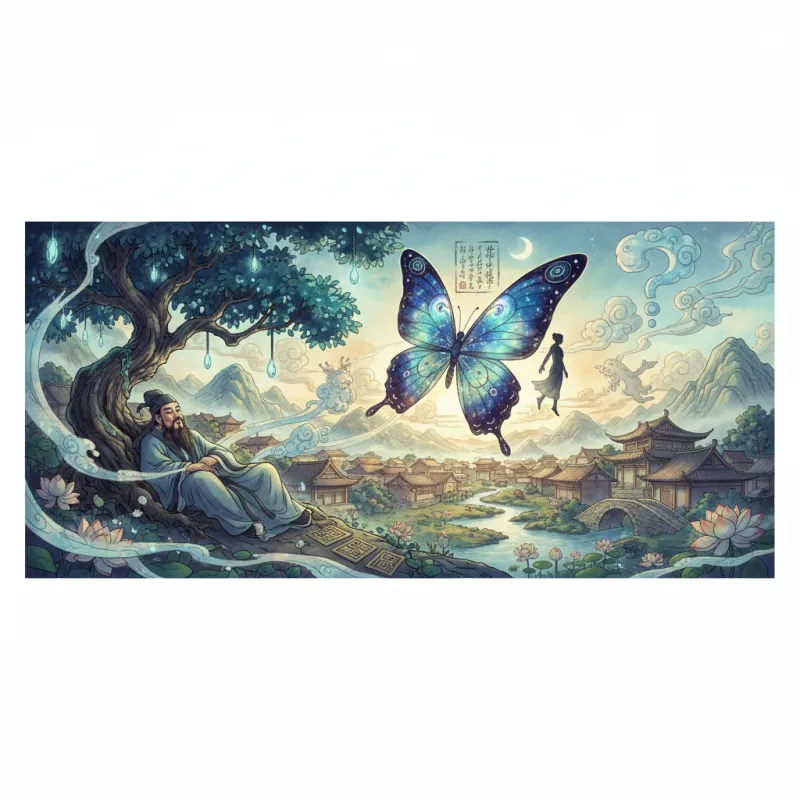
You wake from a dream so vivid that for a moment—maybe longer—you can't remember which world is real. The philosopher Zhuangzi (莊子, Zhuāngzǐ) had this exact experience around 300 BCE, except his dream involved fluttering through gardens as a butterfly, completely unaware he'd ever been human. When he woke, he faced a question that still haunts philosophers today: Was he a man who dreamed of being a butterfly, or is he now a butterfly dreaming of being a man?
The Original Parable in Context
The butterfly dream appears in the second chapter of the Zhuangzi (莊子), titled "On the Equality of Things" (齊物論, Qíwùlùn). The original passage is deceptively simple—just a few lines that have generated centuries of commentary. Zhuangzi describes becoming a butterfly, "fluttering about happily, enjoying himself to his heart's content," with no awareness of his human identity. Upon waking, he finds himself "solid and unmistakable Zhuangzi." But then comes the philosophical gut-punch: he doesn't know if he's Zhuangzi who dreamed he was a butterfly, or a butterfly now dreaming he's Zhuangzi.
This wasn't just philosophical navel-gazing. Zhuangzi lived during the Warring States period (475-221 BCE), when China was fragmenting into competing kingdoms and philosophers were desperately trying to make sense of chaos. While Confucians like Confucius insisted on rigid social hierarchies and moral certainty, Zhuangzi took the opposite approach: maybe our certainties are illusions, and what we call "reality" is just one perspective among infinite possibilities.
What Makes Reality Real?
The butterfly dream attacks our most basic assumption: that we can distinguish reality from illusion. We trust our waking experience because it feels more solid, more consistent, more real than dreams. But Zhuangzi asks: what if that feeling is just another sensation, no more reliable than the butterfly's joy? When you're dreaming, the dream feels completely real. You don't think "this is just a dream"—you think "this is happening." Only after waking do you retrospectively label it as unreal.
The Chinese term Zhuangzi uses for the transformation between states is hua (化), which means metamorphosis or transformation. This isn't about one state being real and another false—it's about the continuous flow between different modes of being. The butterfly and the man are both real expressions of the same underlying reality, what Zhuangzi calls the Dao (道, Dào). The problem isn't that one is an illusion; the problem is our insistence on drawing sharp boundaries between them.
This connects deeply to the Daoist concept of wu wei, or effortless action. Just as the butterfly doesn't strain to be a butterfly, we shouldn't strain to maintain our fixed sense of self. The transformation between states happens naturally, like water flowing downhill.
The Self That Isn't There
Western philosophy, from Descartes onward, has obsessed over the certainty of the self: "I think, therefore I am." Zhuangzi flips this on its head. He's not trying to prove the self exists—he's questioning whether the boundaries we draw around "self" mean anything at all. When he's a butterfly, there's no Zhuangzi. When he's Zhuangzi, there's no butterfly. So which one is the "real" him?
The answer, for Zhuangzi, is neither and both. The self is not a fixed entity but a temporary pattern, like a wave on the ocean. The wave appears, exists for a moment, then dissolves back into the water. Was the wave ever separate from the ocean? In the same way, Zhuangzi-the-man and Zhuangzi-the-butterfly are temporary patterns in the flow of the Dao. The transformation between them—what he calls wuhua (物化, wùhuà), the transformation of things—is the only constant.
This has radical implications. If the self is fluid and temporary, then our desperate clinging to identity, status, and permanence is fundamentally misguided. We're like someone trying to grab water—the tighter we squeeze, the more it slips away. The butterfly doesn't worry about whether it's real or what it will become next. It simply is, fully present in each moment.
Modern Echoes and Quantum Weirdness
The butterfly dream has found unexpected resonance in modern physics and consciousness studies. Quantum mechanics tells us that particles exist in superposition—multiple states simultaneously—until observed. The act of observation collapses these possibilities into one reality. Sound familiar? Zhuangzi's question about who's dreaming whom mirrors the observer problem in quantum physics: reality seems to depend on who's looking.
Neuroscientists studying consciousness have discovered that our brains construct reality from fragmentary sensory data, filling in gaps and creating a coherent narrative. What we experience as "reality" is actually a sophisticated simulation our brains generate. Dreams use the same neural machinery, which is why they can feel so convincing. Zhuangzi intuited this 2,300 years before fMRI machines: the boundary between waking and dreaming is thinner than we think.
The philosopher Thomas Metzinger has argued that the self is a "transparent phenomenal model"—a construct so seamless we mistake it for reality itself. We don't experience having a self; we experience being a self, just as Zhuangzi didn't experience having a butterfly body—he was the butterfly. Only from outside the experience can we see it as a construct.
Living With Uncertainty
The butterfly dream isn't meant to be solved like a logic puzzle. Zhuangzi isn't asking us to figure out which state is "really" real. He's inviting us to sit with the uncertainty, to recognize that our need for certainty is itself the problem. This is quintessentially Daoist: instead of imposing our categories on reality, we should flow with its transformations.
This has practical implications for how we live. If we take the butterfly dream seriously, we stop clinging so tightly to our identities, our plans, our certainties. We become more flexible, more open to transformation. When circumstances change—and they always do—we can change with them, like water taking the shape of its container. The butterfly doesn't resist becoming Zhuangzi; Zhuangzi doesn't resist becoming the butterfly.
Compare this to the Confucian approach, which emphasizes fixed roles and relationships. A son must be filial, a ruler must be benevolent, a scholar must be learned. These identities are meant to be stable and unchanging. Zhuangzi finds this absurd. Everything transforms; why should we be different? The person you were ten years ago is as distant as the butterfly—maybe more so, since at least the butterfly felt real while it lasted.
The Dream We're Still Dreaming
Here's what keeps me up at night about the butterfly dream: Zhuangzi never resolves it. He doesn't wake up from the butterfly dream into some higher reality where everything makes sense. He just notes the transformation between states and moves on. Maybe that's the point. Maybe we're not supposed to wake up from the dream—we're supposed to recognize that "waking up" is just another dream, another transformation in an endless series.
The Buddhist concept of maya, or illusion, takes this even further: all of phenomenal reality is a kind of dream from which we must awaken to reach enlightenment. But Zhuangzi isn't quite saying that. He's not dismissing the butterfly's joy or Zhuangzi's confusion as mere illusion. Both are real experiences, real transformations of the Dao. The illusion is thinking one is more real than the other.
In our current moment, when AI can generate convincing realities, when virtual worlds feel increasingly immersive, when our online and offline selves diverge, Zhuangzi's question becomes urgent again. Which version of you is real—the one scrolling through social media, the one at work, the one alone with your thoughts? Maybe you're all of them, and none of them, transforming moment by moment like a butterfly that dreams it's a philosopher who dreams it's a butterfly.
The genius of Zhuangzi's parable is that it doesn't answer its own question. It just leaves you there, suspended between certainties, wondering which dream you're in right now.
Related Reading
- Yin and Yang Explained: Beyond the Black and White Symbol
- Wu Wei: The Taoist Art of Doing Nothing (and Getting Everything Done)
- Confucius: The Key Teachings That Shaped East Asia
- The Complete Guide to Chinese Culture: Everything You Need to Know
- Confucius Was Not Confucian (And Other Surprises About China's Most Famous Philosopher)
- Legendary Heroes of Chinese Folklore: Tales That Shaped Culture and Identity
- Chinese Calligraphy: Why Writing Is the Highest Art
- Unveiling the Celestial Tales of Chinese Folklore and Legends
Explore Chinese Culture
- Explore feng shui in daily life
- Explore supernatural folklore
- Explore classical Chinese literature