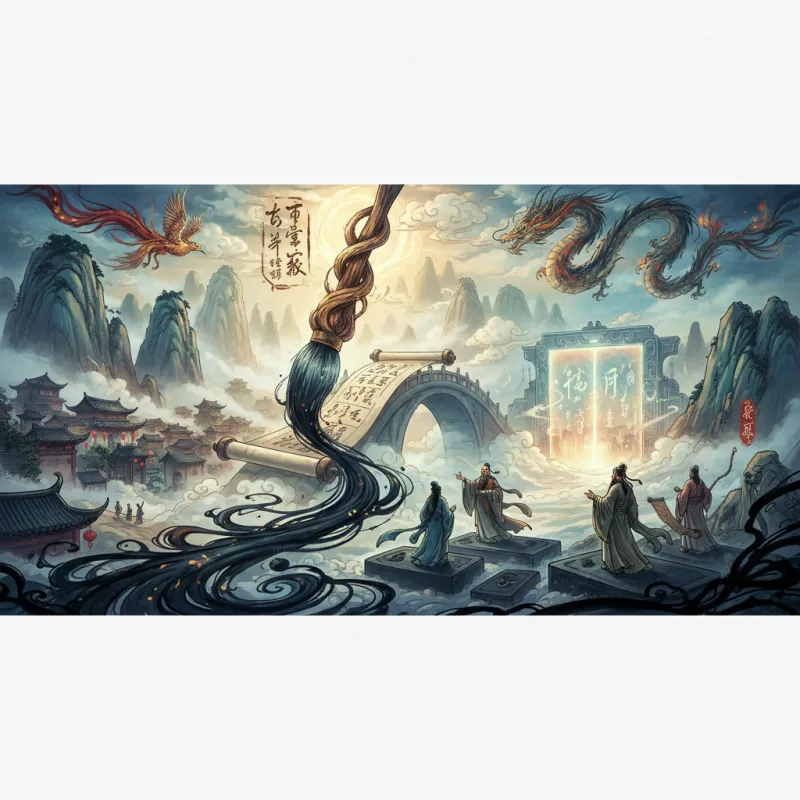
A single brushstroke can reveal whether you're anxious, drunk, or enlightened. In China, your handwriting doesn't just communicate words—it exposes your inner state with the precision of a lie detector test. This is why calligraphy (书法, shūfǎ) sits at the apex of Chinese artistic achievement, ranked above painting, music, and even chess. While Western culture treats handwriting as a utilitarian skill somewhere between typing and tying your shoes, Chinese tradition considers it the most direct expression of human character. The brush doesn't lie.
The Geometry of Consciousness
Chinese characters aren't phonetic symbols—they're architectural structures. Each character occupies an invisible square, and within that space, every stroke must balance against every other stroke. Write the character for "eternal" (永, yǒng) and you're executing eight fundamental stroke types: dot, horizontal, vertical, hook, rising, left-falling, right-falling, and press. Master these eight strokes in this one character, the theory goes, and you've grasped the foundation of all Chinese writing.
But here's where it gets interesting: these aren't just mechanical movements. A horizontal stroke (横, héng) doesn't travel in a straight line—it rises slightly at the beginning, travels with varying pressure, and lifts with a subtle flick at the end. The stroke breathes. It has a beginning, middle, and end, like a miniature narrative. Multiply this by the thousands of characters in common use, each with its own proportions and rhythm, and you begin to understand why calligraphy demands a lifetime of practice.
The spatial relationships within characters mirror Chinese philosophical concepts. Balance without symmetry. Tension without conflict. The character for "middle" (中, zhōng) places a vertical line through the center of a rectangle—perfect balance. But the character for "peace" (安, ān) puts a woman under a roof at an off-center position that somehow feels more stable than perfect symmetry would. This is the Daoist principle of dynamic equilibrium made visible.
Why Calligraphy Outranks Painting
The traditional hierarchy—calligraphy first, then painting, music, and chess—isn't arbitrary. It reflects a sophisticated theory about authenticity and mediation. Painting requires you to observe an external subject, then translate it onto paper. Music requires instruments that stand between your intention and the sound. Chess requires an opponent. But calligraphy? It's just you, the brush, ink, and paper. No intermediary. No translation. The brush moves directly from your mind through your arm, and what appears on paper is an unfiltered record of your qi (气, qì)—your vital energy, your state of being in that exact moment.
This is why collectors pay attention to the circumstances under which a piece was written. Wang Xizhi's (王羲之) "Preface to the Poems Composed at the Orchid Pavilion" from 353 CE is considered the greatest work of calligraphy in Chinese history partly because Wang wrote it while slightly drunk at a garden party, in a state of relaxed spontaneity. He tried to recreate it later when sober—dozens of attempts—but could never match the original's effortless grace. The wine didn't make him sloppy; it removed his self-consciousness, allowing his true nature to flow through the brush.
Compare this to painting, where technical skill can mask inner emptiness. A mediocre person can paint a competent landscape by following established techniques. But in calligraphy, technical mastery is just the entry fee. The real art begins when technique becomes so internalized that it disappears, leaving only character—in both senses of the word.
The Four Treasures and Their Alchemy
Calligraphy requires the "Four Treasures of the Study" (文房四宝, wénfáng sìbǎo): brush, ink, paper, and inkstone. Each element affects the final result in ways that Western pen-and-paper writing never approaches. The brush isn't a rigid tool—it's a bundle of animal hair (rabbit, goat, weasel, or wolf) that responds to pressure, angle, and speed with infinite variation. Press hard and the bristles splay, creating a thick, bold stroke. Lift slightly and the stroke thins to a hair. Twist the brush and the stroke changes character mid-flight.
The ink matters too. Traditional ink comes in solid sticks made from pine soot or oil soot mixed with animal glue. You grind the stick against an inkstone with water, and the ratio of water to ink affects everything—viscosity, darkness, how the ink bleeds into the paper. Watery ink creates soft, atmospheric effects. Thick ink produces sharp, decisive strokes. A calligrapher might use different ink consistencies within a single piece, adjusting the mixture as they work.
Then there's the paper. Xuan paper (宣纸, xuānzhǐ) from Anhui province is prized because it's absorbent enough to capture subtle variations in ink tone but strong enough not to tear under a loaded brush. The paper drinks the ink, creating a slight blur at the edges of strokes—a quality called "flying white" (飞白, fēibái) when done intentionally. This isn't a flaw; it's a feature that adds life and movement to the characters. For more on the materials and techniques, see The Art of Chinese Calligraphy.
The Five Major Scripts
Chinese calligraphy evolved through five major script styles, each with its own aesthetic and philosophical associations. Seal script (篆书, zhuànshū) is the ancient form, used on bronze vessels and imperial seals—formal, archaic, almost pictographic. Clerical script (隶书, lìshū) emerged during the Han dynasty as a more practical administrative hand, with distinctive "silkworm head and wild goose tail" strokes that flare at the ends.
Regular script (楷书, kǎishū) is what most people learn first—the standard printed form, clear and legible, like Times New Roman made with a brush. Running script (行书, xíngshū) is regular script's casual cousin, with strokes that flow into each other, faster and more natural. And then there's cursive script (草书, cǎoshū), where characters dissolve into abstract gestures, legible only to those who've studied the conventions. Cursive is where calligraphy becomes pure expression, where the line between writing and abstract painting blurs completely.
Each script suits different purposes and moods. You wouldn't write a formal document in cursive any more than you'd write a love letter in seal script. But master calligraphers move between scripts the way a musician shifts between genres, choosing the style that matches their message and emotional state.
Reading Between the Strokes
Here's what separates calligraphy from mere handwriting: every formal element carries meaning. Thick strokes suggest strength and confidence. Thin strokes imply delicacy or restraint. Fast strokes show spontaneity; slow strokes indicate deliberation. The space between characters matters as much as the characters themselves—too crowded and the composition feels anxious, too sparse and it feels disconnected.
Calligraphers study the masters by copying their works, not to plagiarize but to inhabit their mindset. When you copy Yan Zhenqing's (颜真卿) powerful regular script, you're not just reproducing shapes—you're trying to feel what he felt, to understand the force and conviction behind those muscular strokes. When you copy Zhao Mengfu's (赵孟頫) elegant running script, you're cultivating his refined, scholarly temperament. This is why calligraphy was considered essential training for scholars and officials. It wasn't about producing pretty documents; it was about cultivating character.
The connection between handwriting and personality was taken so seriously that calligraphy could affect your career. During the imperial examination system, candidates with poor handwriting might fail regardless of their knowledge. The reasoning wasn't superficial—if you couldn't discipline your brush, how could you discipline yourself or govern others? Your calligraphy was your resume, your psychological profile, and your moral credential rolled into one.
The Modern Paradox
Today, most Chinese people type rather than write by hand. The average person's calligraphy skills have declined dramatically over the past few decades. Yet calligraphy's cultural prestige remains intact. Calligraphy classes are booming. Parents enroll children in weekend calligraphy schools. Corporations commission calligraphers for important documents and gifts. The art form has become more precious precisely because it's no longer necessary.
This creates an interesting tension. Calligraphy was originally an everyday practice—scholars wrote letters, officials drafted documents, poets composed verses, all in their own hand. The art emerged from constant practice, from writing as a daily act. Now it's becoming a specialized skill, something you do in a studio rather than at a desk. The question is whether calligraphy can maintain its depth when separated from its original context, or whether it will become a museum art, admired but not lived.
Still, something about calligraphy resists obsolescence. Maybe it's the physicality—the way your whole body engages when you stand at a table, brush in hand, arm moving from the shoulder. Maybe it's the mindfulness it demands; you can't text while doing calligraphy. Or maybe it's the connection to history, the sense that when you write a character, you're participating in a tradition that stretches back three thousand years, adding your voice to an endless conversation about what it means to be human. For insights into how this tradition has been preserved, explore Chinese Calligraphy Styles.
In an age of digital communication, where words are weightless and disposable, calligraphy insists that how you say something matters as much as what you say. The medium isn't just the message—it's the person.
Related Reading
- Famous Calligraphers Through History
- Calligraphy as Meditation Practice
- The Five Scripts of Chinese Calligraphy
- How to Start Learning Chinese Calligraphy
- Exploring the Rich Tapestry of Chinese Folklore, Legends, and Fairy Tales
- Unraveling China's Trickster Tales: Lore, Legends, and Cultural Impact
- Mencius on Human Nature: Are We Born Good?
Explore Chinese Culture
- Explore feng shui in daily life
- Explore supernatural folklore
- Explore classical Chinese literature