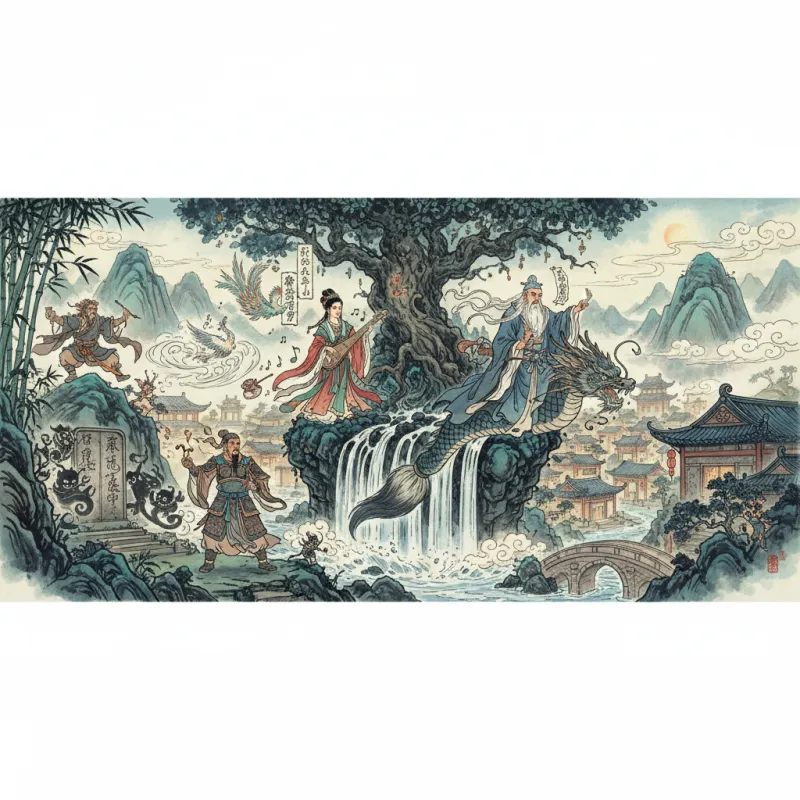
A drunk official stumbles through an imperial garden at midnight, demanding ink and paper. His servants scramble. He grabs a brush and in one fluid burst writes eight columns of characters so wild, so perfectly unhinged, that 1,200 years later calligraphers still argue about whether anyone was sober enough to capture that kind of freedom. That official was Zhang Xu (張旭, Zhāng Xù), and that night produced one of the most studied pieces in Chinese calligraphy history. The masters of Chinese calligraphy weren't just skilled technicians — they were poets, politicians, rebels, and drunks whose brushstrokes became windows into their souls.
Wang Xizhi: The Sage Who Set the Standard
Wang Xizhi (王羲之, Wáng Xīzhī, 303-361 CE) holds a position in Chinese calligraphy that no one else can touch. He's called the "Sage of Calligraphy" (書聖, shū shèng), and that's not hyperbole. His Lanting Xu (蘭亭序, Preface to the Orchid Pavilion) is the most famous piece of calligraphy in Chinese history — so famous that Emperor Taizong of Tang supposedly had the original buried with him. What we have now are copies of copies, and calligraphers have been obsessing over them for 1,600 years.
The legend goes like this: In 353 CE, Wang Xizhi gathered with forty-one friends at the Orchid Pavilion for the Lustration Festival. They floated wine cups down a stream, composed poetry, got pleasantly drunk. Wang Xizhi wrote the preface to their poetry collection in running script (行書, xíngshū), making twenty-some corrections as he went. Later, stone sober, he tried to recreate it. Couldn't. That spontaneous, slightly tipsy version became the gold standard for elegant, flowing calligraphy. The piece balances structure and freedom so perfectly that it's been the model for Chinese Calligraphy Styles ever since.
Wang Xizhi came from an aristocratic family during the Eastern Jin Dynasty, served as a general and administrator, but his real legacy is those brushstrokes. His seventh son, Wang Xianzhi (王獻之, Wáng Xiànzhī), also became a master calligrapher. Together they're called the "Two Wangs" (二王, èr Wáng), and their style dominated Chinese calligraphy for centuries. If you study calligraphy in any serious way, you start with Wang Xizhi. There's no way around him.
Yan Zhenqing: The Loyal Minister's Bold Strokes
Yan Zhenqing (顏真卿, Yán Zhēnqīng, 709-785 CE) represents everything Wang Xizhi doesn't. Where Wang is elegant and flowing, Yan is bold and muscular. Where Wang came from privilege, Yan earned his position through the imperial examination system. Where Wang's life was relatively peaceful, Yan's was marked by war, loyalty, and ultimately martyrdom.
Yan developed what's now called "Yan Style" (顏體, Yán tǐ) — regular script with thick, powerful strokes that look like they could hold up a building. His characters are square, solid, uncompromising. They match his personality. During the An Lushan Rebellion (755-763 CE), when much of the Tang Dynasty's military leadership either fled or surrendered, Yan organized resistance in his home province. He was one of the few officials who stood firm.
His most famous work, Sacrificial Nephew Manuscript (祭姪文稿, Jì Zhí Wéngǎo), was written in 758 CE after his nephew died fighting the rebels. It's raw grief in brushstrokes — characters that start controlled and dissolve into barely legible scrawls as emotion overwhelms technique. The piece has corrections, ink blots, trembling lines. It's the opposite of Wang Xizhi's refined elegance, and that's exactly why it's considered one of the three greatest pieces of running script in Chinese history. You can see a man breaking down on the page.
Yan died at seventy-six, executed by a rebel general after refusing to switch sides. His calligraphy became associated with loyalty, integrity, and moral strength. For over a thousand years, Chinese officials studied Yan's style not just to improve their brushwork but to cultivate the character they believed it represented. As the saying goes, "writing is like the person" (字如其人, zì rú qí rén), and Yan's writing was unshakeable.
Zhang Xu and Huai Su: The Wild Cursive Masters
If Wang Xizhi represents classical perfection and Yan Zhenqing represents moral strength, Zhang Xu (張旭, Zhāng Xù, c. 675-750 CE) and Huai Su (懷素, Huái Sù, 737-799 CE) represent controlled chaos. Both specialized in wild cursive script (狂草, kuáng cǎo), where characters blur together in continuous flowing lines that look more like abstract expressionism than writing.
Zhang Xu was a Tang Dynasty official known for writing while drunk. Really drunk. He'd dip his hair in ink and use his head as a brush. He'd shout and dance before writing. His contemporaries called him "Zhang the Mad" (張顛, Zhāng Diān). His cursive script is so abstract that even trained calligraphers struggle to read it, but the energy is undeniable. Each stroke flows into the next with a momentum that feels inevitable, like watching water find its path downhill.
Huai Su was a Buddhist monk who studied Zhang Xu's style and took it further. He was also known for drinking — apparently Tang Dynasty cursive script and alcohol went hand in hand. His Autobiography (自敘帖, Zì Xù Tiě) is a masterpiece of wild cursive, 126 lines of characters that dance and tumble down the page. The piece includes descriptions of his own calligraphy from various admirers, which is either confident or hilariously immodest depending on your perspective.
What makes their work fascinating is the control underneath the chaos. Wild cursive looks spontaneous, but it requires absolute mastery of brush technique. You have to know the rules perfectly before you can break them this beautifully. Their style influenced Calligraphy as Meditation Practice — that state of flow where technique becomes unconscious and the brush moves on its own.
Su Shi: The Renaissance Man's Brush
Su Shi (蘇軾, Sū Shì, 1037-1101 CE), better known as Su Dongpo (蘇東坡), was a Song Dynasty polymath — poet, painter, calligrapher, statesman, engineer, and food innovator. He's the guy Dongpo pork is named after. He invented a cooking method while in exile. That's the kind of person he was.
His calligraphy reflects his personality: confident, unconventional, slightly irreverent. He developed a style that broke from the Tang Dynasty masters, using a flatter brush angle and more varied stroke weights. His characters lean and sprawl in ways that would have horrified earlier calligraphers, but they work. They have personality. You can see his wit and intelligence in every line.
Su Shi spent much of his career in political exile — he had a talent for writing poems that offended emperors. During one exile to Huangzhou, he wrote Cold Food Festival Poem (寒食帖, Hán Shí Tiě), which became one of his most celebrated calligraphic works. The piece shows his emotional range, moving from melancholy to acceptance, with brushwork that shifts from controlled to loose as the mood changes.
He was part of the "Four Masters of the Song Dynasty" (宋四家, Sòng Sì Jiā), along with Huang Tingjian, Mi Fu, and Cai Xiang. Together they revolutionized calligraphy by emphasizing personal expression over technical perfection. Su Shi argued that calligraphy should reveal the writer's spirit, not just demonstrate skill. This idea — that authenticity matters more than polish — influenced Chinese aesthetics for centuries.
Zhao Mengfu: The Controversial Classicist
Zhao Mengfu (趙孟頫, Zhào Mèngfǔ, 1254-1322 CE) was a Yuan Dynasty calligrapher with an uncomfortable biography. He was a descendant of the Song Dynasty imperial family, but when the Mongols conquered China and established the Yuan Dynasty, he served the new government. Many Chinese scholars considered this betrayal. His calligraphy, however, was so good that even his critics had to acknowledge it.
Zhao revived classical styles, particularly Wang Xizhi's elegant running script, at a time when calligraphy had become increasingly personal and expressive. He argued for returning to the fundamentals, studying the ancient masters, perfecting technique. His regular script is textbook perfect — every stroke precisely placed, every character balanced. It's beautiful, but some critics found it too polished, too safe.
The debate around Zhao Mengfu gets at a central tension in Chinese calligraphy: Should art reflect the artist's moral character? If someone serves a foreign dynasty, can their calligraphy still be considered great? Chinese tradition says writing reveals character, but Zhao's technically perfect brushwork seemed to contradict his politically questionable choices. The discussion continues today.
Despite the controversy, Zhao's influence is undeniable. He was also an accomplished painter and poet, and his calligraphy style became the model for Ming and Qing Dynasty official documents. If you've seen Chinese calligraphy that looks elegant, balanced, and slightly formal, it probably owes something to Zhao Mengfu.
Dong Qichang: The Theorist Who Changed Everything
Dong Qichang (董其昌, Dǒng Qíchāng, 1555-1636 CE) was a Ming Dynasty official, calligrapher, painter, and art theorist whose ideas about Chinese art still shape how we understand it today. He divided Chinese painting and calligraphy into two schools: the "Northern School" (北宗, běi zōng), which emphasized technical skill and professional training, and the "Southern School" (南宗, nán zōng), which valued personal expression and amateur scholar-artists.
This division was somewhat artificial — Dong was creating a theoretical framework more than describing historical reality — but it stuck. He argued that true art came from cultivated individuals expressing their inner nature, not from professional craftsmen following rules. This elevated amateur scholar-artists (like himself) over professional calligraphers and painters.
Dong's own calligraphy synthesized elements from various masters, particularly Wang Xizhi and Yan Zhenqing. His style is refined and scholarly, with a slightly archaic quality that reflects his deep study of historical models. He wasn't trying to innovate; he was trying to understand and preserve the classical tradition while adding his own interpretation.
His theoretical writings influenced how Chinese art was collected, studied, and valued for centuries. The idea that calligraphy and painting should express the artist's cultivation and character — rather than just demonstrate technical skill — became orthodoxy. Whether you agree with his theories or not, you can't understand Chinese calligraphy without understanding Dong Qichang's framework.
The Living Tradition
These masters aren't museum pieces. Walk into any serious calligraphy studio today, and students are still copying Wang Xizhi's Lanting Xu, still studying Yan Zhenqing's powerful strokes, still trying to capture Zhang Xu's wild energy. The tradition is alive because these calligraphers created works that remain technically challenging and emotionally resonant across centuries.
What makes Chinese calligraphy unique is this direct transmission. You don't just study the masters' finished works — you copy them, stroke by stroke, trying to understand their decisions, feel their rhythm, internalize their technique. It's an embodied practice, a physical conversation across time. When you write in Yan Zhenqing's style, you're not just imitating his brushwork; you're trying to cultivate the strength and integrity his characters represent.
The debates continue too. Is technical perfection more important than emotional authenticity? Should calligraphy follow classical models or pursue innovation? Can you separate an artist's work from their moral character? These aren't abstract questions — they're arguments that happen in calligraphy classes, online forums, and academic conferences today. The masters gave us not just beautiful writing, but frameworks for thinking about what art should be and do.
Chinese calligraphy's canon isn't fixed or finished. New calligraphers emerge, new interpretations develop, new technologies change how people practice and share their work. But the foundation remains these masters — their techniques, their innovations, their lives, their brushstrokes that somehow captured something essential about being human and put it on paper in ink.
Related Reading
- How to Start Learning Chinese Calligraphy
- Chinese Calligraphy: Why Writing Is the Highest Art
- The Five Scripts of Chinese Calligraphy
- Delving into Chinese Water Legends: Tales of Spirits and Serpents
- Real Chinese Martial Arts: Beyond the Movie Myths
- Acupuncture: What Science Actually Says
Explore Chinese Culture
- Explore feng shui in daily life
- Explore supernatural folklore
- Explore classical Chinese literature