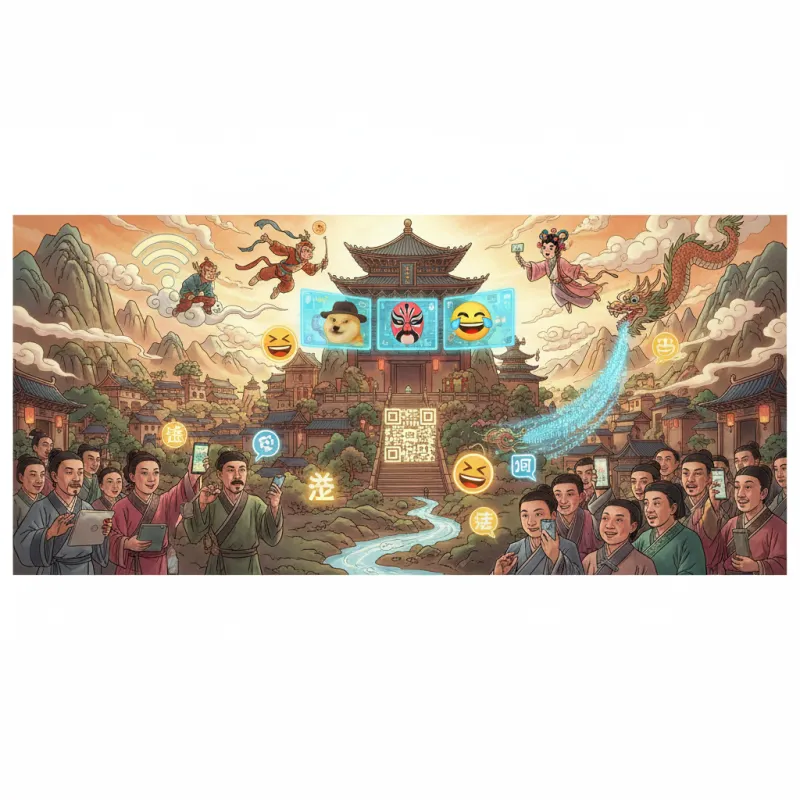
A 22-year-old in Shanghai types "yyds" into a WeChat group chat. Her friend in Beijing responds with "绝绝子" (juéjuézǐ). A third friend drops a "6666" followed by three crying-laughing emojis. To an outsider, this looks like gibberish. To China's 1.05 billion internet users, it's Tuesday.
Chinese internet culture isn't just Western internet culture with Chinese characteristics — it's a parallel digital universe that evolved under entirely different conditions. Behind the 防火长城 (Fánghuǒ Chángchéng, Great Firewall), a generation has created its own memes, slang, platforms, and unwritten rules for digital life. Understanding this culture means understanding how nearly a billion people communicate, create, and connect in ways that often baffle outsiders.
The Platforms That Built a Digital Nation
The infrastructure shapes everything. While Westerners Google, tweet, and scroll Instagram, Chinese netizens — 网民 (wǎngmín) in Mandarin — inhabit an entirely different ecosystem. 微信 (Wēixìn, WeChat) isn't just messaging; it's your wallet, your ID, your newspaper, your shopping mall, and your social life compressed into one super-app. 微博 (Wēibó, literally "micro-blog") serves as the public square where celebrities, journalists, and ordinary citizens debate everything from celebrity scandals to social issues. 抖音 (Dǒuyīn), the domestic version of TikTok, dominates short-form video with an algorithm so addictive that China itself imposed usage limits on minors.
Then there's 哔哩哔哩 (Bìlìbìlì, known as Bilibili), a video platform that started as an anime fan site and evolved into a cultural powerhouse where Gen Z watches everything from gaming streams to educational content. 小红书 (Xiǎohóngshū, "Little Red Book") — named ironically after Mao's famous quotations — has become the go-to platform for lifestyle content, product reviews, and aspirational living. Each platform has its own culture, its own slang, its own unspoken rules.
The Language of the Chinese Internet
Chinese internet slang is a linguistic playground where creativity meets necessity. Some terms emerge from pure wordplay: "yyds" stands for 永远的神 (yǒngyuǎn de shén, "eternal god"), meaning something or someone is absolutely legendary. Type it once and you've saved yourself four characters — efficiency matters when you're typing on a phone keyboard with thousands of possible characters.
Numbers carry secret meanings. "6666" (pronounced "liù liù liù liù") sounds like 溜 (liū), meaning "smooth" or "skilled," so spamming sixes means "you're amazing at this." "233333" represents laughter because "233" resembles a laughing emoji on early Chinese forums. "520" sounds like 我爱你 (wǒ ài nǐ, "I love you"), making May 20th an unofficial Valentine's Day when couples flood social media with declarations.
Pinyin abbreviations create an insider code. "xswl" means 笑死我了 (xiàosǐ wǒle, "laughing to death"). "zqsg" stands for 真情实感 (zhēnqíng shígǎn, "genuine feelings"), used when someone gets unexpectedly emotional about something trivial. "nsdd" — 你说得对 (nǐ shuō de duì, "you're right") — often carries a sarcastic edge, like "sure, Jan."
The creativity extends to visual wordplay. The phrase 草泥马 (cǎo ní mǎ, "grass mud horse") sounds identical to a vulgar insult but technically refers to an alpaca, allowing users to curse while maintaining plausible deniability. This kind of linguistic gymnastics emerged partly from necessity — creative ways to discuss sensitive topics — but evolved into an art form of its own.
Memes With Chinese Characteristics
Chinese memes draw from a deep well of shared cultural references that Westerners often miss entirely. The "社会人" (shèhuìrén, "society person") meme featuring Peppa Pig emerged when the cartoon character became an unlikely symbol of rebellious street culture. The government eventually cracked down on Peppa Pig content, which only made the meme more popular.
Historical figures get the meme treatment too. 诸葛亮 (Zhūgě Liàng), the legendary strategist from the Three Kingdoms period, appears in memes whenever someone displays impressive foresight or cunning. The phrase "我有一个大胆的想法" (wǒ yǒu yīgè dàdǎn de xiǎngfǎ, "I have a bold idea") — originally from a TV drama — now accompanies any ridiculous or impractical suggestion, much like "hear me out" in English.
Celebrity culture fuels endless memes. When actress 杨超越 (Yáng Chāoyuè) became famous despite limited singing and dancing skills, she spawned the "锦鲤" (jǐnlǐ, koi fish) meme representing extreme luck. Fans started sharing her image as a good luck charm before exams or job interviews, turning her into a digital talisman. This connects to traditional Chinese beliefs about lucky symbols and superstitions, now remixed for the digital age.
The "凡尔赛文学" (Fán'ěrsài wénxué, "Versailles literature") meme mocks humble-bragging. Named after the opulent French palace, it describes posts that complain about problems that are actually brags: "Ugh, my husband bought me another Hermès bag but I already have three, where do I even put them?" The term became so popular that it entered mainstream discourse, with state media even using it to criticize ostentatious displays of wealth.
The Rhythm of Digital Life
Chinese internet culture operates on a different temporal rhythm. The platform 微博 (Wēibó) experiences predictable daily surges: morning commute scrolling, lunch break browsing, and the crucial 9-11 PM prime time when the most important discussions happen. Trending topics — 热搜 (rèsōu) — can appear and disappear within hours, sometimes mysteriously vanishing when they touch sensitive subjects.
The concept of "吃瓜" (chīguā, "eating melon") describes the act of watching drama unfold online. The term comes from the image of spectators munching watermelon seeds while watching street performances. When a celebrity scandal breaks, millions of 吃瓜群众 (chīguā qúnzhòng, "melon-eating masses") gather online to watch, comment, and share. The speed and scale of these digital pile-ons can be breathtaking — and occasionally devastating.
Live-streaming has become a massive industry. 主播 (zhǔbō, streamers) broadcast everything from makeup tutorials to rural life to themselves eating enormous quantities of food. The phenomenon of 打赏 (dǎshǎng, tipping) allows viewers to send virtual gifts that convert to real money, creating a new economy where top streamers earn millions. Some streamers have become more influential than traditional celebrities, shaping consumer trends and modern Chinese lifestyle choices.
The Art of Navigating Boundaries
Chinese netizens have developed sophisticated methods for discussing sensitive topics. "那个人" (nàge rén, "that person") might refer to a specific leader without naming them. Replacing characters with similar-sounding words or using English phrases creates plausible deniability. Historical allegories allow commentary on current events — discussing the fall of the Ming Dynasty might really be about contemporary governance.
The term "阴阳怪气" (yīnyáng guàiqì, literally "yin-yang strange energy") describes passive-aggressive or sarcastic communication that says one thing but means another. It's become an art form, allowing people to express criticism while maintaining surface-level compliance. A post praising something in obviously exaggerated terms might actually be mocking it — and everyone in the comments understands the real message.
Emoji use follows different conventions. The 微笑 (wēixiào, smile) emoji 🙂 doesn't mean friendliness — it signals passive aggression, annoyance, or "I'm being polite but I actually think you're an idiot." The crying-laughing emoji 😂 works similarly to Western usage, but Chinese users often spam it in strings of three or more for emphasis. The 抱拳 (bàoquán, clasped hands) emoji 🙏 represents traditional Chinese greeting gestures, not prayer.
Fandoms and Digital Tribes
Chinese fan culture — 饭圈 (fànquān, literally "rice circle") — operates with military precision. Fans organize into hierarchical groups with specific roles: data analysts track streaming numbers, translators handle international content, designers create promotional materials, and "big fans" coordinate campaigns. When a celebrity has a new project, fans mobilize like a corporate marketing department, buying out advertising space, trending hashtags, and flooding comment sections.
This intensity has a dark side. Fan wars between rival celebrity fandoms can be vicious, with coordinated attacks, doxxing, and harassment. The government has repeatedly cracked down on extreme fan behavior, particularly when fans spend enormous sums on idol voting schemes or when conflicts spill into real-world disruption.
Gaming culture represents another massive digital tribe. Terms from games like 王者荣耀 (Wángzhě Róngyào, Honor of Kings) have entered everyday language. Calling someone "青铜" (qīngtóng, bronze rank) means they're a beginner or incompetent, while "王者" (wángzhě, king rank) means expert-level. The phrase "躺赢" (tǎngyíng, "lying down to win") describes succeeding without effort, originally from teammates carrying you to victory.
The Future of a Digital Nation
Chinese internet culture continues evolving at breakneck speed. New platforms rise and fall. Slang terms that dominated last year become cringe this year. The government's regulatory approach shifts, sometimes tightening, occasionally loosening. But the fundamental creativity, humor, and community-building persist.
What makes Chinese internet culture fascinating isn't just its differences from Western digital culture — it's how it reflects deeper aspects of Chinese society. The emphasis on group identity over individualism, the sophisticated use of indirect communication, the blending of ancient cultural references with cutting-edge technology, the navigation of boundaries both explicit and implicit. These aren't bugs in the system; they're features that reveal how a civilization adapts its communication patterns to new media.
For outsiders trying to understand modern China, internet culture offers invaluable insights. The memes people share, the slang they invent, the platforms they choose, the ways they navigate restrictions — these reveal more about contemporary Chinese life than many official sources. Behind every "yyds" and "绝绝子," behind every melon-eating session and Versailles literature post, there's a window into how a billion people think, feel, and connect in the digital age.
The Chinese internet isn't a lesser version of the global internet. It's a parallel universe, fully alive, constantly evolving, and utterly fascinating once you learn to read its language.
Related Reading
- Decoding Chinese Internet Culture: From Baidu Tieba to Bilibili
- Chinese Pop Culture: A Guide for the Curious Outsider
- Modern China Through the Lens of Its Ancient Past
- First Time in China? Essential Tips for Culture-Minded Travelers
- The Silk Road: How Trade Routes Shaped Chinese Culture
- Delving into Chinese Water Legends: Tales of Spirits and Serpents
- Chinese Horror Films: A Genre Guide
Explore Chinese Culture
- Explore feng shui in daily life
- Explore supernatural folklore
- Explore classical Chinese literature