The first time I watched a Chinese idol survival show, I couldn't look away — not because of the music or choreography, but because 400 million other people were watching simultaneously, voting through their phones, buying virtual gifts for contestants, and essentially crowdfunding their favorites into stardom. This wasn't just entertainment; it was participatory spectacle on a scale that makes American Idol look like a high school talent show.
The Platforms That Changed Everything
Chinese pop culture doesn't live on Netflix or Spotify. It thrives on platforms most Westerners have never heard of: Bilibili for anime and gaming content, Douyin (the Chinese TikTok) for short videos, Weibo for celebrity gossip, and Xiaohongshu (Little Red Book) for lifestyle content. Each platform has developed its own culture, slang, and celebrity ecosystem.
Bilibili deserves special attention. Originally a haven for anime fans and gamers, it's evolved into a cultural powerhouse where users post "bullet comments" (弹幕, dànmù) that scroll across videos in real-time, creating a collective viewing experience. The platform's New Year's Eve gala now rivals state television in viewership, featuring everything from traditional opera performers to virtual idols. When a Bilibili creator posts a video essay on ancient Chinese poetry that gets 10 million views, you're witnessing something unprecedented: the gamification of cultural education.
Web Novels: The Content Factory
If you want to understand the engine driving Chinese entertainment, start with web novels (网络小说, wǎngluò xiǎoshuō). These aren't your typical online fanfiction. We're talking about serialized novels that run millions of characters long, updated daily, with authors who write 5,000-10,000 words per day to keep readers hooked. The top platforms like Qidian host hundreds of thousands of titles across every conceivable genre.
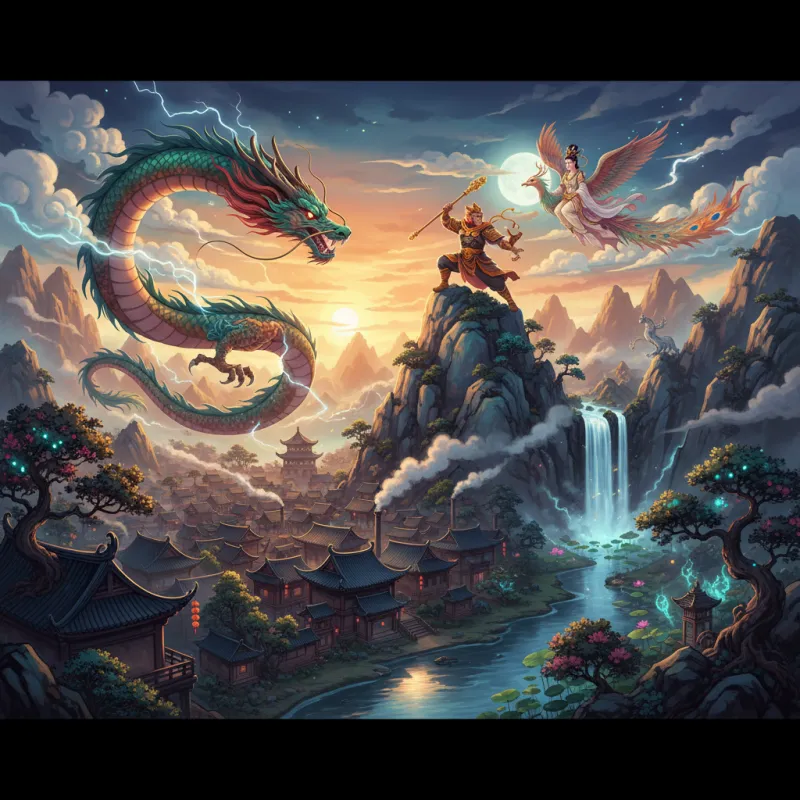
The most popular genre? 玄幻 (xuánhuàn), a uniquely Chinese fantasy that blends martial arts, Taoist cultivation, reincarnation, and power-leveling mechanics borrowed from video games. These stories follow protagonists who cultivate their inner energy through meditation and combat, ascending through increasingly ridiculous power levels — from Qi Condensation to Nascent Soul to Tribulation Transcendence. It's Dragon Ball Z meets Journey to the West meets RPG mechanics.
What makes this ecosystem fascinating is its industrial efficiency. A successful web novel becomes a comic (漫画, mànhuà), then an animated series (动漫, dòngmàn), then a live-action drama, then a mobile game. The novel "The King's Avatar" (全职高手, Quánzhí Gāoshǒu) about a professional esports player went through this entire pipeline, spawning a multimedia empire. This isn't adaptation — it's systematic IP exploitation that would make Disney jealous.
Idol Culture: Manufactured Stardom
Chinese idol culture took K-pop's playbook and scaled it to absurd proportions. Shows like "Produce 101 China" and "Youth With You" let fans vote for their favorite trainees, but voting requires buying products, streaming songs, or purchasing virtual gifts. Fans organize themselves into data teams, funding teams, and voting teams with military precision.
The result? A 17-year-old named Cai Xukun (蔡徐坤) became one of China's biggest stars through a survival show, then saw his fans buy 10,000 bottles of a beverage just to scan QR codes for votes. When the show "Youth With You 3" was cancelled after fans dumped milk to access voting codes, it revealed both the power and the problems of this system. The modern Chinese consumer culture has created entertainment formats that blur the line between fandom and financial investment.
These idols exist in a strange space — simultaneously more accessible and more controlled than Western celebrities. They livestream constantly, post multiple times daily, and maintain the illusion of availability. But their images are carefully managed, their relationships forbidden, and their every move scrutinized by both fans and censors.
Danmei: The Underground Goes Mainstream
One of the most surprising developments in Chinese pop culture is the rise of 耽美 (dānměi), stories featuring romantic relationships between male characters. Originally an underground subculture, danmei has exploded into mainstream consciousness through web novels and their adaptations.
"The Untamed" (陈情令, Chénqíng Lìng), based on the danmei novel "Grandmaster of Demonic Cultivation," became a cultural phenomenon in 2019. The show couldn't explicitly depict the romance due to censorship, but fans read between the lines, creating a massive fandom that propelled the lead actors to superstardom. The novel itself had accumulated over 4 billion views online before adaptation.
This genre reveals something crucial about Chinese pop culture: it operates in constant negotiation with censorship. Creators develop sophisticated techniques for implying what they cannot show, and audiences become expert at reading subtext. It's a cat-and-mouse game that produces its own aesthetic — one of meaningful glances, symbolic gestures, and plausible deniability.
The Virtual Idol Revolution
While the West experiments with virtual influencers, China has industrialized them. Luo Tianyi (洛天依), a Vocaloid character with turquoise pigtails, has held concerts in stadiums, appeared in commercials for KFC and Baidu, and collaborated with human celebrities. She's not a novelty — she's a legitimate pop star who happens to be software.
The appeal makes sense in context. Virtual idols never age, never have scandals, never get tired, and can appear in multiple places simultaneously. They're the logical endpoint of an entertainment industry obsessed with control and scalability. When a virtual idol performs at a Chinese New Year celebration, backed by traditional instruments and singing ancient poetry, you're witnessing the collision of cutting-edge technology with cultural tradition.
Gaming: Where Culture and Commerce Collide
Chinese gaming culture deserves its own encyclopedia. Honor of Kings (王者荣耀, Wángzhě Róngyào), a mobile MOBA, has over 100 million daily active users and generates billions in annual revenue. The game features characters from Chinese history and mythology — you can play as the poet Li Bai, the strategist Zhuge Liang, or the Monkey King — all reimagined with anime aesthetics and modern gameplay.
Genshin Impact took this formula global, creating an open-world game that draws heavily from Chinese fantasy aesthetics while appealing to international audiences. Its success revealed something important: Chinese pop culture doesn't just copy Western or Japanese models anymore. It's creating its own templates that others now study and imitate.
The gaming world also showcases China's unique approach to esports. Professional League of Legends teams have training facilities that resemble tech campuses, complete with nutritionists, psychologists, and coaches. When a Chinese team wins the World Championship, it's national news. The modern Chinese work culture that produces 996 schedules (9am-9pm, 6 days a week) also produces esports athletes who practice with similar intensity.
The Censorship Paradox
You can't discuss Chinese pop culture without addressing the elephant in the room: censorship. Content must navigate an ever-shifting landscape of regulations — no time travel plots, no ghosts, no "effeminate" male celebrities, no excessive wealth display, no historical revisionism. The rules change without warning, and entire genres can be banned overnight.
Yet somehow, creativity persists. Writers develop elaborate metaphors, filmmakers master the art of implication, and fans become expert decoders. When a historical drama can't show palace intrigue explicitly, it develops a visual language of costume colors, camera angles, and musical cues. Constraints breed innovation, even as they frustrate creators.
The result is a pop culture that feels simultaneously vibrant and constrained, innovative and derivative, massive in scale yet fragile in execution. A show can dominate social media for months, then vanish from the internet overnight if it crosses an invisible line.
Why This Matters
Chinese pop culture isn't just interesting because it's big — though the numbers are staggering. It matters because it's developing new models for how entertainment can work in a digital, mobile-first, highly commercialized environment. The integration of e-commerce and entertainment, the gamification of fandom, the industrial approach to IP development — these innovations will influence global entertainment whether we pay attention or not.
More importantly, this is culture that 1.4 billion people consume daily. When we ignore it, we miss crucial context for understanding modern China. The values embedded in these stories, the social dynamics of these fandoms, the economic models of these platforms — they're shaping how a generation thinks about identity, success, relationships, and community.
You don't have to love Chinese idol shows or web novels to recognize their significance. But if you're curious about where entertainment is heading in an increasingly digital, participatory, and commercialized world, China's pop culture ecosystem offers a glimpse of possible futures — for better and worse.
Related Reading
- Chinese Internet Culture: Memes, Slang and Digital Life
- Modern China Through the Lens of Its Ancient Past
- First Time in China? Essential Tips for Culture-Minded Travelers
- Decoding Chinese Internet Culture: From Baidu Tieba to Bilibili
- Wuxia vs. Xianxia vs. Xuanhuan: Chinese Fantasy Genres Explained
- Discovering Love Legends of Chinese Folklore: Tales of Passion and Destiny
- Enchanting Chinese Mountain Legends: Myths, Mysteries, and Cultural Heritage
Explore Chinese Culture
- Explore feng shui in daily life
- Explore supernatural folklore
- Explore classical Chinese literature