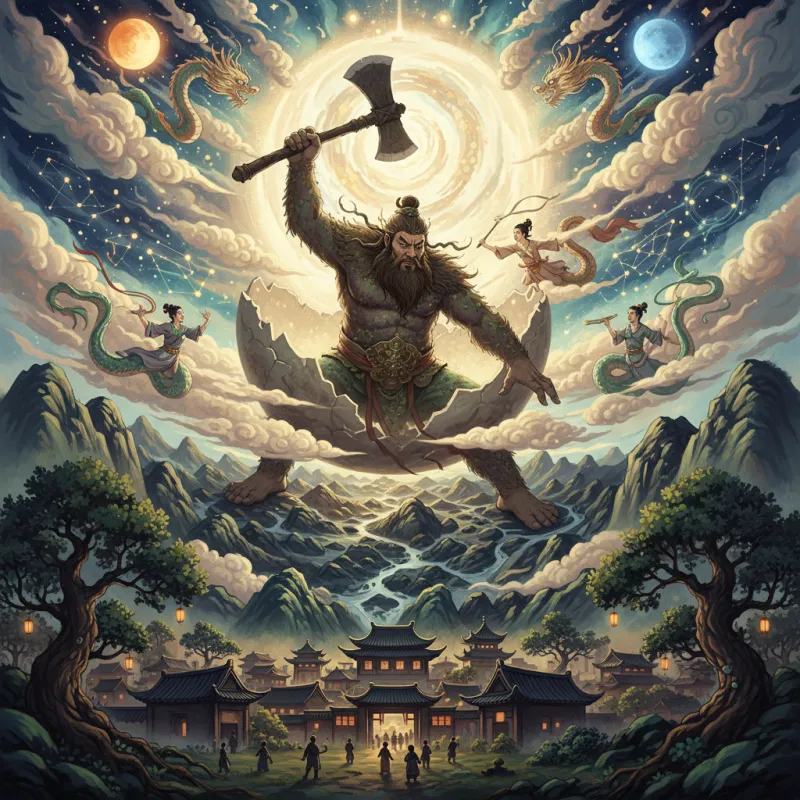
The universe began as an egg. Not the kind you crack for breakfast, but a swirling mass of chaos—formless, timeless, and utterly dark. Inside this cosmic shell, a giant named Pangu (盘古, Pángǔ) slept for eighteen thousand years, curled up like a child waiting to be born. When he finally woke, he didn't stretch and yawn. He shattered everything.
The Cosmic Egg and the Giant Who Broke It
The Pangu creation myth didn't appear in China's earliest texts. Scholars trace it to the Three Kingdoms period (220-280 CE), making it a relative latecomer compared to other Chinese origin stories. The tale likely traveled north from minority groups in southern China, which explains why it feels different from the more bureaucratic, heaven-centered myths that dominated the Yellow River valley.
According to the story, chaos (混沌, hùndùn) wasn't just disorder—it was a specific state of being, where yin and yang hadn't yet separated. Everything that would become the universe existed in potential, compressed into an egg-shaped void. Pangu grew inside this egg, his body absorbing the primordial energy until he became strong enough to crack it open.
When he woke, he used an axe (some versions say his bare hands) to split the egg. The light, pure elements floated upward to become heaven (天, tiān). The heavy, turbid elements sank to become earth (地, dì). But Pangu feared they would merge back into chaos, so he stood between them, one hand pushing up the sky, one foot pressing down the earth. Each day, heaven rose ten feet higher, earth grew ten feet thicker, and Pangu stretched ten feet taller. This continued for another eighteen thousand years.
When the Giant Died, the World Lived
Pangu's death is where the myth becomes truly poetic. After holding heaven and earth apart for millennia, he finally collapsed from exhaustion. But his death wasn't an ending—it was a transformation. His body became the physical world in a process that reads like an anatomical inventory of creation:
His breath became wind and clouds. His voice became thunder. His left eye became the sun, his right eye the moon. His four limbs and five extremities became the four cardinal directions and five sacred mountains. His blood became rivers, his veins became roads. His muscles became farmland, his hair became stars. His skin and body hair became plants and trees. His teeth and bones became metal and stone. His marrow became jade and pearls. His sweat became rain and dew.
Some versions add a darker detail: the fleas and parasites on his body became the human race. It's a humbling origin story, suggesting humans are merely an afterthought, the least significant part of creation. This stands in stark contrast to Western creation myths where humans are the pinnacle of divine intention.
Nüwa: The Goddess Who Made Us From Mud
But humans have another, more dignified origin story. The goddess Nüwa (女娲, Nǚwā) appears in texts dating back to the Warring States period (475-221 BCE), making her myth considerably older than Pangu's. After heaven and earth separated (by whatever means—the myths don't always agree), Nüwa looked around at the empty world and felt lonely.
She knelt beside the Yellow River and scooped up mud, molding it into small figures. When she breathed life into them, they began to walk and talk. Delighted, she made more. But hand-crafting each human was exhausting work, so she dipped a rope in mud and swung it around. The droplets that flew off became people too. The carefully crafted figures became nobles and aristocrats; the rope-flung droplets became commoners. Even in creation myths, China's class consciousness shows through.
Nüwa's role didn't end with humanity's creation. When the pillars holding up heaven broke (in a war between gods, depending on which version you read), she melted five-colored stones to repair the sky and cut off the legs of a giant turtle to prop up the corners of heaven. She's both creator and cosmic repairwoman, a goddess who gets her hands dirty. You can read more about her heroic deeds in Chinese Mythology: Gods and Goddesses.
The Bureaucratic Universe: Heaven's Mandate
Not all Chinese creation stories involve giants or goddesses. Some texts, particularly those influenced by Confucian thought, describe creation as an administrative process. Heaven (天, Tiān) simply existed, eternal and self-generating, and it organized the universe according to natural law (天道, tiāndào).
This version lacks drama but reflects a deeply Chinese worldview: the universe operates like a well-run government, with heaven as the ultimate bureaucrat. The Dao De Jing offers another perspective, suggesting that the Dao (道, Dào)—the Way—existed before heaven and earth, giving birth to them through a process of natural unfolding rather than conscious creation. "The Dao gives birth to One, One gives birth to Two, Two gives birth to Three, Three gives birth to all things."
These philosophical creation stories coexisted with the mythological ones, serving different purposes. Myths like Pangu and Nüwa satisfied the human need for narrative and personality. Philosophical accounts satisfied the intellectual need for systematic explanation.
Why Multiple Stories? The Regional Puzzle
China's vast geography and ethnic diversity meant different regions developed different myths. The Pangu story likely originated among the Yao and Miao peoples in the south. The Nüwa myth emerged in the Central Plains. Other ethnic groups have their own creation stories: the Yi people tell of a cosmic battle between fire and water, the Bai people speak of a creator god named Azhao, and the Naxi have the Dongba creation epic.
These stories didn't compete—they accumulated. Chinese culture has historically been syncretic, absorbing and layering beliefs rather than demanding orthodoxy. A person could honor Nüwa at her temple, reference Pangu when explaining the cosmos, and still practice Daoist philosophy without seeing any contradiction. This pluralism extends to other aspects of Chinese tradition, including the complex pantheon described in Chinese Folk Religion and Deities.
The Cosmic Egg in World Mythology
The cosmic egg appears in creation myths worldwide—from the Hindu Brahmanda to the Finnish Kalevala to the Orphic egg of ancient Greece. But China's version has distinctive features. Pangu doesn't emerge as a god-king who rules creation; he becomes creation itself through death. There's no divine plan, no moral purpose, just transformation.
This reflects a fundamental difference in Chinese cosmology. The universe isn't created by a transcendent deity who remains separate from it. Instead, the divine is immanent, woven into the fabric of existence. When Pangu dies, he doesn't go to heaven—he becomes the mountains, rivers, and sky. The sacred and the material are one.
Living Myths: How These Stories Endure
Walk through any Chinese temple complex and you'll likely find shrines to Nüwa, often depicted holding a compass and square—symbols of her role in ordering the cosmos. Pangu appears less frequently in religious practice but remains culturally significant. His story is taught in schools, referenced in literature, and invoked whenever someone wants to describe something ancient or fundamental.
These myths also influenced Chinese art and literature for millennia. The 16th-century novel Journey to the West references Pangu when describing the origin of the stone that becomes Sun Wukong, the Monkey King. Classical poetry uses images from creation myths—the five-colored stones, the cosmic egg, the separation of heaven and earth—as metaphors for transformation and renewal.
Modern China hasn't abandoned these stories. They appear in films, video games, and fantasy novels, constantly reinterpreted for new generations. The myths remain alive not because people believe them literally, but because they express something essential about how Chinese culture understands the relationship between chaos and order, death and transformation, the individual and the cosmos. They remind us that creation isn't a single event in the distant past—it's an ongoing process, and we're all part of it, whether we're carefully molded from yellow earth or flung from a muddy rope.
Related Reading
- Journey to the West: Why Sun Wukong Is China's Favorite Character
- Journey to the West: A First-Timer's Guide to China's Greatest Novel
- The Chinese Zodiac: Complete Guide to the 12 Animals
- The Four Great Folktales of China: Love, Loyalty and Legend
- Unveiling the Rich Tapestry of Chinese Folklore and Legends
- Discovering Chinese Creation Myths: Legends that Shape a Nation's Cultural Identity
- Legendary Flavors: Exploring Chinese Food Folklore and Timeless Culinary Traditions
Explore Chinese Culture
- Explore feng shui in daily life
- Explore supernatural folklore
- Explore classical Chinese literature