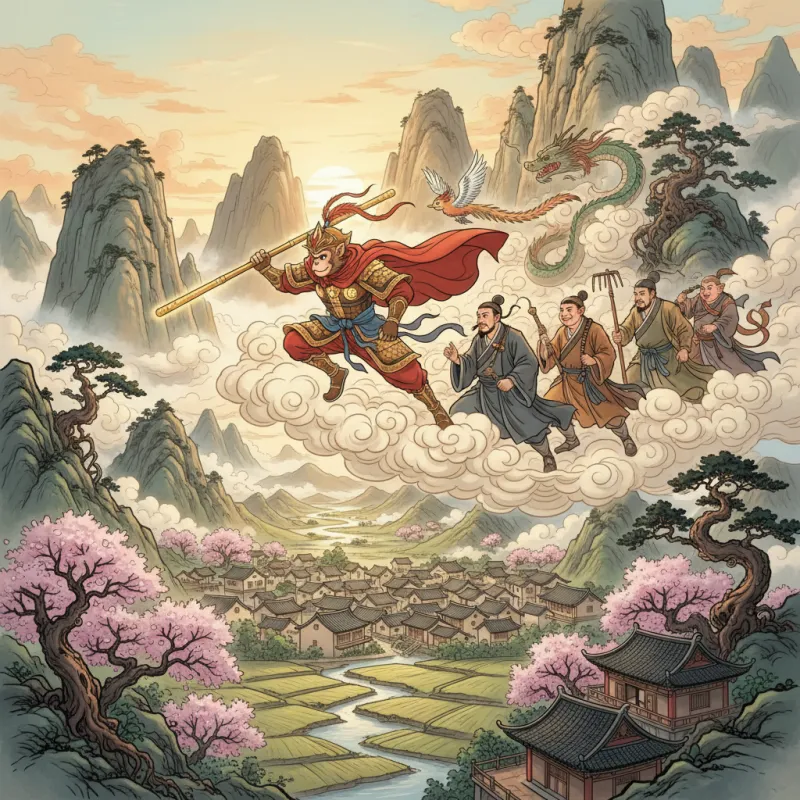
A stone egg cracks open on a mountain peak, and out tumbles a monkey with eyes that shoot beams of golden light across the heavens. The Jade Emperor himself leans forward on his throne, alarmed. This is how Sun Wukong (孙悟空, Sūn Wùkōng) enters the world — not through birth, but through cosmic disruption. And he's been disrupting things ever since.
For over five centuries, the Monkey King has dominated Chinese popular culture with a ferocity that would make modern franchise executives weep with envy. He's appeared in countless films, TV series, operas, video games, and comic books. He inspired Goku from Dragon Ball, the most recognizable anime character on the planet. Yet somehow, the original still feels more alive, more dangerous, more fun than any of his descendants. The question isn't why Sun Wukong became popular — it's why he refuses to fade away.
The Rebel Who Makes Rebellion Look Good
Sun Wukong doesn't just break rules. He demolishes them with a golden staff that can grow to pierce the heavens or shrink to fit behind his ear. In the early chapters of Journey to the West (西游记, Xīyóu Jì), before Wu Cheng'en (吴承恩) forces him into the role of dutiful bodyguard, the Monkey King is pure anarchic joy.
He crashes an immortals' banquet, gets drunk on celestial wine, steals the peaches of immortality, raids Laozi's alchemy lab and eats all his pills of eternal life, then defeats 100,000 heavenly soldiers sent to arrest him. When the Jade Emperor (玉皇大帝, Yùhuáng Dàdì) finally captures him, they try burning him in a furnace for 49 days. He emerges with invulnerable skin and fiery golden eyes that can see through any disguise. The heavens throw everything at him and he just gets stronger.
This isn't the calculated rebellion of a revolutionary with a manifesto. Sun Wukong fights heaven because he's bored, because he's curious, because someone told him he couldn't. He declares himself "Great Sage Equal to Heaven" (齐天大圣, Qítiān Dàshèng) not as political statement but as obvious fact. The audacity is breathtaking.
Chinese literature has plenty of rebels, but most of them rebel for something — justice, family, the people. Sun Wukong rebels because hierarchy itself offends him. He's the id unleashed, and watching him rampage through the celestial bureaucracy scratches an itch that Confucian propriety can never quite reach.
The Trickster Who Outsmarts Everyone (Except Buddha)
Raw power makes Sun Wukong dangerous. His intelligence makes him terrifying. The Monkey King masters 72 transformations (七十二变, qīshí'èr biàn), allowing him to become anything from a temple to a fly. He plucks hairs from his body and blows on them to create thousands of clones. He can somersault 108,000 li in a single leap — roughly 54,000 kilometers, or about four times Earth's diameter.
But his real weapon is his mind. Throughout Journey to the West, Sun Wukong defeats demons not through brute force but through elaborate cons. He transforms into insects to spy on enemies, impersonates their allies to sow confusion, and sets traps within traps. When a demon kidnaps his master Xuanzang (玄奘), Sun Wukong doesn't just charge in swinging. He investigates, plans, adapts.
The novel's most famous episode demonstrates this perfectly. Sun Wukong bets Buddha that he can somersault beyond the edge of the universe. He leaps to what he thinks is the end of existence, finds five pillars, writes "The Great Sage Equal to Heaven Was Here" on one, and urinates at the base (because of course he does). He returns triumphant, only for Buddha to open his hand and reveal the five pillars were his fingers. Sun Wukong never left Buddha's palm.
It's the only time in the novel where someone completely outplays the Monkey King, and it's devastating precisely because Sun Wukong is usually the one pulling off impossible tricks. The scene works because we've seen him win so many times that his defeat actually means something. Buddha doesn't just overpower him — he out-tricksters the ultimate trickster.
The Bodyguard Who Hates His Job
Here's where Journey to the West gets psychologically interesting. After Buddha imprisons Sun Wukong under a mountain for 500 years, the bodhisattva Guanyin (观音, Guānyīn) offers him a deal: escort the monk Xuanzang to India and earn redemption. Sun Wukong accepts, and Buddha places a golden circlet on his head that tightens painfully whenever Xuanzang recites a specific sutra.
The rest of the novel is essentially about a superpowered immortal being forced into customer service. Sun Wukong can defeat any demon they encounter, but he can't leave, can't disobey, and can't even lose his temper without getting a migraine that feels like his skull is splitting. His master Xuanzang is kind but naive, constantly falling for demon disguises that Sun Wukong sees through immediately with his fiery eyes.
The dynamic is comedy gold. Sun Wukong kills a demon disguised as a human. Xuanzang, who can't see through the disguise, accuses him of murdering an innocent person and recites the headache sutra. Sun Wukong writhes in agony, apologizes, and promises to be more careful. Then another demon shows up disguised as the first demon's "grieving family member," and the whole cycle repeats.
What makes this compelling is that Sun Wukong is right. He has the power and knowledge to complete the journey in about fifteen minutes, but he's shackled to a mortal who keeps making terrible decisions. Yet he stays. He complains constantly, threatens to quit regularly, but he stays. The novel never quite explains why, beyond the magical circlet, and that ambiguity is fascinating. Does he actually care about Xuanzang? Is he learning humility? Or is he just too stubborn to admit defeat?
The Immortal Who Cheated Death Seven Times
Sun Wukong's origin story reads like someone trying to create the most unkillable character possible. He's born from stone, already placing him outside normal life and death. He learns immortality from a Taoist master. He eats the peaches of immortality at the heavenly banquet. He drinks the wine of immortality. He eats Laozi's pills of immortality. He gets his name erased from the Book of Life and Death. Then he survives the furnace that was supposed to execute him.
By the time the main plot starts, Sun Wukong has achieved immortality through seven different methods. It's excessive, ridiculous, and completely in character. He doesn't just want to live forever — he wants to make death itself give up and stop trying.
This obsession with immortality connects to deep currents in Chinese culture. The search for eternal life drives countless myths, from the Eight Immortals to the Queen Mother of the West's peach garden. But where most immortality seekers are wise sages or virtuous heroes, Sun Wukong is a monkey who stumbled into power and decided to keep everything he could grab.
There's something darkly funny about his approach. He doesn't achieve immortality through meditation, virtue, or spiritual enlightenment. He achieves it through theft, trickery, and sheer stubborn refusal to accept limitations. It's the immortality quest as heist movie.
The Character Who Contains Multitudes
What makes Sun Wukong endlessly adaptable is that he's not one thing. He's a trickster and a warrior. A rebel and a bodyguard. Selfish and loyal. Arrogant and insecure. Cruel and compassionate. The novel contains all these contradictions without trying to resolve them.
Modern adaptations emphasize different aspects depending on their needs. The 1986 TV series plays up his loyalty and heroism. Stephen Chow's films highlight his trickster nature and tragic elements. Video games focus on his combat prowess. The 2015 Monkey King: Hero Is Back animated film explores his relationship with children and his struggle with powerlessness. Each version finds something genuine in the source material because Wu Cheng'en packed so much into the character.
This flexibility extends to his role in Chinese culture. Children love him because he's fun and powerful. Teenagers identify with his rebellion against authority. Adults appreciate his complexity and the novel's satirical edge. He's a character you can return to at different life stages and find something new.
Compare this to other figures from Chinese mythology. The Jade Emperor represents cosmic order but rarely appears as a protagonist. Nezha (哪吒) is a rebel like Sun Wukong but lacks his humor and cunning. Guan Yu (关羽) embodies loyalty and righteousness but isn't particularly fun. Sun Wukong manages to be entertaining, complex, powerful, and flawed all at once.
The Monkey Who Became a Buddha
The ending of Journey to the West is surprisingly straightforward. After 81 trials, Xuanzang's group reaches India, retrieves the scriptures, and returns to China. Buddha rewards them all with enlightenment and divine positions. Sun Wukong becomes "Victorious Fighting Buddha" (斗战胜佛, Dòuzhàn Shèng Fó).
It should feel like a betrayal. The rebel who fought heaven now joins its ranks. The trickster who mocked authority becomes an authority figure. But somehow it works, partly because the novel makes clear that Sun Wukong hasn't fundamentally changed. He's still himself — he's just learned to channel his nature toward something beyond his own amusement.
The journey doesn't break Sun Wukong. It doesn't make him humble or obedient or boring. It gives him something he never had during his rampage through heaven: purpose beyond himself. He's still the Monkey King, still powerful and clever and irreverent. But now he's also something more.
This is why the character endures. Sun Wukong's arc isn't about suppressing who you are to fit society's expectations. It's about finding a way to be fully yourself while also being part of something larger. That's a tension everyone navigates, and watching a superpowered monkey figure it out makes the struggle feel a little less lonely.
Why He Still Matters
Walk through any Chinese bookstore and you'll find dozens of Journey to the West adaptations. Visit a temple and you might see Sun Wukong statues alongside traditional deities. Turn on a TV during Chinese New Year and there's probably a Journey to the West marathon playing. The Monkey King is everywhere, and he's not going anywhere.
Part of this is simple momentum — popular things stay popular. But Sun Wukong offers something specific that Chinese culture keeps returning to: permission to be difficult. Confucian values emphasize harmony, respect for hierarchy, and social obligation. These aren't bad things, but they can be suffocating. Sun Wukong is the release valve, the character who says "what if I just didn't" and makes it work.
He's also genuinely fun in a way that much classical literature isn't. Journey to the West is funny, action-packed, and weird. Sun Wukong fights demons, yes, but he also argues with dragons, gets drunk with immortals, and once transformed into a beautiful woman to seduce a demon king. The novel never takes itself too seriously, and neither does its protagonist.
Five hundred years after Wu Cheng'en wrote him into existence, Sun Wukong remains China's favorite character because he's everything people wish they could be: powerful, clever, free, and ultimately, despite everything, good. He's the stone monkey who cracked open the heavens and let a little chaos in. And the heavens, it turns out, needed the disruption.
Related Reading
- The Four Great Folktales of China: Love, Loyalty and Legend
- Journey to the West: A First-Timer's Guide to China's Greatest Novel
- Chinese Creation Myths: How the World Began
- The Chinese Zodiac: Complete Guide to the 12 Animals
- Gongfu Tea Ceremony Step by Step
- Discovering Love Legends of Chinese Folklore: Tales of Passion and Destiny
- Traditional Chinese Medicine: The Debate That Will Not End
Explore Chinese Culture
- Explore feng shui in daily life
- Explore supernatural folklore
- Explore classical Chinese literature