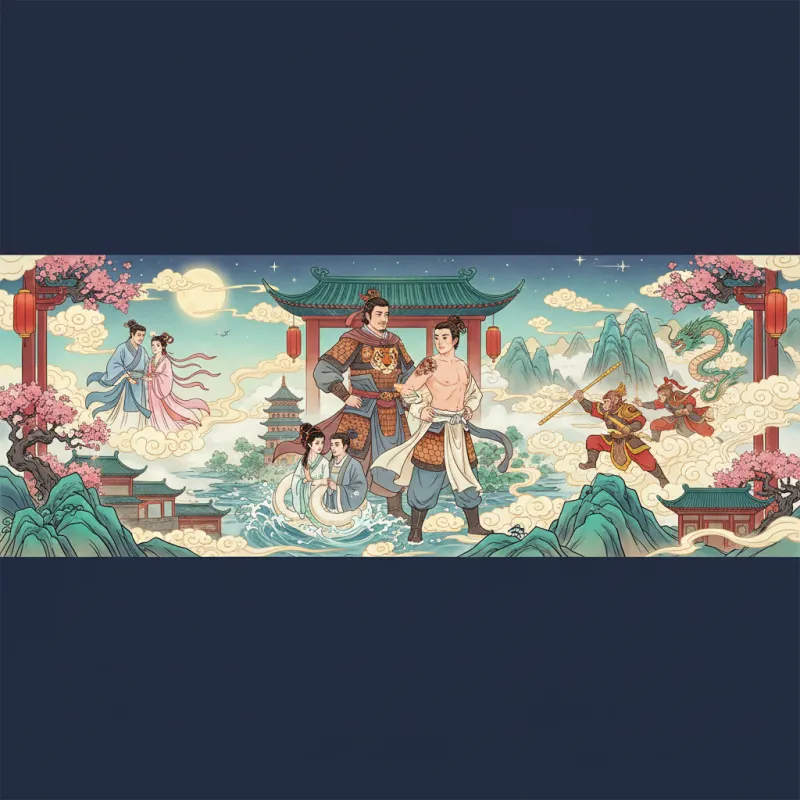
A young scholar opens an umbrella over a beautiful woman caught in sudden rain. This simple act of kindness will cost him his life, his sanity, and his soul — and yet, centuries later, Chinese audiences still weep at the story and call it one of the greatest love tales ever told. The 四大民间传说 (Sì Dà Mínjiān Chuánshuō, Four Great Folktales) don't traffic in happy endings. They traffic in something more valuable: the truth about what love demands when society, heaven, and fate conspire against it.
These four stories — The Legend of the White Snake, The Butterfly Lovers, Lady Meng Jiang, and The Cowherd and the Weaver Girl — have been performed in opera houses, painted on porcelain, adapted into films, and whispered between generations for over a thousand years. They're not just entertainment. They're the emotional vocabulary through which Chinese culture processes impossible choices: duty versus desire, loyalty versus survival, human love versus cosmic order.
The Legend of the White Snake: When Love Crosses Species
白蛇传 (Bái Shé Zhuàn) asks a question that still makes audiences uncomfortable: if a demon loves you perfectly, is she still a demon?
Bai Suzhen, a white snake spirit who has cultivated herself for a thousand years, takes human form and falls in love with Xu Xian, a gentle pharmacist in Hangzhou. Their marriage is tender and genuine — she uses her knowledge of herbs to help him build a successful medicine shop, they care for each other through illness, she becomes pregnant with his child. By every measure that matters, they're happy.
Enter Fahai, a Buddhist monk who cannot tolerate the transgression of a demon living among humans, regardless of her virtue. He reveals Bai Suzhen's true form to Xu Xian (who literally dies of fright, though she revives him with a magical herb), then imprisons her beneath Leifeng Pagoda, separating her from her newborn son for decades.
The genius of this story is that it refuses to make Fahai a simple villain. He's upholding cosmic order — the boundary between human and demon exists for reasons. But the story also refuses to condemn Bai Suzhen's love. She's more devoted, more self-sacrificing, more human than most humans. The tragedy isn't that she's a demon; it's that the categories themselves are inadequate to capture what she and Xu Xian share.
Modern adaptations often give the story a happy ending, with Bai Suzhen freed from the pagoda. But the original versions let her stay imprisoned, because the point isn't whether love conquers all — it's whether love matters even when it doesn't. The answer, across centuries of retellings, is yes.
The Butterfly Lovers: Romeo and Juliet, But Make It Chinese
梁山伯与祝英台 (Liáng Shānbó yǔ Zhù Yīngtái) predates Shakespeare's famous tragedy by over a thousand years, and it's arguably more devastating because the lovers never even get to consummate their relationship.
Zhu Yingtai disguises herself as a man to attend school (women were forbidden from formal education during the Eastern Jin Dynasty). For three years, she studies alongside Liang Shanbo, and they become inseparable friends. He never suspects she's a woman, despite sharing a room with her — a detail that has inspired countless jokes and queer readings of the text over the centuries.
When Zhu Yingtai finally returns home and reveals the truth, Liang Shanbo rushes to propose, only to discover she's already been betrothed to another man by her father. He falls ill from grief and dies. On her wedding day, Zhu Yingtai's procession passes his grave. She demands to pay respects, and when she approaches the tomb, it splits open. She throws herself inside, and the grave closes behind her.
Two butterflies emerge and fly away together.
The story is performed as 越剧 (Yuèjù, Yue Opera), where the tragic violin concerto adaptation by He Zhanhao and Chen Gang has become one of the most famous pieces of Chinese classical music. Listen to it once and you'll understand why this story has survived 1,700 years — the music captures the ache of love that never got to exist in the world, only in death.
What makes this different from Western tragic romances is the complete absence of choice. Zhu Yingtai doesn't choose death to be with her lover in some romantic gesture — she chooses it because there's literally no other option. Marriage to another man means the death of her self anyway. The butterflies aren't a happy ending; they're the only form of freedom available.
Lady Meng Jiang: The Woman Who Wept Down a Wall
孟姜女哭长城 (Mèng Jiāngnǚ Kū Chángchéng) is the only one of the four tales that's explicitly political, and it's been making Chinese emperors uncomfortable for two millennia.
Meng Jiang's husband is conscripted to build the Great Wall under the Qin Dynasty — the same wall that tourists photograph today, built on the bones of hundreds of thousands of forced laborers. When winter comes and he doesn't return, she makes the journey north herself, carrying warm clothes.
She arrives to discover he's already dead, buried somewhere in the wall itself. Her grief is so profound that she weeps for three days and three nights, and her tears cause a section of the Great Wall to collapse, revealing her husband's bones so she can give him a proper burial.
The Qin emperor, hearing of this woman whose sorrow could destroy his greatest achievement, summons her to the capital. Some versions say he wants to marry her; others say he wants to punish her. She agrees to marry him on the condition that he give her husband a proper state funeral. After the funeral, she throws herself into the sea.
This story has been told and retold during every period of Chinese history when the government demanded too much from its people. It's been banned, censored, and rewritten, but it persists because it names something true: that grand national projects are built on individual suffering, and that a woman's grief can be more powerful than an empire's glory.
The story connects to broader themes in Chinese mythology about the relationship between human emotion and cosmic forces — the idea that genuine feeling can literally reshape the physical world.
The Cowherd and the Weaver Girl: Love Across the Milky Way
牛郎织女 (Niúláng Zhīnǚ) is the origin story of 七夕 (Qīxì), the Chinese Valentine's Day, celebrated on the seventh day of the seventh lunar month. It's also the only one of the four tales where the lovers are still alive, still separated, still waiting.
Zhinü, the Weaver Girl, is a goddess who descends to earth and falls in love with Niulang, a humble cowherd. They marry and have two children. But her mother, the Queen Mother of Heaven, is furious that a goddess has married a mortal. She drags Zhinü back to heaven and creates the Milky Way to separate them forever.
Niulang, with the help of his magical ox (who sacrifices itself so he can use its hide to fly), pursues her to heaven with their children. Just as he's about to reach her, the Queen Mother draws a river of stars between them — the Silver River, what we call the Milky Way.
The magpies of the world, moved by their devotion, form a bridge across the stars once a year so the couple can reunite. On the seventh night of the seventh month, Chinese tradition says that if it rains, those are Zhinü's tears of joy at seeing her husband and children again.
Unlike the other three tales, this one doesn't end in death or transformation. It ends in eternal separation punctuated by brief, precious reunions. In some ways, that's the cruelest fate of all — not the finality of death, but the endless repetition of loss and reunion, year after year, century after century.
The story resonates differently in modern China, where millions of migrant workers leave their families in rural areas to work in cities, seeing their children and spouses only once or twice a year. The Cowherd and the Weaver Girl aren't ancient figures anymore — they're every couple separated by economic necessity, every parent who misses their child's childhood, every love that survives despite impossible distance.
Why These Stories Still Matter
The Four Great Folktales have survived because they refuse to lie. They don't promise that love conquers all, that virtue is rewarded, or that the universe is just. They promise something more honest: that love matters even when it fails, that loyalty has meaning even when it leads to suffering, and that some griefs are so profound they reshape the world.
These aren't stories about heroes who defeat evil and live happily ever after. They're stories about ordinary people — a pharmacist, a student, a wife, a cowherd — who love so completely that their stories become immortal. The white snake is still imprisoned under the pagoda. The butterflies still flutter over the grave. Lady Meng Jiang's tears still echo in every protest against unjust power. The magpies still build their bridge across the stars.
Every Chinese New Year, every Mid-Autumn Festival, every Qixi celebration, these stories are retold in some form — in opera performances, television dramas, animated films, video games. They've been adapted into every medium that exists, and they'll be adapted into every medium that will exist, because they address something fundamental about the human experience: the gap between what we want and what we're allowed to have, and the question of whether love means anything if it can't change that gap.
The Stories We Need, Not the Stories We Want
Western fairy tales often end with "and they lived happily ever after." The Four Great Folktales end with separation, death, transformation, and eternal longing. This isn't pessimism — it's realism about the costs of love in a world that doesn't always make room for it.
Bai Suzhen loves across the boundary of species and pays with her freedom. Liang Shanbo and Zhu Yingtai love across the boundary of gender expectations and pay with their lives. Meng Jiang loves across the boundary of state power and pays with everything. Niulang and Zhinü love across the boundary of heaven and earth and pay with eternal separation.
But here's what the stories also say: they loved anyway. They loved knowing the cost. They loved because the alternative — a life without that love — wasn't worth living.
That's why these stories have survived for over a thousand years, through dynasties and revolutions, through modernization and globalization. They're not about a China that once was. They're about the human heart, which hasn't changed at all. We still fall in love with the wrong people. We still choose loyalty over safety. We still weep for losses that can't be recovered. We still believe, against all evidence, that love means something even when it can't save us.
The Four Great Folktales don't offer comfort. They offer recognition. And sometimes, that's more valuable than a happy ending.
Related Reading
- The Chinese Zodiac: Complete Guide to the 12 Animals
- Journey to the West: A First-Timer's Guide to China's Greatest Novel
- Chinese Creation Myths: How the World Began
- Journey to the West: Why Sun Wukong Is China's Favorite Character
- Unveiling the Rich Tapestry of Chinese Folklore and Festival Origins
- Legendary Flavors: Exploring Chinese Food Folklore and Timeless Culinary Traditions
- Bruce Lee's Legacy: How One Man Changed Global Culture
Explore Chinese Culture
- Explore feng shui in daily life
- Explore supernatural folklore
- Explore classical Chinese literature