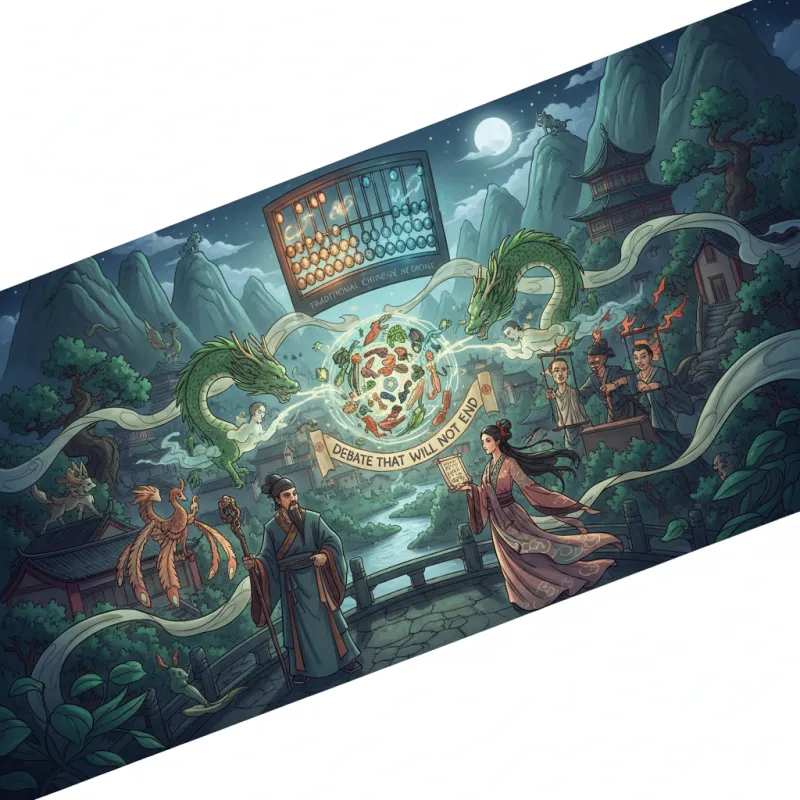
You walk into a pharmacy in Beijing. On one side: antibiotics, blood pressure medication, insulin—the familiar arsenal of Western medicine. On the other side: dried seahorses, ginseng roots shaped like tiny humans, and something that might be a fungus or might be a mummified bat. The pharmacist moves between both worlds without hesitation, writing prescriptions that blend both systems as if this were the most natural thing in the world.
Welcome to the most exhausting argument in Chinese culture.
The Battle Lines Are Drawn (And Redrawn, And Redrawn Again)
Traditional Chinese medicine (中医, zhōngyī) doesn't just divide opinion—it creates tribal warfare. Mention TCM at a dinner party in Shanghai and watch the room split into armed camps. On one side: defenders who invoke five thousand years of accumulated wisdom. On the other: critics who point to the lack of double-blind studies and the occasional rhino horn in the ingredient list.
Here's what makes this debate so intractable: both sides are partly right, and both are talking past each other.
The defenders aren't wrong that TCM has produced genuine medical insights. Artemisinin, the antimalarial drug that won Tu Youyou a Nobel Prize in 2015, came directly from TCM texts describing sweet wormwood (青蒿, qīnghāo) as a fever treatment. The critics aren't wrong that much of TCM lacks rigorous clinical evidence and that some practices—like using pangolin scales or bear bile—are both medically questionable and ecologically catastrophic.
The real problem? We're trying to evaluate a pre-scientific medical system using post-scientific criteria, and nobody's quite sure how to do that honestly.
What TCM Actually Claims (And Why That Matters)
TCM operates on principles that sound mystical to modern ears but made perfect sense in their historical context. The core concepts:
Qi (气, qì) — Usually translated as "vital energy," though that's not quite right. Think of it more as the body's functional capacity. When TCM practitioners say your qi is blocked, they're observing symptoms that Western medicine might attribute to poor circulation, inflammation, or nerve dysfunction. Different language, sometimes overlapping observations.
Yin and Yang (阴阳, yīn yáng) — Not mystical forces but a classification system. Yin represents cooling, moistening, calming functions. Yang represents warming, drying, activating functions. A "yin deficiency" might manifest as night sweats and insomnia—symptoms Western medicine would approach differently but would still recognize as real.
The Five Phases (五行, wǔxíng) — Wood, Fire, Earth, Metal, Water. Not literal elements but categories for organizing observations about how body systems interact. The Liver (capital L, meaning the TCM organ system, not just the anatomical liver) is associated with Wood, which "controls" Earth (the Spleen system). In practice, this means liver problems often affect digestion—an observation Western gastroenterology would confirm, though it would explain the mechanism differently.
Meridians (经络, jīngluò) — Pathways through which qi flows. No anatomical structure corresponds to meridians, which drives critics crazy. But acupuncture points often correlate with nerve clusters, trigger points, and fascial planes. The map isn't accurate, but it sometimes leads to the right destination.
Here's the crucial point: TCM developed as a way to systematize clinical observations without the benefit of microscopes, blood tests, or germ theory. It's a pre-scientific medical system that nonetheless accumulated genuine empirical knowledge through trial and error over centuries.
The Inconvenient Truths Nobody Wants to Admit
For the defenders: Most TCM theory is unfalsifiable, which means it's not science. When a treatment fails, TCM can always explain it away—the diagnosis was wrong, the patient's constitution was unusual, the herbs weren't prepared correctly. This flexibility makes TCM clinically adaptable but intellectually slippery.
For the critics: Dismissing all of TCM as worthless ignores the fact that it's the medical system that kept 1.4 billion people alive for millennia. Yes, life expectancy was lower, but people survived infections, set broken bones, managed chronic pain, and treated digestive disorders. Some of that was luck and natural healing, but not all of it.
The archaeological evidence is fascinating. A 2,000-year-old medical text discovered in the Mawangdui tombs describes using moldy soybean curd to treat infections—a crude form of antibiotic therapy. Smallpox inoculation (variolation) was practiced in China by the 10th century, centuries before Jenner's vaccine. These weren't accidents.
Where Western Medicine and TCM Actually Overlap
Modern research has validated some TCM practices while debunking others. The scorecard is mixed:
Validated: Acupuncture shows real effects for chronic pain, nausea, and some other conditions—though whether it works through meridians or through neurological mechanisms is still debated. Certain herbal formulas have demonstrated efficacy in clinical trials. Tai chi and qigong improve balance and reduce fall risk in elderly patients.
Debunked: Rhino horn is just keratin (you might as well chew your fingernails). Bear bile contains ursodeoxycholic acid, which is medically useful, but can be synthesized—there's no need to torture bears. Most "kidney yang tonics" are just expensive placebos.
Complicated: Cupping leaves dramatic circular bruises but probably works through the same mechanisms as deep tissue massage. Gua sha (scraping therapy) might improve microcirculation, or might just be controlled tissue damage that triggers healing responses. The jury's still out.
The most interesting cases are the ones where TCM and Western medicine observe the same phenomenon but explain it differently. Take ginseng, which TCM classifies as a qi tonic. Western research shows it has adaptogenic properties—it helps the body respond to stress. Different frameworks, similar clinical observations.
The Cultural Nationalism Problem
Here's where the debate gets ugly. TCM has become entangled with Chinese national identity in ways that make rational discussion nearly impossible.
During the Cultural Revolution, Mao promoted TCM as "the people's medicine" while simultaneously persecuting traditional practitioners. The contradiction was intentional—Mao wanted a distinctly Chinese medical system but one stripped of "feudal superstition." The result was a sanitized, standardized version of TCM that bore little resemblance to the diverse regional practices that had existed for centuries.
Modern China has doubled down on this approach. The government invests billions in TCM research and promotion, not just for health reasons but as soft power. TCM Confucius Institutes spread Chinese medicine globally alongside Chinese language. Criticizing TCM can be seen as criticizing China itself.
This politicization poisons the well. Legitimate scientific criticism gets dismissed as Western cultural imperialism. Genuine medical concerns about endangered species in TCM formulas get framed as attacks on Chinese culture. Meanwhile, TCM practitioners who want to modernize their field face accusations of betraying tradition.
What a Honest Assessment Actually Looks Like
If we're being intellectually honest, here's where we land:
TCM is a pre-scientific medical system that contains both genuine empirical knowledge and a lot of outdated theory. Some TCM treatments work—not because of qi or meridians, but because they stumbled onto effective interventions through centuries of trial and error. Other TCM treatments are useless or harmful.
The smart approach isn't to accept or reject TCM wholesale. It's to extract what works, understand why it works in modern scientific terms, and discard what doesn't. This is already happening, though slowly. Researchers are isolating active compounds from traditional herbs, studying acupuncture's neurological effects, and testing herbal formulas in clinical trials.
But this process requires something both sides resist: admitting uncertainty. TCM defenders must acknowledge that not everything in the classical texts is correct. Critics must acknowledge that absence of evidence isn't always evidence of absence—some TCM practices might work through mechanisms we don't yet understand.
The Path Forward (If Anyone's Interested)
The future of TCM probably looks like integrative medicine—using TCM approaches where they're effective and Western medicine where it's superior. Acupuncture for chronic pain, antibiotics for bacterial infections. Herbal formulas for mild digestive issues, surgery for appendicitis.
This requires TCM to submit to rigorous testing and to abandon practices that fail those tests. It requires Western medicine to take TCM research seriously rather than dismissing it out of hand. It requires both sides to prioritize patient outcomes over cultural pride.
Will this happen? Maybe. The younger generation of Chinese doctors is more willing to question traditional practices. International research collaboration is increasing. The endangered species crisis is forcing TCM to find alternatives to animal products.
But the debate will continue, because it's not really about medicine. It's about identity, modernity, and what it means to be Chinese in a globalized world. TCM is a proxy war for much larger questions about tradition versus progress, East versus West, and whether ancient wisdom has a place in the modern world.
The honest answer to all these questions is: it's complicated. Which is exactly what nobody wants to hear.
Related Reading
- Chinese Herbal Medicine: A Beginner's Guide
- Traditional Chinese Medicine: What Western Science Gets Wrong About Getting It Wrong
- Acupuncture: What Science Actually Says
- Qi: The Concept That Runs Chinese Culture
- Unveiling Chinese Creation Myths: The Stories that Shaped a Civilization
- Chinese Creation Myths: How the World Began
- Exploring Transformation in Chinese Folklore: Legends, Fairy Tales, and Cultural Traditions
Explore Chinese Culture
- Explore feng shui in daily life
- Explore supernatural folklore
- Explore classical Chinese literature