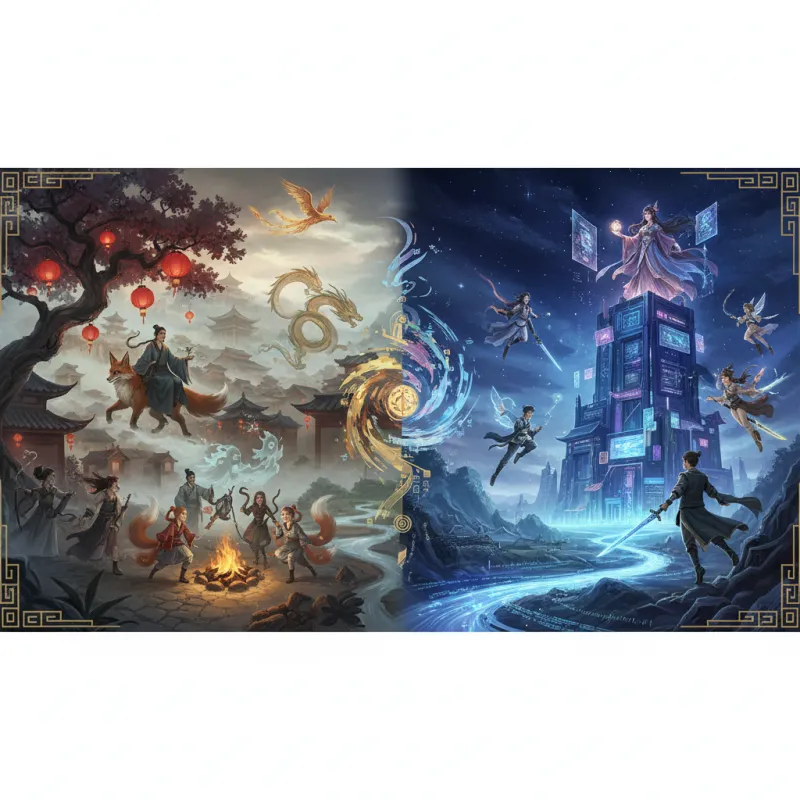
A fox spirit transforms into a beautiful woman and seduces a young scholar. A ghost bride seeks revenge on her murderer. A demon disguised as a monk devours travelers on a mountain pass. These aren't modern horror tropes — they're plot points from stories written over 300 years ago, and they're still being adapted, remixed, and reimagined in Chinese web novels today.
Chinese supernatural fiction isn't just a genre. It's an unbroken literary bloodline that stretches from the Han Dynasty to your smartphone screen, evolving with each generation while keeping its essential DNA intact.
The Ancient Roots: When Historians Collected Ghost Stories
The tradition begins in an unexpected place: history books. Around 350 CE, a scholar named Gan Bao (干宝) compiled the Soushenji (搜神记, "In Search of the Supernatural"), a collection of over 450 tales about ghosts, fox spirits, dragons, and immortals. But here's what's remarkable — Gan Bao wasn't writing pulp fiction. He was a respected historian who believed these supernatural accounts were as worthy of preservation as military campaigns and political intrigues.
This set the tone for everything that followed. In China, supernatural fiction was never relegated to the cultural basement. Scholars wrote it. Officials collected it. Philosophers debated it. The line between "serious literature" and "ghost stories" was always blurry, sometimes nonexistent.
By the Tang Dynasty (618-907 CE), the chuanqi (传奇, "tales of the strange") had emerged as a sophisticated literary form. These weren't campfire tales — they were carefully crafted stories with complex plots, psychological depth, and social commentary. The scholar Yuan Zhen wrote supernatural romances. The official Li Gongzuo penned tales of dragon kings and underwater palaces. This was respectable work for respectable people.
The Undisputed Masterpiece: Pu Songling's Liaozhai
Then came Pu Songling (蒲松龄, 1640-1715), and everything changed.
His Liaozhai Zhiyi (聊斋志异, "Strange Tales from a Chinese Studio") is to Chinese supernatural fiction what Shakespeare is to English drama — the work that defines the entire tradition. Written during the Qing Dynasty, Liaozhai contains 491 tales of fox spirits, ghosts, demons, and immortals, each one a miniature masterpiece of storytelling.
What makes Liaozhai extraordinary isn't just the supernatural elements. It's how Pu Songling used ghosts and demons to critique Qing society. His fox spirits are often more moral than human officials. His ghosts expose corruption. His demons reveal the hypocrisy of Confucian scholars. The supernatural becomes a lens for examining the very real problems of his world.
Take "Nie Xiaoqian" (聂小倩), one of the most famous stories. A beautiful ghost is forced by a demon to seduce and kill young men. She falls in love with one of her intended victims and helps him escape. It's a love story, yes, but also a meditation on agency, coercion, and the possibility of redemption. This story has been adapted into films, TV series, and novels dozens of times — most famously as the 1987 Hong Kong film A Chinese Ghost Story.
Pu Songling failed the imperial examinations repeatedly and spent his life as a poor tutor. He died in obscurity. But Liaozhai became immortal, influencing every supernatural writer who came after.
The Republican Era: Modernization and Monsters
The early 20th century brought Western influence, political upheaval, and new forms of media. Chinese supernatural fiction adapted. Lu Xun (鲁迅), the father of modern Chinese literature, wrote "Diary of a Madman" — a story that blurs the line between psychological horror and social critique. The supernatural became psychological, internal, modern.
But traditional ghost stories didn't disappear. They went underground, circulating in popular magazines and oral traditions. The Chinese ghost remained a powerful cultural figure, even as China modernized.
The Internet Revolution: From Liaozhai to Web Novels
Then came the internet, and Chinese supernatural fiction exploded.
Starting in the early 2000s, web novel platforms like Qidian (起点中文网) created a new ecosystem for supernatural fiction. Writers could publish serially, readers could comment in real-time, and successful novels could reach millions of readers. The genre diversified wildly: xianxia (仙侠, immortal heroes), xuanhuan (玄幻, mysterious fantasy), lingyi (灵异, supernatural horror), xiuzhen (修真, cultivation).
These aren't just modern inventions. They're direct descendants of the classical tradition. The fox spirits of Liaozhai become the spirit beasts of cultivation novels. The immortals of Tang chuanqi become the ascending cultivators of xianxia. The social critique of Pu Songling becomes the anti-establishment themes of modern web fiction.
Consider Mo Dao Zu Shi (魔道祖师, "Grandmaster of Demonic Cultivation") by Mo Xiang Tong Xiu. It's a cultivation novel with ghosts, demons, and necromancy — but also a sophisticated exploration of morality, justice, and the cost of power. It's been adapted into animation, live-action drama, audio drama, and manhua. It's Liaozhai for the streaming era.
Or Zhen Hun (镇魂, "Guardian") by Priest, which blends supernatural investigation with urban fantasy and queer romance. The ghosts and demons are thoroughly modern, but the underlying structure — scholars encountering the supernatural, moral complexity, social commentary — is pure classical tradition.
The Global Reach: Translation and Transformation
Chinese supernatural fiction is now a global phenomenon. Novels like Grandmaster of Demonic Cultivation and Heaven Official's Blessing have massive international fanbases. Translation communities work around the clock to bring new chapters to English, Spanish, Russian, and Vietnamese readers. The Chinese festival traditions and folklore embedded in these stories are reaching audiences who've never set foot in China.
This global spread is creating fascinating hybrids. Western readers bring their own genre expectations — urban fantasy, paranormal romance, LitRPG — and Chinese writers respond by incorporating these elements. The tradition evolves, as it always has.
Why It Endures: The Power of the Supernatural
Chinese supernatural fiction has survived for over two millennia because it does something essential: it makes the invisible visible. Ghosts reveal hidden truths. Fox spirits expose hypocrisy. Demons embody social anxieties. The supernatural is never just entertainment — it's a tool for understanding reality.
Pu Songling used fox spirits to critique corrupt officials. Modern web novelists use cultivation systems to explore meritocracy and power. The specific supernatural elements change, but the underlying function remains constant: the impossible makes the possible visible.
This is why the tradition never died, even during periods of political suppression or cultural upheaval. You can ban ghost stories, but you can't ban the human need to process reality through the lens of the impossible. The supernatural always finds a way back.
The Living Tradition
Walk into any Chinese bookstore today, and you'll find shelves of supernatural fiction. Open any web novel platform, and you'll find thousands of ongoing supernatural serials. The tradition that began with Gan Bao's Soushenji in 350 CE is still producing new work every single day.
The fox spirits are now cultivators. The ghosts haunt modern apartments instead of ancient temples. The scholars have become hackers and detectives. But the essential DNA remains: supernatural beings, moral complexity, social commentary, and the belief that the impossible can reveal truth.
From Liaozhai to web novels, Chinese supernatural fiction has never stopped evolving. And it shows no signs of stopping now.
Related Reading
- Chinese Horror Films: A Genre Guide
- Chinese Ghost Stories: Tales from the Supernatural Tradition
- Chinese Astrology: Stars, Stems, and Branches Decoded
- Chinese Fortune Telling: Ancient Methods Still Used Today
- Unveiling the Mysteries of Chinese Folklore: Legends and Cultural Traditions
- Chinese Calligraphy: The Five Major Styles
- Discovering the Rich Tapestry of Chinese Folklore: Myths, Legends, and Traditions
- Chinese Dynasties: A Quick Guide to 5,000 Years
Explore Chinese Culture
- Explore feng shui in daily life
- Explore supernatural folklore
- Explore classical Chinese literature