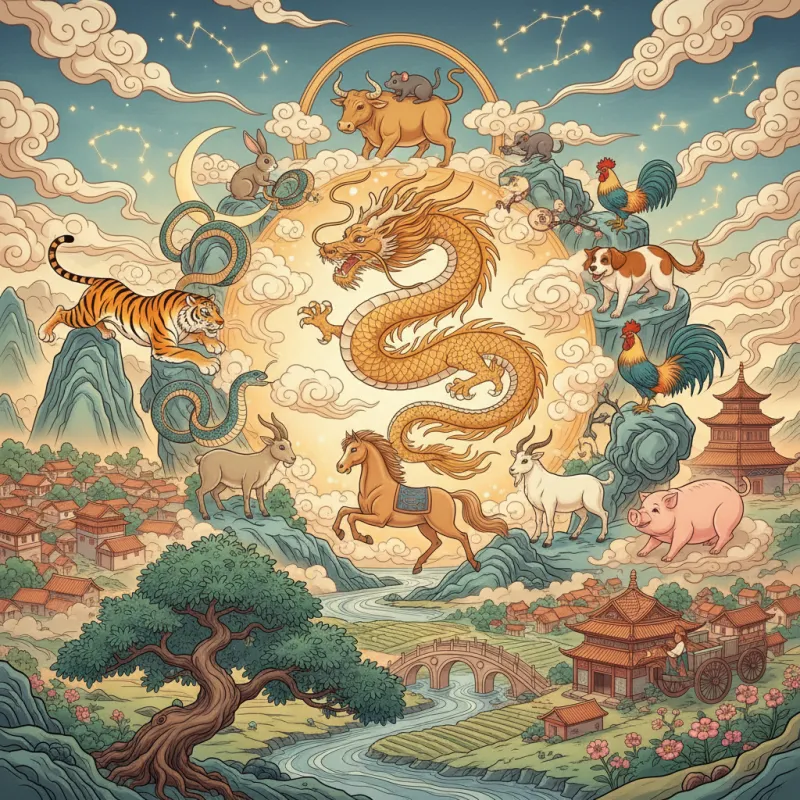
Every Chinese New Year, millions of people around the world ask the same question: "What's my animal?" But here's what most don't realize—the zodiac isn't just a cute way to label birth years. It's a 2,000-year-old system rooted in Han Dynasty astronomy, Taoist philosophy, and folk tales that parents still use to decide if their kids should marry. The twelve animals aren't random mascots; they're a cosmic ranking system that supposedly emerged from a legendary race orchestrated by the Jade Emperor himself.
The Great Race: How the Order Was Decided
According to the most popular origin story, the Jade Emperor (玉皇大帝, Yù Huáng Dàdì) announced a grand race to determine which animals would represent the years. The first twelve to cross the celestial river would earn their place in the zodiac. The cunning Rat, too small to swim the distance, hitched a ride on the Ox's back and jumped off at the last second to claim first place. The Tiger arrived third, exhausted from fighting the current. The Rabbit hopped across on stepping stones and floating logs. The Dragon, who could fly, came fifth because he stopped to make rain for a village—a detail that explains why dragons are associated with benevolence despite their power. The Snake hid in the Horse's hoof and scared it, securing sixth place. The Goat, Monkey, and Rooster worked together on a raft, arriving eighth, ninth, and tenth. The Dog, despite being an excellent swimmer, got distracted playing in the water and came eleventh. The Pig stopped for a feast and a nap, waddling in last.
This tale isn't just charming folklore—it encodes Confucian values about intelligence versus brute strength, cooperation, and the idea that even the last shall have their place. Different regions tell variations, but the order remains constant, cycling endlessly through the Chinese calendar.
Rat (鼠, Shǔ): The Clever Survivor
Years: 1924, 1936, 1948, 1960, 1972, 1984, 1996, 2008, 2020, 2032
Rats get a bad reputation in Western culture, but in Chinese tradition, they're symbols of intelligence and wealth. The character 鼠 appears in idioms about shrewdness and survival. People born in Rat years are said to be quick-witted, resourceful, and excellent at spotting opportunities—think of how rats always find food, no matter the circumstances. They're natural entrepreneurs and problem-solvers, though critics say they can be opportunistic and overly cautious with money.
Famous Rat-year births include Shakespeare, Mozart, and more recently, actors like Hugh Grant. The 2020 Rat year was particularly significant as it marked the beginning of a new 60-year cycle in the Chinese calendar, combining with the Metal element.
Ox (牛, Niú): The Reliable Workhorse
Years: 1925, 1937, 1949, 1961, 1973, 1985, 1997, 2009, 2021, 2033
If you want something done right, ask an Ox. These individuals are the dependable backbone of any organization—methodical, patient, and incredibly strong-willed. The Ox's role in Chinese agricultural society cannot be overstated; for millennia, oxen plowed the fields that fed dynasties. This animal represents honest labor and perseverance.
Ox people are said to be terrible at small talk but excellent at long-term planning. They value tradition, dislike change, and can be stubborn to a fault. The phrase "牛脾气" (niú píqi, "ox temper") describes someone impossibly headstrong. Barack Obama, Margaret Thatcher, and Vincent van Gogh were all born in Ox years—make of that what you will.
Tiger (虎, Hǔ): The Fearless Rebel
Years: 1926, 1938, 1950, 1962, 1974, 1986, 1998, 2010, 2022, 2034
Tigers are the zodiac's natural leaders and risk-takers. In Chinese culture, tigers ward off evil spirits—you'll see tiger imagery on children's clothing and door gods for protection. The White Tiger is one of the Four Symbols guarding the cardinal directions in Chinese cosmology, representing the west and autumn.
People born in Tiger years are charismatic, confident, and competitive. They're the ones who quit stable jobs to start companies or travel the world. The downside? They can be impulsive, hot-tempered, and terrible at taking advice. Tiger years are considered auspicious for births, though some traditional families worry about Tiger daughters being "too strong" for marriage—a sexist notion that's thankfully fading. Lady Gaga, Leonardo DiCaprio, and Queen Elizabeth II are all Tigers.
Rabbit (兔, Tù): The Diplomatic Peacemaker
Years: 1927, 1939, 1951, 1963, 1975, 1987, 1999, 2011, 2023, 2035
Don't mistake the Rabbit's gentleness for weakness. In Chinese mythology, the Jade Rabbit lives on the moon, grinding herbs for the elixir of immortality—a symbol of selfless dedication. Rabbits are the zodiac's diplomats, known for their grace, sensitivity, and ability to navigate social situations without making enemies.
Rabbit people are said to be lucky in life, avoiding major disasters through intuition and careful planning. They're artistic, compassionate, and excellent listeners, though they can be overly cautious and conflict-avoidant. The Chinese phrase "守株待兔" (shǒu zhū dài tù, "waiting by a tree stump for rabbits") comes from a parable about a farmer who caught one rabbit by accident and wasted his life waiting for another—a warning against passive luck-seeking. Albert Einstein, Lionel Messi, and Angelina Jolie were born in Rabbit years.
Dragon (龙, Lóng): The Auspicious Powerhouse
Years: 1928, 1940, 1952, 1964, 1976, 1988, 2000, 2012, 2024, 2036
The Dragon is the only mythical creature in the zodiac, and it's the most coveted birth year. Chinese birth rates consistently spike during Dragon years because parents believe these children will be destined for greatness. Dragons represent imperial power, wisdom, and good fortune—emperors wore robes embroidered with five-clawed dragons, a symbol forbidden to commoners.
Dragon people are said to be natural-born leaders with magnetic personalities. They're ambitious, innovative, and unafraid of challenges. The flip side? They can be arrogant, demanding, and poor at handling criticism. The 2012 Dragon year saw a 5% increase in births across Chinese communities worldwide. Bruce Lee, John Lennon, and Salvador Dalí were Dragons—fitting, given their larger-than-life personas. For more on dragon symbolism, see Chinese Dragon Mythology.
Snake (蛇, Shé): The Wise Strategist
Years: 1929, 1941, 1953, 1965, 1977, 1989, 2001, 2013, 2025, 2037
Snakes get an unfair reputation in Western culture, but in Chinese tradition, they're symbols of wisdom and transformation. The White Snake (白蛇, Bái Shé) from the classic tale "Legend of the White Snake" is one of Chinese literature's most beloved characters—a snake spirit who becomes human through centuries of cultivation.
Snake people are intuitive, philosophical, and excellent at reading between the lines. They're the strategists who see ten moves ahead, though they can be secretive and possessive. Snakes are said to be lucky with money but unlucky in love, needing partners who understand their need for privacy. Audrey Hepburn, Abraham Lincoln, and Pablo Picasso were all born in Snake years.
Horse (马, Mǎ): The Free Spirit
Years: 1930, 1942, 1954, 1966, 1978, 1990, 2002, 2014, 2026, 2038
Horses represent freedom, energy, and independence. In ancient China, horses were symbols of status and military power—the Tang Dynasty's expansion was built on superior cavalry. The phrase "马到成功" (mǎ dào chéng gōng, "success comes with the horse's arrival") is still used to wish someone good luck.
Horse people are enthusiastic, sociable, and always on the move. They're terrible at routine and excellent at inspiring others. The downside? They can be impatient, commitment-phobic, and prone to starting projects they never finish. Horse years are considered good for travel and new ventures. Paul McCartney, Genghis Khan, and Oprah Winfrey are Horses.
Goat (羊, Yáng): The Creative Nurturer
Years: 1931, 1943, 1955, 1967, 1979, 1991, 2003, 2015, 2027, 2039
The Goat (sometimes called Sheep or Ram—the character 羊 covers all three) represents gentleness, creativity, and family values. In Chinese culture, goats symbolize filial piety because they kneel to nurse, showing respect to their mothers.
Goat people are said to be artistic, empathetic, and deeply connected to beauty. They're the friends who remember your birthday and notice when you've had a bad day. However, they can be overly dependent on others, pessimistic, and terrible with money. Traditional Chinese astrology considers Goat years less auspicious, leading to birth rate drops—a superstition that modern Chinese people increasingly reject. Michelangelo, Steve Jobs, and Nicole Kidman were born in Goat years.
Monkey (猴, Hóu): The Clever Trickster
Years: 1932, 1944, 1956, 1968, 1980, 1992, 2004, 2016, 2028, 2040
The Monkey is the zodiac's entertainer and problem-solver. Sun Wukong (孙悟空, Sūn Wùkōng), the Monkey King from "Journey to the West," is one of Chinese literature's most iconic characters—clever, rebellious, and ultimately redeemable. His story has influenced everything from Dragon Ball to modern Chinese cinema.
Monkey people are witty, adaptable, and excellent at thinking on their feet. They're natural performers who can talk their way out of anything. The downside? They can be manipulative, unreliable, and prone to taking shortcuts. Monkeys are said to be lucky in career but need to watch their tendency toward arrogance. Leonardo da Vinci, Julius Caesar, and Tom Hanks are Monkeys. For more on the Monkey King's adventures, see Journey to the West Stories.
Rooster (鸡, Jī): The Punctual Perfectionist
Years: 1933, 1945, 1957, 1969, 1981, 1993, 2005, 2017, 2029, 2041
Roosters are the zodiac's alarm clocks—punctual, organized, and impossible to ignore. In Chinese culture, roosters symbolize fidelity and punctuality. The character 鸡 appears in idioms about diligence and attention to detail.
Rooster people are confident, hardworking, and brutally honest. They're the colleagues who arrive early, dress impeccably, and aren't afraid to point out mistakes. However, they can be critical, inflexible, and overly concerned with appearances. Roosters are said to be lucky in career advancement but need to work on their people skills. Beyoncé, Serena Williams, and Confucius were born in Rooster years.
Dog (狗, Gǒu): The Loyal Guardian
Years: 1934, 1946, 1958, 1970, 1982, 1994, 2006, 2018, 2030, 2042
Dogs represent loyalty, honesty, and justice. In Chinese culture, dogs are protectors—the Tiangou (天狗, Tiāngǒu, "heavenly dog") is a mythological creature that eats the sun during eclipses. The phrase "狗拿耗子" (gǒu ná hàozi, "dog catching mice") describes someone meddling in others' business, but it's said with affection.
Dog people are the friends who'll help you move at 3 AM and never mention it again. They're principled, protective, and deeply loyal to their inner circle. The downside? They can be anxious, judgmental, and prone to worrying about worst-case scenarios. Mother Teresa, Winston Churchill, and Elvis Presley were Dogs.
Pig (猪, Zhū): The Generous Optimist
Years: 1935, 1947, 1959, 1971, 1983, 1995, 2007, 2019, 2031, 2043
The Pig completes the zodiac cycle, representing abundance, generosity, and contentment. In Chinese culture, pigs symbolize wealth—a fat pig means a prosperous household. The character 猪 appears in idioms about good fortune and simple pleasures.
Pig people are said to be the zodiac's most genuine souls—kind, generous, and free from malice. They enjoy life's pleasures without guilt and trust others easily. However, they can be naive, overindulgent, and terrible at saying no. Pigs are considered lucky in wealth but need to watch their tendency toward excess. Henry VIII, Hillary Clinton, and Arnold Schwarzenegger were born in Pig years.
Beyond the Animals: Elements and Compatibility
The zodiac isn't just about animals—each year also corresponds to one of five elements (Wood, Fire, Earth, Metal, Water), creating a 60-year cycle. A Metal Rat (2020) has different characteristics than a Water Rat (1972). This complexity makes Chinese astrology far more nuanced than Western horoscopes.
Compatibility matters too. The zodiac divides into four "trine" groups of compatible animals: Rat-Dragon-Monkey, Ox-Snake-Rooster, Tiger-Horse-Dog, and Rabbit-Goat-Pig. Traditional matchmakers still consult these groupings, though modern couples increasingly ignore them. The most incompatible pairs are supposedly Rat-Horse, Ox-Goat, Tiger-Monkey, Rabbit-Rooster, Dragon-Dog, and Snake-Pig—animals directly opposite in the cycle.
Whether you believe in zodiac compatibility or dismiss it as superstition, the system reveals something profound about Chinese culture: the belief that we're all connected to larger cosmic patterns, that timing matters, and that understanding ourselves means understanding our place in the eternal cycle. Every twelve years, your animal year returns—your 本命年 (běnmìngnián, "origin life year")—and tradition says you should wear red underwear for protection. It's advice that's both absurd and oddly comforting, a reminder that even in our modern world, ancient wisdom still has something to say about who we are and who we might become.
Related Reading
- The Dragon in Chinese Culture: Power and Good Fortune
- Jade in Chinese Culture: The Stone of Heaven
- The Chinese Tea Ceremony: Finding the Dao in Every Cup
- Real Chinese Martial Arts: Beyond the Movie Myths
- First Time in China? Essential Tips for Culture-Minded Travelers
Explore Chinese Culture
- Explore feng shui in daily life
- Explore supernatural folklore
- Explore classical Chinese literature