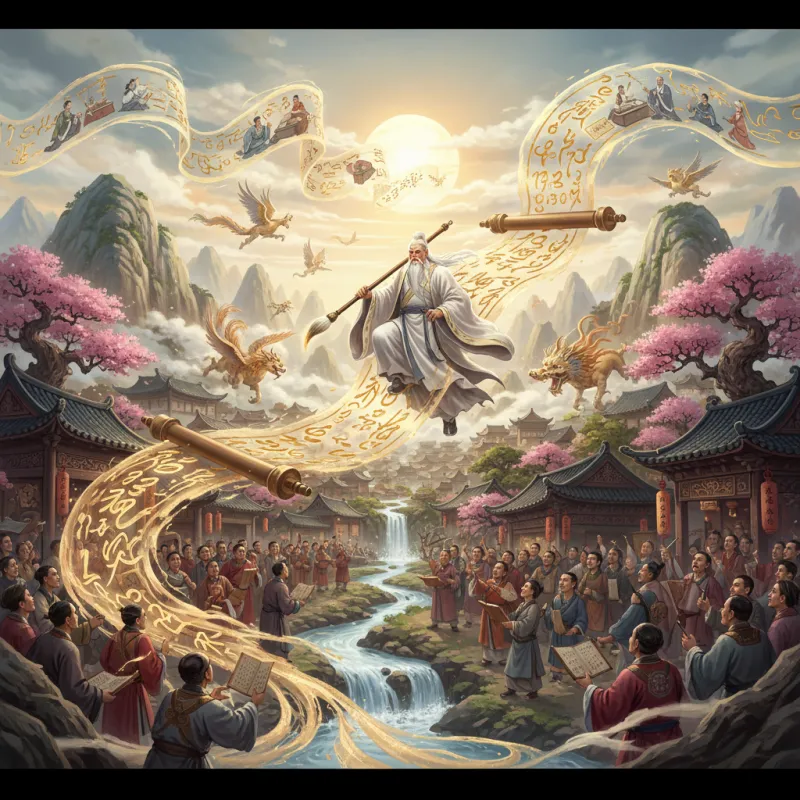
A single brushstroke can reveal whether you're anxious, drunk, or enlightened. In China, this isn't mysticism—it's calligraphy, and masters have been reading character and cosmos in ink for over two thousand years. While Western culture separates the novelist from the painter, the poet from the sculptor, Chinese tradition insists they're all doing the same thing: making visible the invisible movements of the heart and mind through the written word.
The Character as Canvas
Chinese characters aren't phonetic symbols—they're compressed paintings. Each one began as a picture: 山 (shān, mountain) still looks like peaks, 水 (shuǐ, water) flows like a stream. When you write them, you're not spelling sounds; you're choreographing a dance of brush, ink, and paper that's been refined since the Shang Dynasty oracle bones of 1200 BCE.
This is why calligraphy (书法, shūfǎ—literally "the method of writing") ranks above painting in the traditional hierarchy of Chinese arts. A landscape painting might capture a mountain, but a calligrapher writing 山 captures both the mountain and the act of seeing it, thinking it, becoming it. The character is simultaneously representation, abstraction, and performance.
Wang Xizhi (王羲之, 303-361 CE), often called the Sage of Calligraphy, wrote his masterpiece "Lanting Xu" (Preface to the Orchid Pavilion) while tipsy at a spring gathering. He tried to recreate it later, sober and deliberate, but could never match the original's spontaneous grace. The emperor Taizong loved it so much he had it buried with him. What we have now are copies of copies, traced and retraced by admirers across dynasties, each one a conversation with Wang's long-dead hand.
The Four Treasures and Five Scripts
Before you can understand calligraphy as art, you need to know the tools. The Four Treasures of the Study (文房四宝, wénfáng sìbǎo) are brush, ink, paper, and inkstone—each one a craft tradition in itself. The brush isn't a pen; it's a bundle of animal hair that responds to the slightest pressure, angle, and speed. Ink isn't liquid; it's a solid stick ground against stone with water, mixed fresh for each session. The paper (or silk) absorbs and bleeds in ways that make every stroke irreversible.
With these tools, calligraphers work in five major script styles, each with its own aesthetic and historical moment. Seal script (篆书, zhuànshū) is archaic and ceremonial, used on official seals and ancient bronzes. Clerical script (隶书, lìshū) emerged in the Han Dynasty as a bureaucratic shorthand that became unexpectedly elegant. Regular script (楷书, kǎishū) is the standard—clear, balanced, teachable. Running script (行书, xíngshū) flows faster, connecting strokes like cursive. And cursive script (草书, cǎoshū) is pure abstraction, where characters dissolve into gesture and rhythm.
A master knows all five and chooses based on mood, message, and moment. Zhang Xu (张旭, 8th century) was famous for his "wild cursive" written while drunk, his brush flying across paper in ecstatic illegibility. His contemporary Huai Su (怀素) was a Buddhist monk whose cursive was equally wild but disciplined by meditation. Same script, different souls. Much like how Chinese Opera uses gesture and costume to reveal character, calligraphy uses stroke and structure to reveal the writer's inner state.
What the Brush Reveals
Here's what makes calligraphy the highest art: it's a lie detector. You can fake a painting's subject, but you can't fake the quality of your brushwork. Every hesitation, every rush of confidence, every moment of distraction shows up in the ink. The brush records your breathing, your posture, your state of mind with forensic precision.
This is why Chinese scholars spent decades practicing calligraphy before they were considered educated. It wasn't about penmanship—it was about cultivating the self. The Confucian ideal held that moral character and aesthetic character were inseparable. A person with a chaotic mind would produce chaotic characters. A person with a refined spirit would produce refined strokes. Calligraphy was both diagnosis and cure.
The Song Dynasty poet and calligrapher Su Shi (苏轼, 1037-1101) wrote some of his best work while exiled to remote provinces for political reasons. His "Cold Food Festival" scroll, written during banishment, shows characters that lean and stumble like a drunk or a man walking against wind. The content is melancholy, but the brushwork is defiant—each stroke insisting on beauty despite circumstances. You can see his refusal to be broken.
The Collector's Obsession
In China, owning a piece of calligraphy by a master was like owning a piece of their soul. Emperors built collections. Scholars bankrupted themselves for a single scroll. The Qing Dynasty emperor Qianlong was so obsessed with Wang Xizhi that he covered genuine ancient calligraphies with his own seals and inscriptions—essentially graffiti-ing priceless artifacts to prove he'd seen them.
This wasn't just materialism. A calligraphy scroll was a time machine. When you looked at characters written a thousand years ago, you were seeing the exact pressure, speed, and angle of a long-dead hand. You could trace the strokes with your eyes and feel the rhythm of their creation. It was the closest thing to meeting the dead.
Collectors would host "calligraphy appreciation parties" where scrolls were unrolled, studied, debated, and sometimes copied on the spot. These weren't quiet museum visits—they were loud, wine-soaked arguments about whether a particular hook was too aggressive or a certain dot too timid. The scrolls themselves often accumulated layers of commentary: seals, inscriptions, and poems added by each owner, turning a single piece into a multi-generational conversation.
Calligraphy and Painting Merge
By the Song Dynasty, the line between calligraphy and painting had blurred completely. Literati painters (文人画, wénrénhuà) used the same brushwork for both, and their paintings were judged by calligraphic standards: the quality of the line, the rhythm of the composition, the "bone structure" of the brushstrokes. A bamboo painting was really just cursive script in disguise.
This is why Chinese painting looks so different from Western painting. There's no chiaroscuro, no perspective, no attempt at photographic realism. Instead, there's calligraphic line—expressive, abstract, more interested in capturing the essence of a thing than its appearance. When Qi Baishi (齐白石, 1864-1957) painted shrimp, he didn't paint what shrimp look like; he painted what shrimp feel like, using brushstrokes that dart and curve with aquatic life.
The greatest compliment you could give a Chinese painting was that it had "书卷气" (shūjuàn qì)—literally "the air of books," meaning it showed the refinement and learning that came from a lifetime of reading and writing. A painting without calligraphic quality was just decoration. A painting with it was philosophy made visible, much like how traditional Chinese festivals transform abstract values into lived experience.
Why It Still Matters
In the age of keyboards and touchscreens, calligraphy might seem obsolete. But in China, it's having a renaissance. Calligraphy classes are packed. Exhibitions draw crowds. Young artists are experimenting with the form, projecting giant characters on buildings, writing with mops and brooms, even using calligraphic principles in digital design.
This isn't nostalgia—it's recognition that calligraphy addresses something keyboards can't. When you write by hand with a brush, you're forced to slow down, to pay attention, to coordinate mind, breath, and body. It's meditation, exercise, and art all at once. In a culture increasingly dominated by speed and distraction, calligraphy offers a different way of being present.
The traditional view that calligraphy is the highest art form isn't about ranking creative practices. It's about recognizing that writing—the act of making language visible—is fundamental to how we think, remember, and imagine. In Chinese culture, where characters are pictures and pictures are characters, where the same brush writes poems and paints mountains, calligraphy sits at the center of everything. It's not just an art form. It's the art form from which all others flow.
Related Reading
- Chinese Landscape Painting: Mountains and Water
- Chinese Arts: The Four Treasures of the Study and Beyond
- Chinese Calligraphy: The Five Major Styles
- Chinese Opera: A Living Art Form
- Chinese Horror Films: A Genre Guide
- The Chinese Language: Why It Is Both Harder and Easier Than You Think
- Unveiling the Celestial Tales of Chinese Folklore and Legends
Explore Chinese Culture
- Explore feng shui in daily life
- Explore supernatural folklore
- Explore classical Chinese literature