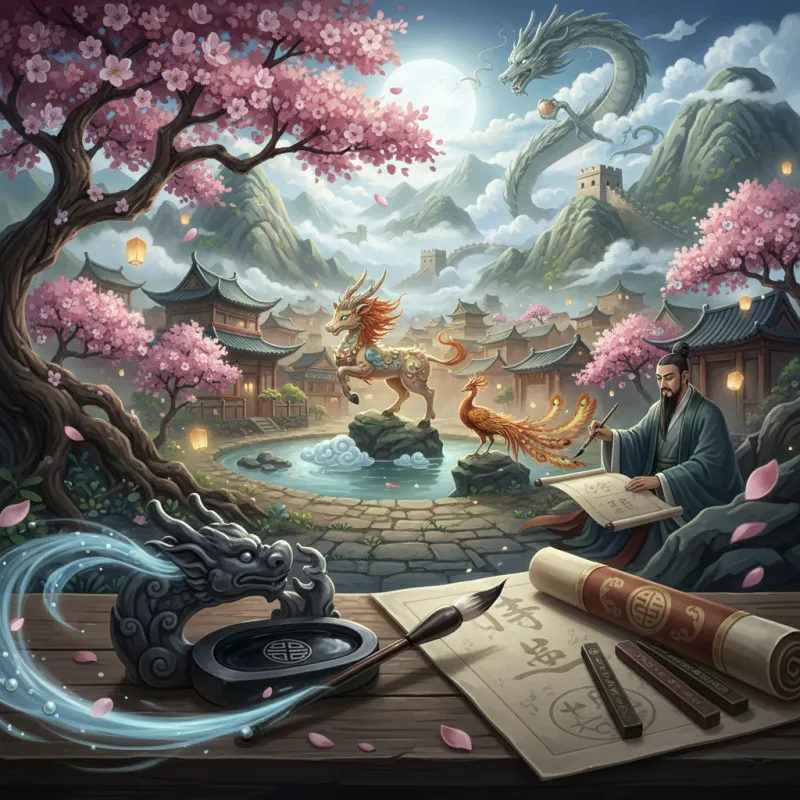
A scholar in Tang Dynasty China could spend an entire morning grinding ink. Not because the process was difficult, but because rushing would dishonor the words yet to be written. This wasn't procrastination—it was philosophy made physical. The Four Treasures of the Study (文房四宝, wénfáng sìbǎo) weren't just tools for writing. They were the interface between thought and immortality, the physical embodiment of a civilization that believed the written word could outlast empires.
The Brush: An Extension of Breath
The Chinese brush (笔, bǐ) is deceptively simple—animal hair bound to bamboo. But calling it a writing tool is like calling a Stradivarius a wooden box with strings. A single brush can produce a line as thin as spider silk or as bold as a thumb, all in one continuous stroke. The secret lies in the hair: wolf hair for strength and spring, goat hair for softness and ink retention, rabbit hair for delicate detail. Master calligraphers often used "mixed hair" brushes (兼毫, jiānháo) that combined these qualities.
Wang Xizhi (王羲之), the 4th-century "Sage of Calligraphy," reportedly wore out dozens of brushes practicing by a pond, turning the water black with ink. His Preface to the Poems Composed at the Orchid Pavilion remains the most celebrated piece of calligraphy in Chinese history—and he wrote it half-drunk at a party, with a brush that responded to every tremor of his hand. That's the point: the brush doesn't just record movement, it amplifies intention. A moment of hesitation shows. So does confidence, anger, or joy.
The brush handle is traditionally bamboo because bamboo is hollow—a Daoist principle made manifest. The tool should be empty of ego, a channel rather than an obstacle. Some scholars used handles made from jade or ivory, but purists considered this vulgar. The brush was meant to disappear in the hand, leaving only the connection between mind and paper.
The Ink: Darkness That Takes Time
Chinese ink (墨, mò) comes in solid sticks that look like small black bricks, often decorated with gold characters or landscape scenes. The finest ink sticks are made from pine soot collected from burning specific species of pine in Anhui Province, mixed with animal glue and aged for years—sometimes decades. The Qing Dynasty emperor Qianlong was known to use ink sticks that were over a century old, believing that age gave the black a depth that fresh ink couldn't match.
The grinding process is where ink becomes meditation. You add a few drops of water to the inkstone, then grind the stick in slow circles, gradually adding more water as the ink darkens. It takes five to ten minutes to produce enough ink for a session of calligraphy. This isn't inefficiency—it's intentional delay, a buffer between the chaos of daily life and the focused state required for creation. Japanese Zen monks adopted this practice wholesale, recognizing that the grinding itself was a form of mindfulness training.
The quality of ink reveals itself in subtle ways. Cheap ink looks flat black. Fine ink has dimension—it seems to contain layers of darkness, with hints of blue or purple in the deepest strokes. When diluted with water for painting, it produces the "five colors of ink" (墨分五色, mò fēn wǔ sè): scorched black, thick black, heavy black, light black, and clear black. Chinese landscape painters built entire compositions using only these gradations, proving that limitation breeds creativity.
The Paper: Drinking Darkness
Xuan paper (宣纸, xuānzhǐ), named after Xuanzhou in Anhui Province where it originated during the Tang Dynasty, is made from the bark of the blue sandalwood tree mixed with rice straw. It's absorbent in a way that Western paper isn't—ink doesn't sit on the surface, it sinks in immediately and spreads slightly, creating a soft edge that's impossible to achieve on non-absorbent paper. This quality is called "bleeding" (洇, yīn), and it's a feature, not a bug.
The absorbency means there's no erasing, no second chances. Every stroke is permanent the instant the brush touches paper. This unforgiving nature shaped Chinese artistic philosophy: you practice the stroke a thousand times in your mind and in the air before committing it to paper. The 17th-century painter Shitao wrote that he could spend an entire day contemplating a single brushstroke, then execute it in a second.
Xuan paper comes in different absorbencies. Raw xuan (生宣, shēng xuān) is highly absorbent, preferred for expressive calligraphy and spontaneous painting. Sized xuan (熟宣, shú xuān) is treated with alum to reduce absorbency, allowing for more controlled, detailed work. The choice of paper is itself an artistic decision, determining what's possible before the first stroke is made.
The paper is also remarkably durable. Documents written on xuan paper over a thousand years ago remain legible today, while Western paper from the 19th century is often crumbling. The secret is the long fibers and the absence of acid in the manufacturing process. Chinese scholars understood that they were writing for posterity—the paper had to last as long as the ideas.
The Inkstone: The Altar of Transformation
The inkstone (砚, yàn) is where ink stick becomes liquid ink, where solid becomes fluid. The finest inkstones are carved from specific types of stone—Duan stone from Guangdong, She stone from Anhui, Tao River stone from Gansu. These stones are prized for their texture: fine enough to grind the ink stick smoothly, but with enough tooth to actually abrade the stick and release the soot.
A good inkstone can cost more than a house. The Qing Dynasty scholar Ji Xiaolan owned an inkstone that had been used by the Song Dynasty poet Su Shi six centuries earlier—it was his most treasured possession, mentioned in his will before his children. Inkstones were passed down through generations, accumulating history with each use. The grinding surface develops a patina over decades, a physical record of thousands of hours of preparation.
The inkstone has two parts: the grinding surface and the ink pool where the liquid collects. The relationship between these areas affects how the ink flows and how much can be prepared at once. Some inkstones include carved decorations—dragons, landscapes, poems—but the grinding surface itself is always left plain. Function precedes ornament, always.
Scholars developed personal relationships with their inkstones. The 11th-century poet Mi Fu wrote love poems to his inkstones, describing their textures and colors with the language usually reserved for romantic partners. This wasn't eccentricity—it was recognition that these objects were partners in the creative process, not mere tools.
Beyond the Four: The Supporting Cast
The Four Treasures don't work in isolation. A complete scholar's studio included dozens of supporting items, each with its own aesthetic and function. The brush rest (笔架, bǐjià) kept brushes from rolling away and prevented the hair from being crushed. Water droppers (水滴, shuǐdī) added water to the inkstone in controlled amounts—some were shaped like frogs or toads, creatures associated with water in Chinese symbolism.
Paperweights (镇纸, zhèn zhǐ) held the paper flat during writing. These were often made from jade, bronze, or carved wood, and became collectibles in their own right. The seal (印章, yìnzhāng) and seal paste (印泥, yìnní) were essential for marking finished works—a painting without the artist's seal was considered incomplete, like a letter without a signature.
The arrangement of these objects on the desk was itself an art form, related to the practice of scholar's rocks and the aesthetic principles that governed Chinese gardens. The desk was a microcosm, a miniature landscape where creativity could flourish. Some scholars spent as much time arranging their tools as using them, understanding that environment shapes output.
The Philosophy of Tools
Why did Chinese civilization invest so much meaning in writing tools? Because in a culture where the written word was the primary path to power—through the imperial examination system—and where calligraphy was considered the highest art form, these tools were literally the instruments of destiny. A poor farmer's son could, in theory, use these four treasures to write his way into the imperial bureaucracy. The tools were democratic in a way that birth and wealth were not.
But there's a deeper reason. The Four Treasures embody core Chinese philosophical principles. The brush is Confucian—it requires discipline, practice, and respect for tradition. The ink is Daoist—it transforms through patient process, and its depth comes from emptiness (the hollow bamboo handle, the space in the inkstone). The paper is Buddhist—it accepts everything without resistance, yet retains everything permanently. The inkstone is all three—solid yet yielding, permanent yet constantly changing through use.
Together, they form a system that values process over product, preparation over spontaneity, and the journey over the destination. You can't rush grinding ink. You can't erase a stroke on xuan paper. You can't fake mastery of the brush. The tools enforce honesty and presence, qualities that Chinese philosophy has always prized above cleverness or speed.
The Four Treasures Today
In contemporary China, most people write with ballpoint pens or type on phones. But the Four Treasures haven't disappeared—they've become markers of cultural continuity. Calligraphy classes are increasingly popular, seen as a way to connect with tradition in a rapidly modernizing society. High-end ink sticks and inkstones remain luxury goods, purchased as gifts or investments.
The tools have also found new audiences internationally. Western artists have discovered that Chinese brushes and ink can produce effects impossible with Western materials. The immediacy and permanence of ink on xuan paper appeals to contemporary sensibilities about authenticity and presence. Some Western calligraphers now study Chinese techniques, not to copy Chinese characters, but to apply the principles to Latin letters.
The Four Treasures remind us that tools shape thought. The medium isn't just the message—it's the mindset. When you grind ink for ten minutes before writing, you're not just preparing materials, you're preparing yourself. When you know that every stroke is permanent, you think differently about commitment and intention. When your brush responds to the slightest change in pressure or angle, you become aware of tensions you didn't know you were holding.
These aren't just historical artifacts or exotic curiosities. They're a complete philosophy of creativity, preserved in physical form. The Four Treasures teach patience in an impatient age, permanence in a disposable culture, and the value of preparation in a world that prizes speed. That's why they've survived for over two thousand years, and why they'll likely survive two thousand more.
Related Reading
- Traditional Chinese Music: Instruments, Scales and Soul
- Chinese Opera for Beginners: A Visual and Musical Feast
- Chinese Calligraphy: Why Writing Is Considered the Highest Art Form
- The Chinese Tea Ceremony: Finding the Dao in Every Cup
- Chinese Calligraphy: The Five Major Styles
- Exploring Transformation in Chinese Folklore: Legends, Fairy Tales, and Cultural Traditions
- Chinese Dynasties: A Quick Guide to 5,000 Years
- The Enchanting World of Chinese Folklore: Legends and Cultural Traditions
Explore Chinese Culture
- Explore feng shui in daily life
- Explore supernatural folklore
- Explore classical Chinese literature