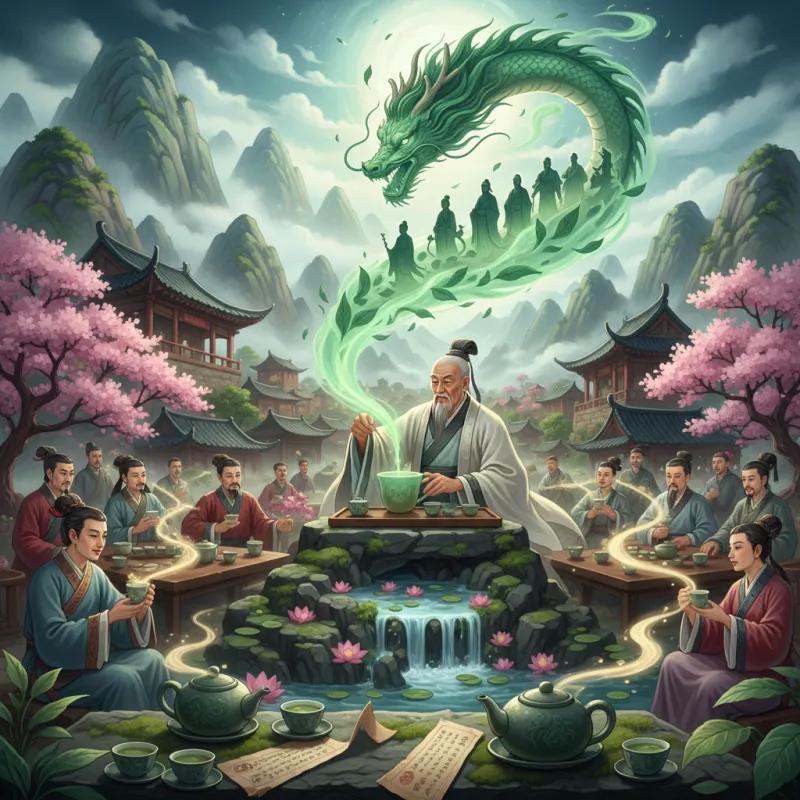
The old tea master's hands moved with practiced precision, pouring boiling water over the leaves in a motion so fluid it seemed choreographed. "You Westerners," he said without looking up, "you think tea is something you drink when you're thirsty." He paused, watching the leaves unfurl in the gaiwan. "We Chinese know better. Tea is how we think."
He wasn't being poetic. He was being literal.
The Philosophy Beneath the Leaves
Tea (茶, chá) entered Chinese civilization around 2737 BCE, according to legend, when leaves accidentally fell into Emperor Shennong's boiling water. But it didn't become a philosophical practice until the Tang Dynasty (618-907 CE), when a Buddhist monk named Lu Yu wrote the Cha Jing (茶经, Chá Jīng) — The Classic of Tea. This wasn't a recipe book. It was a manifesto.
Lu Yu argued that tea drinking was a spiritual discipline, a way to cultivate inner peace and clarity. He described twenty-four implements needed for proper tea preparation, not because he was fussy, but because the ritual itself was the point. The careful attention required to heat water to the precise temperature, to pour at the correct angle, to observe the color and aroma — this was meditation disguised as beverage preparation.
The Buddhists understood something profound: the mind that can focus completely on making tea is a mind that can focus completely on anything. Tea became a training ground for consciousness itself.
Three Cups, Three Philosophies
Chinese tea culture absorbed and reflected the three great philosophical traditions that shaped Chinese thought. Each brought its own interpretation to the simple act of drinking tea.
Confucianism saw tea as a social harmonizer. The elaborate tea ceremonies weren't about showing off — they were about creating a space where hierarchy softened and genuine communication could occur. When a business deal went sour, you invited the other party for tea. The ritual gave everyone time to save face, reconsider positions, and find middle ground. Tea was diplomacy in a cup.
Taoism embraced tea's connection to nature and simplicity. The Taoist tea drinker sought the most natural, unprocessed teas — white tea that was barely touched by human hands, wild-grown leaves from mountain cliffs. They valued the tea's qi (气, qì), its life energy, and believed that drinking tea was a way to harmonize with the natural world. The famous Taoist saying "the Tao that can be spoken is not the eternal Tao" found its parallel in tea: the best tea experiences were beyond words.
Buddhism, particularly Chan (Zen) Buddhism, made tea an integral part of monastic life. Monks drank tea to stay awake during long meditation sessions, but it became more than a stimulant. The tea ceremony itself became a form of meditation — what the Japanese would later call cha-no-yu (茶の湯), though the Chinese practice predated it by centuries. The monk Zhaozhou (778-897 CE) famously answered nearly every question with "Go drink tea" (吃茶去, chī chá qù), suggesting that enlightenment wasn't found in clever answers but in simple, present-moment awareness.
The Gongfu Method: Precision as Practice
Walk into any traditional Chinese tea house, and you'll witness gongfu cha (工夫茶, gōngfu chá) — literally "making tea with skill." This isn't the casual tea-bag-in-a-mug approach. This is tea as performance art, as meditation, as philosophy made visible.
The gongfu method uses a small teapot (often Yixing clay, which absorbs the tea's essence over years of use) and tiny cups. The first infusion is discarded — it's called "washing the tea" or "awakening the leaves." Subsequent infusions last only seconds, sometimes just fifteen or twenty. A single portion of leaves might be infused ten, fifteen, even twenty times, each steeping revealing different flavor notes and characteristics.
Why such precision? Because gongfu tea teaches you to pay attention. You notice how the second infusion differs from the fifth. You observe how water temperature affects bitterness. You learn patience — rushing ruins everything. You practice presence — distraction means over-steeped, bitter tea.
This is why tea masters say that tea ceremony practices are really training in awareness. The tea is almost incidental.
Tea as Social Architecture
In Chinese culture, offering tea isn't just hospitality — it's a complex social language with its own grammar and vocabulary.
When you visit someone's home, they offer tea immediately. Refusing is insulting. When you pour tea for others, you fill their cups before your own — this demonstrates respect and selflessness. When someone pours for you, you tap two fingers on the table (or three, if you're showing extra respect) — this gesture supposedly originated when a Qing Dynasty emperor poured tea for his disguised companions, who couldn't kowtow without revealing his identity, so they "kowtowed" with their fingers instead.
During business negotiations, tea serves as a buffer and a signal. If someone keeps refilling your cup, they're interested in continuing the conversation. If they let your cup sit empty, they're signaling the meeting should end. Accepting a second pot of tea means you're open to further discussion. Declining means you've reached your position.
Family conflicts are resolved over tea. The younger person pours for the elder as an apology. The act of accepting the tea is accepting the apology. No words needed — the tea ceremony itself carries the meaning.
The Health Philosophy: Food and Medicine from the Same Source
Traditional Chinese Medicine operates on the principle of yào shí tóng yuán (药食同源) — "medicine and food share the same origin." Tea sits at the intersection of this philosophy, neither purely food nor purely medicine, but something in between.
Different teas address different imbalances in the body's systems. Green tea is considered "cooling" — good for clearing heat and toxins, ideal for summer or for people with "hot" constitutions. Pu-erh tea (普洱茶, pǔ'ěr chá) is "warming" and aids digestion, particularly of fatty foods (which is why it's traditionally served with dim sum). White tea is gentle and subtle, suitable for those with sensitive stomachs. Oolong tea (乌龙茶, wūlóng chá) balances between cooling and warming, making it versatile for different seasons and constitutions.
But the health benefits go beyond physical. The Tang Dynasty physician Sun Simiao wrote that tea "makes one think better, sleep less, and move more lightly." He wasn't talking about caffeine — he was describing tea's effect on mental clarity and spiritual lightness. The act of preparing and drinking tea mindfully was itself therapeutic, a break from the chaos of daily life, a moment of intentional calm.
The Aesthetics of Imperfection
Here's where Chinese tea philosophy diverges sharply from, say, Japanese tea ceremony. The Japanese perfected tea into an art of precise, almost austere beauty. The Chinese kept it looser, more spontaneous, more human.
A Chinese tea master might use a chipped cup because it has history, because the chip tells a story. The Yixing teapot develops a patina over years of use — it becomes more valuable as it becomes more "imperfect." The tea leaves themselves are never uniform; they're wild, irregular, each leaf different from the next.
This reflects the Taoist principle of ziran (自然, zìrán) — naturalness, spontaneity, being true to one's nature. The perfect tea experience isn't about executing a flawless ceremony. It's about being fully present with the tea, the people, the moment — imperfections and all.
The Song Dynasty poet Su Shi wrote about making tea with river water during a boat journey, using whatever implements were at hand. The tea was probably terrible by technical standards. But the experience — the friends, the river, the spontaneity — made it perfect.
Why This Matters Now
In contemporary China, traditional tea culture faces pressure from coffee shops and bubble tea chains. Young people in Shanghai and Beijing increasingly prefer lattes to longjing. Some see this as cultural loss.
But perhaps they're missing the point. The philosophy of tea was never about the beverage itself. It was about attention, presence, connection, and harmony. These principles can manifest in any form — even in a carefully made pour-over coffee or a mindfully prepared matcha latte.
The old tea master I mentioned at the beginning once told me: "Tea culture isn't about preserving ancient rituals. It's about preserving ancient wisdom. The ritual is just the vehicle." He then proceeded to make tea using an electric kettle and a glass mug, completely abandoning traditional implements. The tea was extraordinary.
That's the real lesson of Chinese tea philosophy. It's not about the tools or the ceremony or even the tea itself. It's about cultivating a mind that can be fully present, that can find depth in simple acts, that can transform the mundane into the meaningful. Whether you're using a Ming Dynasty Yixing teapot or a paper cup from 7-Eleven, the question remains the same: Are you really here? Are you really tasting? Are you really alive to this moment?
The tea, as Zhaozhou knew, is just an excuse to practice being human.
Related Reading
- The Six Types of Chinese Tea
- Why Chinese Tea Culture Is Not Japanese Tea Ceremony
- Tea and Zen: The Spiritual Connection
- Gongfu Tea Ceremony Step by Step
- The Dragon in Chinese Culture: Power and Good Fortune
- Chinese Festivals Explained: The Stories Behind the Celebrations
- Unveiling the Celestial Tales of Chinese Folklore and Legends
Explore Chinese Culture
- Explore feng shui in daily life
- Explore supernatural folklore
- Explore classical Chinese literature