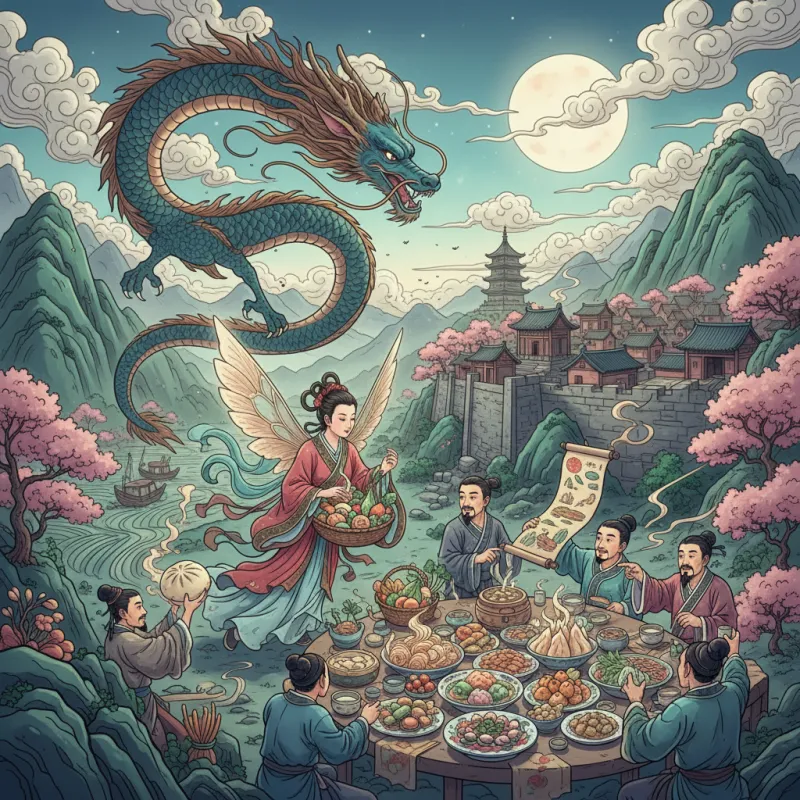
The fortune cookie on your plate isn't Chinese. Neither is General Tso's chicken, crab rangoon, or that gloopy orange sauce drowning your "sesame chicken." But the real deception runs deeper than menu fraud—it's a fundamental misunderstanding of what Chinese food actually is, how it works, and why it matters.
The Meal Structure Nobody Teaches You
Walk into a Chinese home at dinnertime and you'll see something that contradicts everything Western Chinese restaurants have taught you. There's no single massive plate of orange chicken with a mountain of fried rice. Instead, the table holds four, five, maybe seven dishes—a vegetable stir-fry, a braised fish, a soup, cold pickled vegetables, a small portion of twice-cooked pork, steamed rice in individual bowls. Everyone shares everything.
This is cài (菜)—the dishes that accompany rice—and it operates on principles that have nothing to do with the protein-centric, single-entrée model of Western dining. The goal isn't to fill up on one thing. It's tiáowèi (调味), the balancing of flavors, and yíngyǎng dāpèi (营养搭配), the matching of nutritional properties. A rich, oily dish needs a light, crisp vegetable. Something spicy requires something cooling. Heavy flavors need delicate ones. This isn't poetry—it's the practical logic that has governed Chinese home cooking for centuries.
Western Chinese restaurants serve you a pound of meat in brown sauce because that's what sells, not because that's what Chinese people eat. The average Chinese home meal might include meat, but it's sliced thin, distributed across a vegetable dish, stretched to serve many. The vegetables are the point. The balance is the point.
The Eight Cuisines Are Not Eight Flavors
When people talk about Chinese regional cuisines, they usually mention the bā dà càixì (八大菜系)—the Eight Great Culinary Traditions. Then they reduce each one to a single adjective. Sichuan is spicy. Cantonese is mild. Shandong is salty. This is like describing French cuisine as "buttery" and calling it done.
Take Sichuan cuisine (川菜). Yes, it's famous for málà (麻辣)—that numbing-spicy combination of Sichuan peppercorn and dried chili that makes your lips tingle and your forehead sweat. But Sichuan cooking actually recognizes 24 distinct flavor profiles, and most of them aren't spicy at all. There's jiāyán (家常), the everyday homestyle flavor that's savory and slightly sweet. There's yúxiāng (鱼香), "fish-fragrant," which contains no fish but uses the aromatics typically used for fish—garlic, ginger, scallions, pickled chili. There's guàibù (怪味), "strange flavor," which balances sweet, salty, sour, spicy, and numbing all at once.
Cantonese cuisine (粤菜) gets dismissed as "bland" because it doesn't assault you with chili oil. But Cantonese cooking is technically demanding in ways that spicy food never has to be. When you can't hide behind aggressive seasoning, your ingredients must be impeccable and your technique must be precise. Cantonese chefs steam fish with ginger and scallions, letting you taste whether that fish was swimming this morning or last week. They make bái zhuó xiā (白灼虾)—shrimp blanched in plain water—and serve it with a dipping sauce, because the shrimp itself is the point. This isn't timidity. It's confidence.
Jiangsu cuisine (苏菜), centered around Suzhou and Nanjing, specializes in hóngshāo (红烧)—red-braising—where ingredients simmer slowly in soy sauce, rice wine, and rock sugar until they turn mahogany and tender. Anhui cuisine (徽菜) is all about wild ingredients from the mountains—bamboo shoots, mushrooms, wild herbs—and techniques like stewing and braising that coax flavor from tough ingredients. Each cuisine is a complete culinary philosophy, not a flavor note.
The Yin-Yang Principle You're Ignoring
Chinese food culture is inseparable from Chinese medicine, and Chinese medicine is built on the concept of balance—yīnyáng (阴阳). Foods aren't just tasty or nutritious. They're rè (热, heating) or liáng (凉, cooling). They're shī (湿, dampness-inducing) or zào (燥, drying). Eating isn't just about calories and vitamins. It's about maintaining your body's internal equilibrium.
Ginger is heating. Watermelon is cooling. If you have a cold, you eat ginger soup to warm your body and drive out the chill. If it's summer and you're overheated, you eat cooling foods like cucumber, bitter melon, and mung beans. If you're feeling shànghuǒ (上火)—literally "rising fire," a state of internal heat that manifests as canker sores, acne, or irritability—you avoid fried foods, spicy foods, and lamb, and you eat more vegetables and drink herbal tea.
This isn't superstition. It's a systematic approach to diet that has governed Chinese eating for thousands of years, and it's completely absent from Western Chinese restaurants, where the only principle is "more sauce, more salt, more sugar." A proper Chinese meal considers the season, the weather, the eater's constitution, and the properties of every ingredient. You don't just throw random dishes together. You compose a meal the way you'd compose music, with attention to harmony and contrast.
For more on how traditional Chinese medicine influences food choices, see Traditional Chinese Medicine and Food Therapy.
The Texture Obsession
Westerners eat for flavor. Chinese eat for kǒugǎn (口感)—mouthfeel, texture, the physical sensation of food. This is why Chinese cuisine includes things that baffle Western eaters: sea cucumber, which tastes like nothing but has a slippery, gelatinous texture. Wood ear mushrooms, prized for their crisp, crunchy bite. Fish maw, chicken feet, duck tongues, pork tendon—all valued primarily for texture, not flavor.
The ideal Chinese meal includes a range of textures: something crispy (cuì, 脆), something tender (nèn, 嫩), something chewy (rèn, 韧), something smooth (huá, 滑). A dish of gōngbǎo jīdīng (宫保鸡丁, Kung Pao chicken) isn't just about the spicy-sweet-sour sauce. It's about the contrast between tender chicken, crunchy peanuts, and crisp vegetables. A proper hóngshāo ròu (红烧肉, red-braised pork belly) should be rùkǒu jí huà (入口即化)—"melts in your mouth"—with a texture so tender it dissolves on your tongue.
Western Chinese restaurants serve everything in the same thick, gloopy sauce with the same soft, uniform texture. It's the textural equivalent of playing one note over and over. Chinese cooking is a symphony.
The Rice Relationship
Here's what Western Chinese restaurants get catastrophically wrong: they serve fried rice as a main dish, often loaded with eggs, peas, ham, and soy sauce, as if it's the point of the meal. In China, fried rice is what you make when you have leftover rice and random ingredients to use up. It's a snack, a quick lunch, a way to avoid waste. It is not the foundation of dinner.
Plain steamed rice—mǐfàn (米饭)—is the foundation. It's served in individual bowls, and you eat it with the cài (菜), the dishes. You take a bite of rice, then a bite of vegetable, then a bite of meat, then a sip of soup. The rice is the neutral base that lets you taste everything else. It's the canvas, not the painting.
In southern China, rice is so central that the word for "eat" is chīfàn (吃饭)—literally "eat rice." When you ask someone if they've eaten, you say chīfàn le ma? (吃饭了吗?)—"Have you eaten rice?" Rice isn't a side dish. It's the meal itself, and everything else is there to make the rice interesting.
Northern Chinese cuisine relies more on wheat—noodles, dumplings, steamed buns, pancakes—but the principle is the same. The starch is the base. The dishes are the accompaniment. Western Chinese restaurants flip this relationship, making the heavily sauced meat the star and the rice an afterthought. It's backwards.
The Banquet vs. The Everyday
Much of what the world thinks of as "Chinese food" is actually banquet food—yànxí (宴席)—the elaborate, expensive dishes served at weddings, business dinners, and important celebrations. Whole fish, Peking duck, abalone, shark fin (now increasingly rejected for environmental reasons), lobster, elaborate cold appetizer platters. These are special-occasion foods, not Tuesday dinner.
Chinese home cooking is simpler, faster, and more vegetable-forward. A typical weeknight dinner might be qīngchǎo shíjìdòu (清炒四季豆, stir-fried green beans), xīhóngshì chǎo jīdàn (西红柿炒鸡蛋, tomato and egg stir-fry), a soup made from winter melon and pork ribs, and steamed rice. It takes 30 minutes to prepare, costs very little, and provides balanced nutrition. No heavy sauces, no deep-frying, no MSG-laden brown gloop.
The gap between banquet food and home food is enormous, but Western Chinese restaurants serve a bastardized version of banquet food every day, as if every meal were a wedding. Real Chinese eating is far more modest, more vegetable-centric, and more concerned with balance than with spectacle.
The Condiment Cabinet
Chinese cooking doesn't rely on one or two sauces. It relies on a pantry of ingredients that build layers of flavor: light soy sauce (shēngchōu, 生抽) for saltiness, dark soy sauce (lǎochōu, 老抽) for color and depth, oyster sauce for umami, Shaoxing rice wine (liàojiǔ, 料酒) for aroma, black vinegar (hēicù, 黑醋) for tang, sesame oil (xiāngyóu, 香油) for fragrance, doubanjiang (dòubànjiàng, 豆瓣酱, fermented broad bean paste) for funky, spicy depth.
Each ingredient has a specific role. You don't just dump everything into the wok and hope for the best. You add aromatics—ginger, garlic, scallions, sometimes Sichuan peppercorn or star anise—to hot oil first, releasing their fragrance. Then you add your main ingredient. Then you add your liquids in a specific order: wine to deglaze, soy sauce for seasoning, a bit of sugar to balance, vinegar at the end to preserve its brightness. The technique is called bào (爆, exploding), and it happens fast, over high heat, with constant motion.
Western Chinese restaurants use pre-made sauces—thick, sweet, cornstarch-heavy glop that tastes the same whether it's on chicken, beef, or shrimp. Real Chinese cooking builds flavor from scratch, every time, adjusting for the ingredient, the season, and the eater's preference.
What Gets Lost in Translation
The biggest thing the world gets wrong about Chinese food isn't a specific dish or ingredient. It's the underlying philosophy. Chinese cuisine is about balance, variety, seasonality, and the relationship between food and health. It's about eating many things in small amounts, not one thing in large amounts. It's about texture as much as flavor. It's about the social act of sharing dishes, not the individual act of consuming a personal entrée.
Western Chinese food is optimized for takeout, for individual portions, for bold flavors that survive a 20-minute drive in a plastic container. It's designed for a different eating culture, and in the process, it has become something else entirely—not Chinese food, but a Chinese-American invention that has its own history and its own appeal, but shouldn't be confused with the real thing.
If you want to understand Chinese food, don't go to a Chinese restaurant in America. Go to a Chinese home. Watch how the meal is structured, how the dishes are balanced, how the rice is served, how everyone shares. Or read about the principles that govern Chinese cooking—the yin and yang, the five flavors (wǔwèi, 五味: sweet, sour, bitter, spicy, salty), the importance of xiānwèi (鲜味, umami), the concept of huǒhòu (火候, heat control). Chinese food is a complete culinary system, thousands of years old, and it deserves to be understood on its own terms.
For a deeper look at how Chinese festivals shape food traditions, see Chinese New Year Food Symbolism. And to understand the regional diversity of Chinese cuisine, explore Regional Chinese Cuisines: A Journey Through China's Culinary Landscape.
Related Reading
- Dim Sum Culture: More Than Just Dumplings
- The Chinese Tea Ceremony: History and Practice
- The Eight Great Cuisines of China: A Flavorful Tour
- Why Chinese Food Tastes Different in China: A Culinary Reality Check
- Chinese Tea Culture: A Journey Through 5,000 Years of Brewing
- Chinese Landscape Painting: Mountains and Water
- Unraveling China's Trickster Tales: Lore, Legends, and Cultural Impact
- Unraveling the Rich Tapestry of Chinese Animal Tales in Folklore
Explore Chinese Culture
- Explore feng shui in daily life
- Explore supernatural folklore
- Explore classical Chinese literature