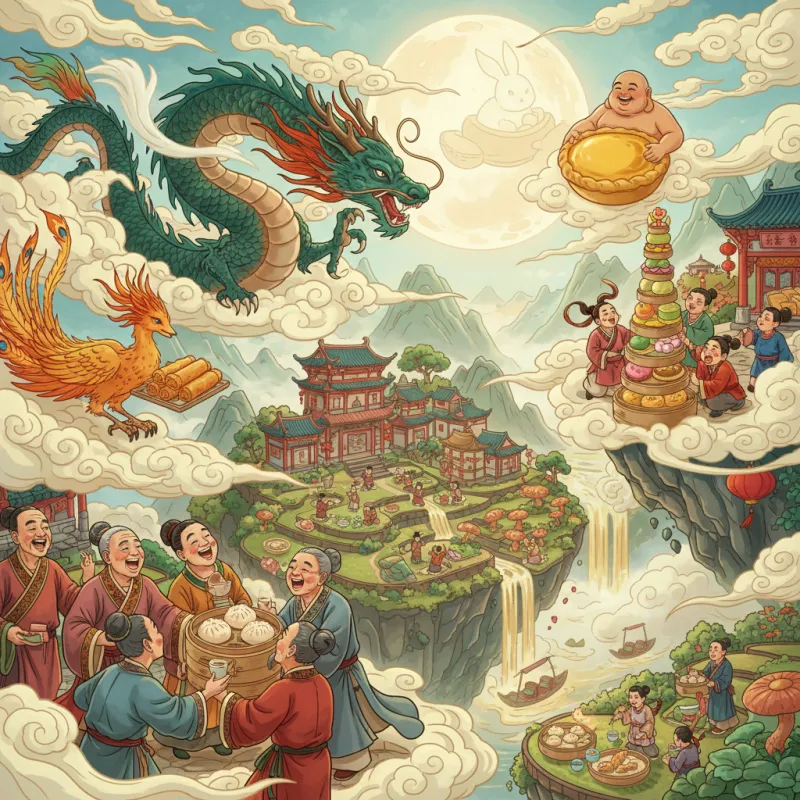
The clatter of porcelain, the rhythmic squeak of dim sum carts, the steam rising from bamboo baskets—step into a traditional Cantonese teahouse at dawn, and you'll witness something that transcends mere breakfast. Here, retired men debate politics over har gow, families gather across three generations, and the ancient ritual of yum cha (飲茶, yǐn chá, "drinking tea") unfolds exactly as it has for over a thousand years. But make no mistake: what's happening here isn't just about food. It's about time itself—the luxury of lingering, the art of small pleasures, and a philosophy that says the best things in life come in small, carefully crafted packages.
From Silk Road Rest Stops to Global Phenomenon
Dim sum's origin story begins not in the glittering restaurants of Hong Kong, but along the dusty Silk Road during the Song Dynasty (960-1279 AD). Teahouses sprouted along these trade routes as essential rest stops where merchants and travelers could recover from their journeys. The proprietors discovered something crucial: tea alone wasn't enough. Their guests needed sustenance, but nothing so heavy it would slow them down. The solution? Dian xin (點心, diǎn xīn), literally "touch the heart"—small, delicate snacks designed to complement tea rather than overwhelm it.
What started as simple steamed buns and rice rolls evolved into an art form during the Ming (1368-1644) and Qing (1644-1912) dynasties. Cantonese chefs, renowned for their obsession with freshness and technique, transformed dim sum into the elaborate tradition we recognize today. By the early 20th century, Hong Kong's teahouses had become the epicenter of dim sum culture, where master chefs competed to create ever more intricate designs and flavors. The bamboo steamer basket itself became iconic—a symbol of patience, as good dim sum cannot be rushed.
The Sacred Ritual of Yum Cha
To understand dim sum, you must first understand yum cha. These aren't interchangeable terms. Yum cha is the practice; dim sum is what you eat during it. The distinction matters because yum cha represents a specific social contract: you arrive early (traditionally between 6 AM and noon), you order tea first, and you settle in for hours. This isn't grab-and-go dining. It's the antithesis of modern efficiency culture.
The tea selection alone reveals layers of tradition. Pu-erh (普洱茶, pǔ'ěr chá) for its digestive properties and earthy depth. Chrysanthemum (菊花茶, júhuā chá) for cooling the body. Oolong (烏龍茶, wūlóng chá) for balance. Each tea serves a purpose beyond flavor—they're chosen to complement the richness of the food, aid digestion, and facilitate conversation. The teapot lid tilted open signals the server you need more hot water, a silent language that keeps the ritual flowing without interruption.
The cart system, now sadly disappearing from many modern establishments, was itself a stroke of genius. Rather than ordering from a menu, diners would flag down roaming carts laden with bamboo steamers and plates. You chose with your eyes and nose, making split-second decisions as the cart rolled past. This created an atmosphere of gentle chaos and discovery—you never quite knew what would appear next, and the best items often sold out quickly, adding an element of competition to the leisurely affair.
The Dim Sum Hierarchy: From Humble to Haute
Not all dim sum are created equal, and any regular knows the unspoken hierarchy. At the top sit the "Four Heavenly Kings": har gow (蝦餃, xiā jiǎo, crystal shrimp dumplings), siu mai (燒賣, shāo mài, pork and shrimp dumplings), char siu bao (叉燒包, chā shāo bāo, barbecue pork buns), and egg tarts (蛋撻, dàn tà). Order these first—they're the litmus test of any dim sum kitchen.
Har gow, with its translucent wrapper revealing pink shrimp within, requires a wrapper so thin you can count the pleats (there should be at least seven, ideally more). The shrimp must be fresh, never frozen, with that distinctive snap. A master dim sum chef can make har gow blindfolded, the muscle memory built over decades of repetition. Siu mai, by contrast, shows off the kitchen's ability to balance pork fat with shrimp, the golden crown of roe or crab on top signaling premium quality.
Then come the supporting players, each with devoted followings: cheong fun (腸粉, cháng fěn, rice noodle rolls) slippery and delicate; lo bak go (蘿蔔糕, luó bo gāo, turnip cake) pan-fried until crispy; phoenix talons (鳳爪, fèng zhuǎ, chicken feet) braised until the skin achieves that peculiar textural magic between tender and gelatinous. Yes, chicken feet. If you can't handle them, you're missing the point—dim sum culture celebrates every part of the animal, waste nothing, honor everything.
The adventurous should seek out century egg congee (皮蛋粥, pí dàn zhōu), tripe in ginger and spring onion, or the increasingly rare beef offal. These dishes separate tourists from initiates, connecting modern diners to the working-class origins of dim sum culture when nothing was too humble to transform into something delicious.
Regional Variations and the Cantonese Dominance
While dim sum is fundamentally Cantonese, other regions have developed their own interpretations. Shanghai offers xiaolongbao (小籠包, xiǎo lóng bāo, soup dumplings), technically a type of dim sum though Shanghainese would bristle at the categorization. These delicate pouches of broth and pork require a different eating technique—nibble a small hole, sip the soup, then eat the dumpling. Burn your tongue once, and you'll never forget the lesson.
Chaozhou (Teochow) dim sum tends toward lighter, more delicate flavors with an emphasis on seafood. Their fun guo (粉果, fěn guǒ, translucent dumplings) use a different wrapper than Cantonese versions, slightly chewier and more substantial. Hakka contributions include various stuffed tofu preparations and heartier, more rustic offerings that reflect their agricultural heritage.
But Cantonese dim sum remains the gold standard, and Hong Kong its spiritual home. The city's competitive restaurant culture pushed dim sum to artistic heights. Michelin-starred dim sum restaurants like Tim Ho Wan proved that street food techniques could achieve fine dining recognition. Yet the best dim sum often comes from unassuming neighborhood joints where the same family has been making the same recipes for three generations, and the tea is strong enough to strip paint.
The Social Architecture of the Teahouse
Dim sum restaurants operate on different social rules than typical dining establishments. Large round tables dominate, designed for communal eating. Strangers might share tables during peak hours—an intimacy unthinkable in Western dining culture. The lazy Susan in the center becomes a democratic distribution system; everyone has equal access, and hoarding is frowned upon.
Generational dynamics play out in fascinating ways. Grandparents often bring grandchildren for weekend yum cha, passing down not just recipes but social codes. Which dishes to try first, how to properly use chopsticks to serve others before yourself, the etiquette of tea pouring (always fill others' cups before your own, tap two fingers on the table to say thank you). These aren't written rules—they're absorbed through repetition and observation, the same way Chinese festival traditions transmit cultural knowledge across generations.
Business deals happen over dim sum. Political alliances form. Marriages are arranged. The teahouse serves as neutral ground, the food and tea creating a relaxed atmosphere where difficult conversations become easier. There's something about sharing small plates that breaks down barriers—perhaps because everyone's guard drops when reaching for the last har gow.
Dim Sum in the Modern World
The globalization of dim sum has been both blessing and curse. You can now find decent xiaolongbao in Des Moines and passable char siu bao in Stockholm. But something essential often gets lost in translation. The carts disappear, replaced by check-off menus. The tea becomes an afterthought. The meal speeds up, optimized for turnover rather than lingering.
Some Hong Kong establishments have fought back by doubling down on tradition. They've made the cart service a selling point, hired veteran dim sum chefs as celebrities, and educated diners about the craft behind each basket. Others have innovated boldly—truffle har gow, foie gras siu mai, molecular gastronomy techniques applied to ancient recipes. Purists howl, but dim sum has always evolved. Those Song Dynasty travelers would barely recognize what we eat today.
The pandemic accelerated changes already underway. Takeout dim sum, once considered impossible (the texture! the steam!), became normalized. Frozen dim sum improved dramatically. Home cooks attempted recipes previously left to professionals. Whether these changes stick or we return to the teahouse remains to be seen, but dim sum has survived dynastic changes, wars, and colonization. It'll survive this too.
Why Dim Sum Matters Beyond the Plate
At its core, dim sum represents a philosophy about time and pleasure that modern life desperately needs. In a world obsessed with efficiency, yum cha insists on slowness. In a culture of individual portions, dim sum demands sharing. In an era of fast food, it celebrates craft and patience—each dumpling folded by hand, each bun steamed to order.
The "touch the heart" translation of dian xin isn't just poetic—it's literal. These small bites are meant to satisfy without overwhelming, to nourish without weighing you down, to bring joy in modest portions. It's the same philosophy behind Chinese tea culture, where the ritual matters as much as the beverage, and the best experiences unfold slowly, revealing layers of complexity.
When you sit down for dim sum, you're participating in something larger than breakfast. You're connecting to Silk Road merchants, Qing Dynasty teahouses, Hong Kong's golden age, and every family that's gathered over steaming baskets to share food and time. The dumplings are delicious, yes. But they're also a vehicle for something more essential: the radical act of slowing down, sharing generously, and touching the heart.
Related Reading
- Chinese Tea Culture: A Journey Through 5,000 Years of Brewing
- Why Chinese Food Tastes Different in China: A Culinary Reality Check
- The Eight Great Cuisines of China: A Flavorful Tour
- The Chinese Tea Ceremony: History and Practice
- Food Symbolism in Chinese Culture: Every Dish Tells a Story
- Chinese Wisdom Literature: The Proverbs That Run a Civilization
- Traditional Chinese Medicine: The Debate That Will Not End
- Chinese Internet Culture: Memes, Slang and Digital Life
Explore Chinese Culture
- Explore feng shui in daily life
- Explore supernatural folklore
- Explore classical Chinese literature