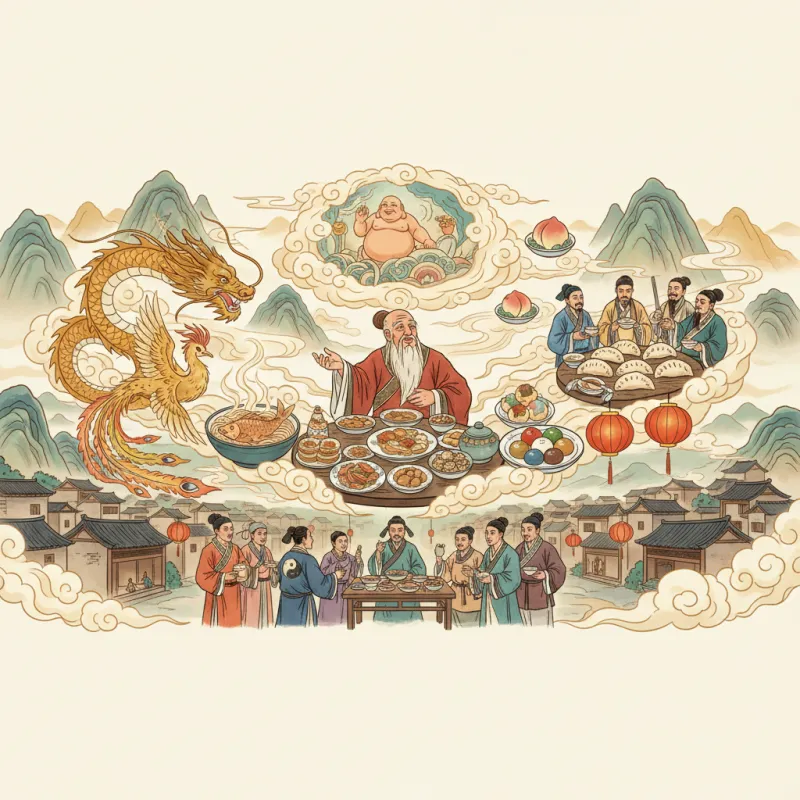
Picture this: A grandmother carefully arranges eight dishes around a whole steamed fish at a New Year's Eve dinner, leaving the fish untouched until the meal ends. Her grandson reaches for it, and she gently stops his hand. "鱼 (yú) means abundance," she whispers. "If we finish it tonight, we finish our prosperity for the year." This isn't superstition—it's a sophisticated symbolic language that's been encoding wishes, warnings, and wisdom into Chinese meals for millennia.
The Sound of Fortune: How Homophones Built a Culinary Code
Chinese food symbolism operates on a principle that seems almost magical to non-tonal language speakers: if two words sound alike, they share essence. This isn't poetic license—it's fundamental to how Chinese culture constructs meaning. The word for fish, 鱼 (yú), sounds identical to 余 (yú), meaning surplus or abundance. Therefore, serving fish doesn't just represent prosperity; it actively invites it to the table.
This homophonic logic creates an entire symbolic vocabulary. Oranges and tangerines, 橙 (chéng) and 橘 (jú), sound like 成 (chéng, success) and 吉 (jí, luck). During Chinese New Year celebrations, pyramids of these golden fruits aren't decorative—they're linguistic spells for a successful year. Apples, 苹果 (píngguǒ), contain the character 平 (píng, peace), making them essential gifts when visiting the sick or elderly.
The genius of this system is its flexibility. Regional dialects create local symbolic meanings that wouldn't work in Mandarin. In Cantonese, dried oysters (蠔豉, hóu sī) sound like "good business" (好市, hóu sī), making them indispensable at business banquets in Hong Kong and Guangdong. Lettuce (生菜, sāng choi in Cantonese) sounds like "growing wealth" (生財, sāng choi), which is why lion dancers "eat" lettuce hung above shop doors during opening ceremonies.
Numbers on the Table: The Mathematics of Meaning
Chinese banquets follow strict numerical symbolism that determines everything from dish count to seating arrangements. Eight is the ultimate lucky number because 八 (bā) sounds like 發 (fā), as in 發財 (fācái, getting rich). A proper celebratory banquet serves eight, eighteen, or twenty-eight dishes. Wedding banquets often cost significantly more when scheduled on dates containing eights—August 8, 2008 (08/08/08) saw a wedding boom across China that overwhelmed venues for months.
Four, conversely, is avoided with near-paranoia because 四 (sì) sounds like 死 (sǐ, death). Buildings skip fourth floors. Gift sets never contain four items. A banquet with four dishes would be not just unlucky but insulting, suggesting you wish death upon your guests. This isn't quaint tradition—modern Chinese hospitals still avoid room numbers with four, and luxury car license plates without fours sell for premiums.
Six represents smoothness and easy progress (六, liù, sounds like 流, liú, flowing). Nine symbolizes longevity because 九 (jiǔ) sounds like 久 (jiǔ, long-lasting). The Qing Dynasty's imperial banquets famously featured the "Manchu-Han Imperial Feast" with 108 dishes—a number combining the auspicious multiples of nine and twelve. While no modern banquet reaches such excess, the principle remains: numbers aren't arbitrary; they're messages.
The Whole Fish Philosophy: Shape and Presentation as Symbol
A fish must be served whole—head, tail, intact—because completeness symbolizes wholeness in life and business. Serving fish fillets at a formal dinner would be like sending a greeting card with half the message missing. The fish's direction matters too: the head points toward the guest of honor, offering them the "head" position in fortune. In some regions, the head and tail must remain on the plate after eating, bookending the meal with abundance at both beginning and end.
Whole chickens serve similar symbolic purposes, representing family unity and completeness. During traditional Chinese wedding customs, the bride's family sends a whole chicken to the groom's family, often with the head and feet still attached. The head represents leadership, the wings represent protection, and the feet represent a stable foundation—an entire marriage philosophy encoded in poultry.
Long noodles symbolize longevity so directly that cutting them before serving is considered bad luck, especially at birthday celebrations. The longer the noodle, the longer the life. I've watched elderly relatives perform impressive feats of chopstick coordination to eat three-foot noodles without breaking them, treating it as seriously as any religious ritual. These 长寿面 (chángshòu miàn, longevity noodles) aren't just birthday food—they're edible prayers for a long life.
Round foods represent reunion and completeness. Tangyuan (汤圆, tāngyuán), glutinous rice balls served during the Lantern Festival, are perfectly spherical because 圆 (yuán) means both "round" and "reunion." Families separated by distance make special efforts to share tangyuan together, the round shape symbolizing the family circle made whole again. Mooncakes during Mid-Autumn Festival carry the same symbolism—their roundness mirrors the full moon and represents family completeness.
Color-Coded Wishes: The Chromatic Language of Chinese Cuisine
Red dominates celebratory Chinese cuisine because it symbolizes joy, luck, and prosperity. Red-cooked dishes (红烧, hóngshāo), where meat is braised in soy sauce until deep mahogany, appear at virtually every celebration. Red dates (红枣, hóngzǎo) fill wedding sweets. Even the red skin of roasted pork becomes symbolically significant—it's not just crispy; it's auspicious.
White, conversely, is the color of death and mourning. While white foods aren't forbidden, they're carefully balanced with other colors at celebrations. A banquet with predominantly white dishes—tofu, white fish, cauliflower—would seem funereal. This is why white chrysanthemums are funeral flowers, and why wearing all white to a wedding would be shockingly offensive.
Gold and yellow represent imperial power and earth element stability. Golden-brown roasted meats, yellow croaker fish, and egg-yolk-rich dishes signal wealth and grounding. The Qing Dynasty reserved certain yellow foods exclusively for the emperor—commoners caught eating imperial yellow foods faced severe punishment. While such restrictions have vanished, the association between golden foods and prosperity remains deeply embedded.
Green symbolizes growth, renewal, and spring. Fresh vegetables at New Year banquets aren't just nutritional balance—they represent new growth in the coming year. The specific green matters too: jade-green vegetables like bok choy (白菜, báicài) sound like "hundred fortunes" in some dialects, multiplying their symbolic value.
Ingredient Hierarchies: What You Serve Reveals What You Value
Certain ingredients carry such powerful symbolism that their presence transforms a meal's meaning. Sea cucumber, abalone, shark fin, and bird's nest—the "four treasures of Chinese cuisine"—signal extreme respect for guests, not just because they're expensive but because their rarity symbolizes the preciousness of the relationship. Modern ethical concerns about shark fin and bird's nest have created interesting tensions between traditional symbolism and contemporary values, with many families now substituting other luxury ingredients while maintaining the symbolic gesture.
Lotus seeds (莲子, liánzǐ) appear in wedding sweets because 莲 (lián) sounds like 连 (lián, continuous), and the seeds represent continuous birth of children. Red dates and peanuts join them because 早生贵子 (zǎo shēng guì zǐ, "soon give birth to precious children") can be constructed from their names: 枣 (zǎo, dates), 生 (shēng, peanuts/birth), 桂 (guì, longan), 子 (zǐ, seeds/children). Wedding beds are literally scattered with these four ingredients, turning the bedroom into a symbolic fertility garden.
Bamboo shoots represent resilience and upward growth—bamboo bends but doesn't break, and shoots grow rapidly upward. Serving bamboo shoots to someone starting a new venture wishes them flexible strength and quick growth. Wood ear mushrooms, with their ear-like shape, are believed to improve hearing and wisdom—eating them symbolizes becoming a better listener.
Dumplings (饺子, jiǎozi) shaped like ancient Chinese gold ingots (元宝, yuánbǎo) represent wealth, making them essential New Year's food. Families gather to make hundreds of dumplings together on New Year's Eve, sometimes hiding a coin in one—whoever finds it receives extra luck for the year. The communal preparation is itself symbolic: family unity creating future prosperity.
Regional Variations: How Geography Shapes Symbolic Meaning
Southern Chinese symbolism often differs dramatically from northern traditions, creating a complex regional tapestry of food meanings. In Guangdong, the phrase "好意头" (hǎo yìtóu, good beginning) drives food choices—any ingredient whose name suggests positive beginnings becomes essential for New Year. This leads to dishes like 发菜 (fàcài, hair seaweed) which sounds exactly like 发财 (fācái, getting rich), though environmental concerns have now made real fàcài rare and controversial.
Fujian cuisine emphasizes seafood symbolism more heavily than inland regions. Oysters represent good business, clams represent closing deals, and prawns represent happiness and laughter because 虾 (xiā) sounds like 哈 (hā, laughter). A Fujian New Year banquet might feature ten seafood dishes, each carrying layered symbolic meanings that would be less emphasized in, say, Sichuan or Shanxi.
Northern wheat-eating regions invest different symbolism in their staple foods. Steamed buns (馒头, mántou) represent prosperity and abundance—their rising during steaming symbolizes fortunes rising. The number of pleats on a dumpling can carry meaning: more pleats suggest more wealth being gathered together. Some families compete to make the most elaborately pleated dumplings, turning food preparation into symbolic art.
Hakka communities maintain unique symbolic traditions, like their signature dish 梅菜扣肉 (méicài kòuròu, preserved mustard greens with pork belly), where the layered arrangement symbolizes family generations stacked in harmony. The preserved vegetables represent ancestors' wisdom preserved across time, while the rich pork represents current prosperity—together, they symbolize continuity between past and present.
The Modern Evolution: Ancient Symbols in Contemporary Kitchens
Today's Chinese families navigate fascinating tensions between traditional food symbolism and modern realities. Younger generations might roll their eyes at leaving fish uneaten or avoiding the number four, yet they still follow these practices at family gatherings, recognizing them as cultural grammar rather than literal belief. The symbolism has evolved from magical thinking into cultural identity—you serve whole fish not because you truly believe it creates abundance, but because it signals "we are Chinese, and we honor our traditions."
Social media has created new symbolic foods. Strawberries (草莓, cǎoméi) have become popular gifts because young people creatively interpret the characters as "草" (grass/humble) + "莓" (berry/beautiful), suggesting humble beauty. This modern invention follows ancient homophonic logic while creating entirely new meanings. Similarly, certain Western foods get absorbed into Chinese symbolic systems: chocolate becomes acceptable gift food because its brown color suggests earth element stability.
Environmental and ethical concerns challenge traditional symbolism. As mentioned, shark fin's symbolic value as luxury and respect now conflicts with conservation ethics. Many families now serve alternative "auspicious" dishes that maintain symbolic intent without environmental cost. This adaptation shows the system's flexibility—the underlying principle of encoding wishes into food remains, even as specific ingredients change.
Restaurant culture has commercialized food symbolism in interesting ways. High-end restaurants create elaborate symbolic presentations, like desserts shaped like gold ingots or prosperity symbols carved into vegetables. This theatrical approach to symbolism sometimes feels more performative than meaningful, yet it keeps the symbolic vocabulary alive and visible, teaching younger generations the language even in commercialized form.
Eating the Message: Why Food Symbolism Still Matters
Understanding Chinese food symbolism transforms how you experience Chinese meals. That whole fish isn't just protein—it's a wish for your abundance. Those eight dishes aren't arbitrary—they're a mathematical blessing. The grandmother insisting you eat longevity noodles without breaking them isn't being superstitious; she's speaking a symbolic language where food becomes prayer, wish, and blessing simultaneously.
This symbolic system reveals something profound about Chinese culture: the belief that intention and attention shape reality. By carefully selecting, preparing, and presenting food with symbolic awareness, Chinese culture suggests we can influence fortune, health, and relationships. Whether you believe in the literal efficacy or appreciate it as cultural poetry, food symbolism represents one of humanity's most elaborate systems for encoding meaning into daily life.
The next time you attend a Chinese banquet, look beyond the flavors. Count the dishes. Notice what's whole and what's cut. Observe the colors, shapes, and arrangements. You're not just eating a meal—you're reading a complex text written in ingredients, a story told in courses, a blessing encoded in every bite. Every dish really does tell a story, and learning to read that story opens a window into thousands of years of cultural wisdom, one delicious symbol at a time.
Related Reading
- The Eight Great Cuisines of China: A Flavorful Tour
- The Chinese Tea Ceremony: History and Practice
- Chinese Food Culture: What the World Gets Wrong About Chinese Cuisine
- Chinese Tea Culture: A Journey Through 5,000 Years of Brewing
- Dim Sum Culture: More Than Just Dumplings
- Modern Retellings of Chinese Folklore: Bridging Ancient Legends and Contemporary Culture
- Legendary Flavors: Exploring Chinese Food Folklore and Timeless Culinary Traditions
- Discovering Love Legends of Chinese Folklore: Tales of Passion and Destiny
Explore Chinese Culture
- Explore feng shui in daily life
- Explore supernatural folklore
- Explore classical Chinese literature